
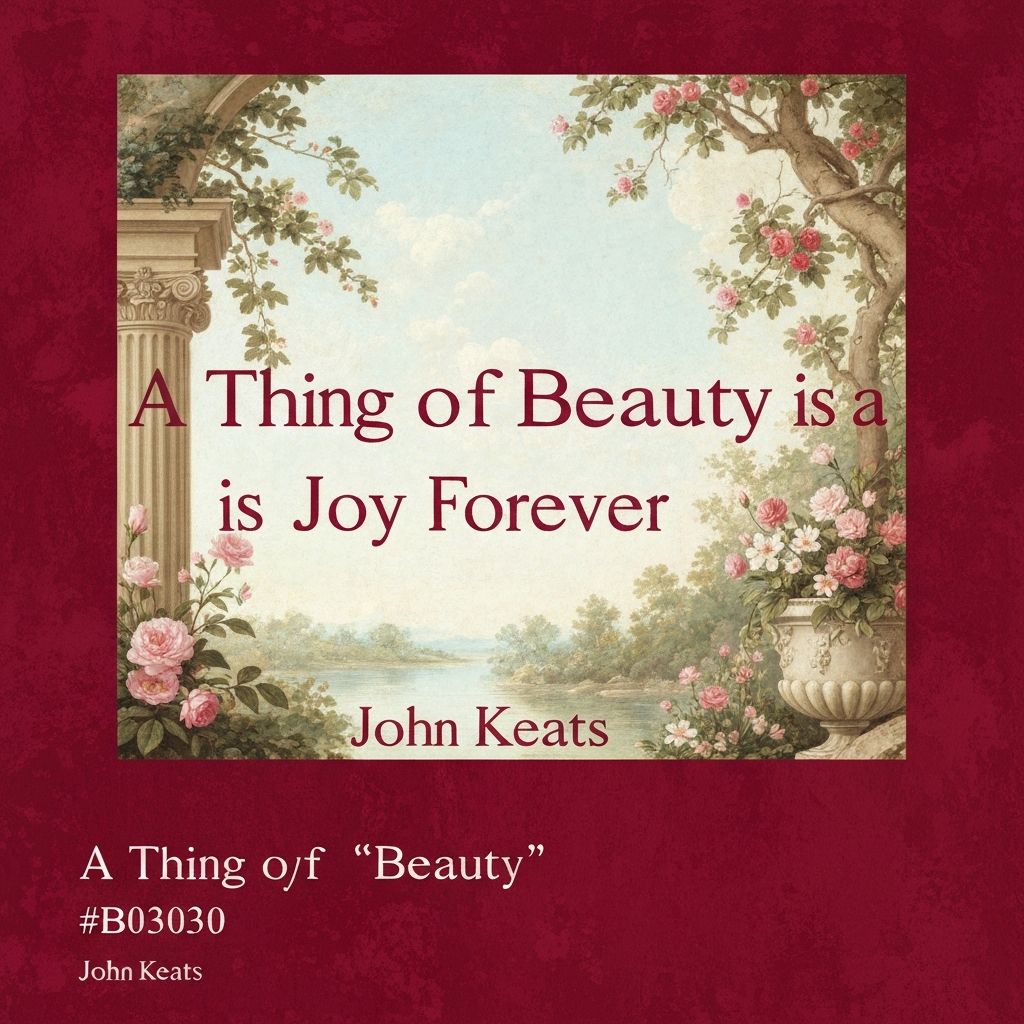
The Origins of "A Thing of Beauty Is a Joy Forever"
The immortal phrase "A thing of beauty is a joy forever" opens one of English literature's most celebrated poems, "Endymion," written by John Keats in 1818. The full opening lines read: "A thing of beauty is a joy for ever: / Its loveliness increases; it will never / Pass into nothingness." These words have transcended their literary origins to become a universally recognized expression of the enduring power of beauty. Keats composed this poem at the age of 22, demonstrating a remarkably mature understanding of aesthetics, human experience, and the relationship between beauty and happiness.
Keats wrote "Endymion" during a period of intense creative output, drawing inspiration from the Greek myth of Endymion, a shepherd beloved by the moon goddess Selene. The poem is structured as a romantic quest, following Endymion's pursuit of an ideal beauty that he has glimpsed in dreams. Through this mythological framework, Keats explores profound questions about the nature of beauty, the pursuit of ideals, and the relationship between earthly and transcendent experience. The opening line serves as the thesis for the entire work, establishing the principle that beauty possesses a permanence that outlasts the transient nature of human life.
Literary Analysis of the Complete Passage
The full opening passage of "Endymion" expands on the initial statement in ways that enrich its meaning considerably. After declaring that beauty is a joy forever, Keats writes that "its loveliness increases," suggesting that beautiful things do not merely maintain their appeal but grow more meaningful over time. This observation runs counter to the common assumption that familiarity breeds contempt, instead proposing that our appreciation of beauty deepens with repeated encounter and reflection. The passage continues by listing examples of beauty—the sun, the moon, old and young trees, sheep, daffodils, streams—that provide "a bower quiet for us, and a sleep / Full of sweet dreams, and health, and quiet breathing."
Keats's catalog of beautiful things is notable for its inclusiveness. He does not limit beauty to the conventional objects of aesthetic admiration such as fine art or spectacular landscapes. Instead, he finds beauty in the ordinary and everyday: trees providing shade, flowers blooming by a stream, the warmth of sunlight. This democratic approach to beauty suggests that joy is available to everyone, not just those with access to galleries, theaters, or scenic vistas. The implication is revolutionary in its simplicity: beauty surrounds us, and our capacity for joy depends not on our circumstances but on our ability to perceive and appreciate the beauty that is already present.
The phrase "it will never pass into nothingness" introduces the concept of beauty's permanence, a theme that recurs throughout Romantic literature and connects to broader philosophical discussions about the nature of value and meaning. Keats suggests that while individual beautiful objects may perish—flowers wilt, sunsets fade, youth passes—the beauty they embodied continues to exist in memory, art, and the cumulative effect of beautiful experiences on the human spirit. This idea provides consolation against the anxiety of impermanence that underlies much of human experience.
Philosophical Dimensions of Beauty and Joy
The connection between beauty and joy that Keats articulates resonates with philosophical traditions spanning millennia. Plato, in his dialogue "Symposium," describes a ladder of beauty ascending from physical beauty to the beauty of the soul, and ultimately to the Form of Beauty itself—an absolute, eternal beauty that exists beyond the physical world. Keats's assertion that a thing of beauty is a joy forever echoes this Platonic idea that beauty connects us to something eternal, providing a bridge between our finite existence and a larger, enduring reality.
Aristotle's concept of eudaimonia, often translated as "happiness" or "flourishing," provides another philosophical framework for understanding Keats's assertion. Aristotle argued that the good life is not about momentary pleasure but about a sustained state of flourishing that comes from living well and exercising one's capacities fully. The appreciation of beauty can be understood as one such capacity, and the joy that beauty provides is not a fleeting pleasure but a component of the deep, sustained happiness that characterizes a life well-lived. In this framework, cultivating one's capacity for aesthetic appreciation is not a luxury but an essential aspect of human flourishing.
The German philosopher Immanuel Kant offers yet another perspective on the relationship between beauty and joy. In his "Critique of Judgment," Kant argues that the experience of beauty involves a unique form of pleasure that is disinterested—that is, it does not depend on possessing or using the beautiful object. We can find joy in a beautiful sunset without wanting to own it or in a beautiful melody without needing to perform it. This disinterested pleasure is, for Kant, evidence of a universal human capacity for aesthetic experience, a capacity that connects us to one another across differences of culture, language, and circumstance.
The Appreciation of Beauty in Everyday Life
While Keats's line is often quoted in literary and philosophical contexts, its greatest relevance may be in everyday life. The appreciation of beauty is not a passive experience but an active practice that can be cultivated and developed. Just as physical fitness requires regular exercise, the capacity for aesthetic appreciation benefits from intentional attention and practice. This might involve pausing to notice the quality of light at a particular time of day, listening carefully to the sounds of nature, or taking time to observe the details of well-designed objects that we might otherwise take for granted.
Research in positive psychology supports Keats's intuition that beauty contributes to lasting joy. Studies have shown that people who regularly notice and appreciate beautiful things in their environment report higher levels of life satisfaction, greater positive emotion, and lower levels of stress and anxiety. The practice of "savoring"—deliberately attending to and prolonging positive experiences—has been shown to increase well-being, and the appreciation of beauty is one of the most accessible forms of savoring available. These findings suggest that Keats was not merely expressing a poetic sentiment but articulating a psychological truth.
The appreciation of beauty in everyday life also connects us to the present moment, countering the tendency to dwell on past regrets or future anxieties. When we are fully absorbed in the experience of something beautiful—a piece of music, a natural landscape, a perfectly prepared meal—we experience a form of mindful presence that is increasingly recognized as beneficial for mental health and well-being. The joy of beauty is thus not only lasting in memory but also therapeutic in the moment, providing a respite from the mental noise that characterizes much of modern life.
Beauty in Art and Cultural Expression
The arts represent humanity's most sustained effort to create and preserve beauty, and Keats's assertion that beautiful things never "pass into nothingness" finds its strongest evidence in the endurance of great art. The cave paintings at Lascaux, created more than 17,000 years ago, continue to inspire wonder and admiration in modern viewers. The music of Bach, composed three centuries ago, still moves listeners to tears. The poetry of Keats himself, written over two hundred years ago, continues to provide joy and insight to readers worldwide. Art demonstrates that beauty can indeed endure far beyond the lifespan of its creator.
Different cultures express and appreciate beauty in distinct ways, yet certain aesthetic principles appear to be universal. Symmetry, proportion, harmony, and the interplay of simplicity and complexity are valued across cultures, suggesting that the human capacity for aesthetic appreciation has deep evolutionary roots. Cultural expressions of beauty—from Japanese ikebana to West African textiles, from Indian classical music to European cathedral architecture—represent variations on universal themes, each culture finding its unique voice within the shared human experience of beauty.
The digital age has created unprecedented opportunities for accessing and sharing beauty from around the world. A person in any country can now view masterworks from the world's greatest museums, listen to performances of the finest musicians, read poetry in dozens of languages, and explore natural wonders through high-resolution imagery and virtual reality. This democratization of access to beauty fulfills, in a practical sense, the inclusive vision that Keats articulated: beauty is not the preserve of the privileged few but a source of joy available to all who are willing to notice and appreciate it.
The Therapeutic Power of Beauty
The connection between beauty and well-being has been recognized throughout human history and is increasingly validated by contemporary research. Hospitals that incorporate natural views, art, and pleasant design features report better patient outcomes than those in purely utilitarian environments. Schools designed with attention to beauty and aesthetics report improved student engagement and performance. Workplaces that incorporate natural elements, quality design, and aesthetic considerations experience higher employee satisfaction and productivity. These findings suggest that beauty is not a luxury but a fundamental human need that, when met, contributes to health, happiness, and effectiveness.
Art therapy, music therapy, horticultural therapy, and other therapeutic modalities that engage the aesthetic sense have demonstrated effectiveness in treating a range of conditions, from depression and anxiety to chronic pain and dementia. The mechanism appears to involve beauty's ability to activate reward pathways in the brain, reduce stress hormone levels, and facilitate emotional expression and processing. For individuals who may have difficulty articulating their experiences verbally, the experience of beauty provides an alternative pathway to emotional engagement and healing.
Nature-based aesthetic experiences are particularly powerful in their therapeutic effects. Research consistently shows that exposure to natural beauty—whether through direct experience in natural environments or through viewing nature imagery—reduces stress, improves mood, enhances cognitive function, and promotes physical healing. The Japanese practice of shinrin-yoku, or "forest bathing," formalizes this relationship, prescribing immersion in natural beauty as a preventive health practice. Keats, who found beauty in "old trees" and "daffodils with the green world they live in," would likely have approved wholeheartedly.
Cultivating an Appreciation of Beauty
For those who wish to deepen their experience of beauty and the joy it provides, several practices can help cultivate this capacity. First, slow down. The appreciation of beauty requires attention, and attention requires time. In a culture that valorizes speed and productivity, deliberately pausing to notice beauty is both a counter-cultural act and an investment in well-being. Take time each day to consciously observe something beautiful, whether it is the color of the sky, the pattern of light on a wall, or the grace of a stranger's gesture.
Second, broaden your definition of beauty. If you tend to associate beauty only with grand landscapes or famous artworks, challenge yourself to find beauty in unexpected places: the geometry of a well-organized toolbox, the rhythm of city traffic, the texture of an old brick wall. Keats found beauty in sheep and streams; you can find it wherever you are willing to look with fresh eyes. This expanded vision of beauty multiplies the opportunities for joy in everyday life and reduces dependence on exceptional experiences for aesthetic satisfaction.
Third, share beauty with others. The joy of beauty is amplified when it is shared, and pointing out something beautiful to another person is one of the simplest acts of generosity available. Share a photograph, recommend a piece of music, read a poem aloud, or simply call someone's attention to a beautiful moment. In doing so, you not only enhance their experience but also deepen your own appreciation through the act of articulation. As Keats understood, beauty is not a private possession but a shared inheritance, a joy that increases rather than diminishes when it is given away.
