
Defining Immigration and Emigration
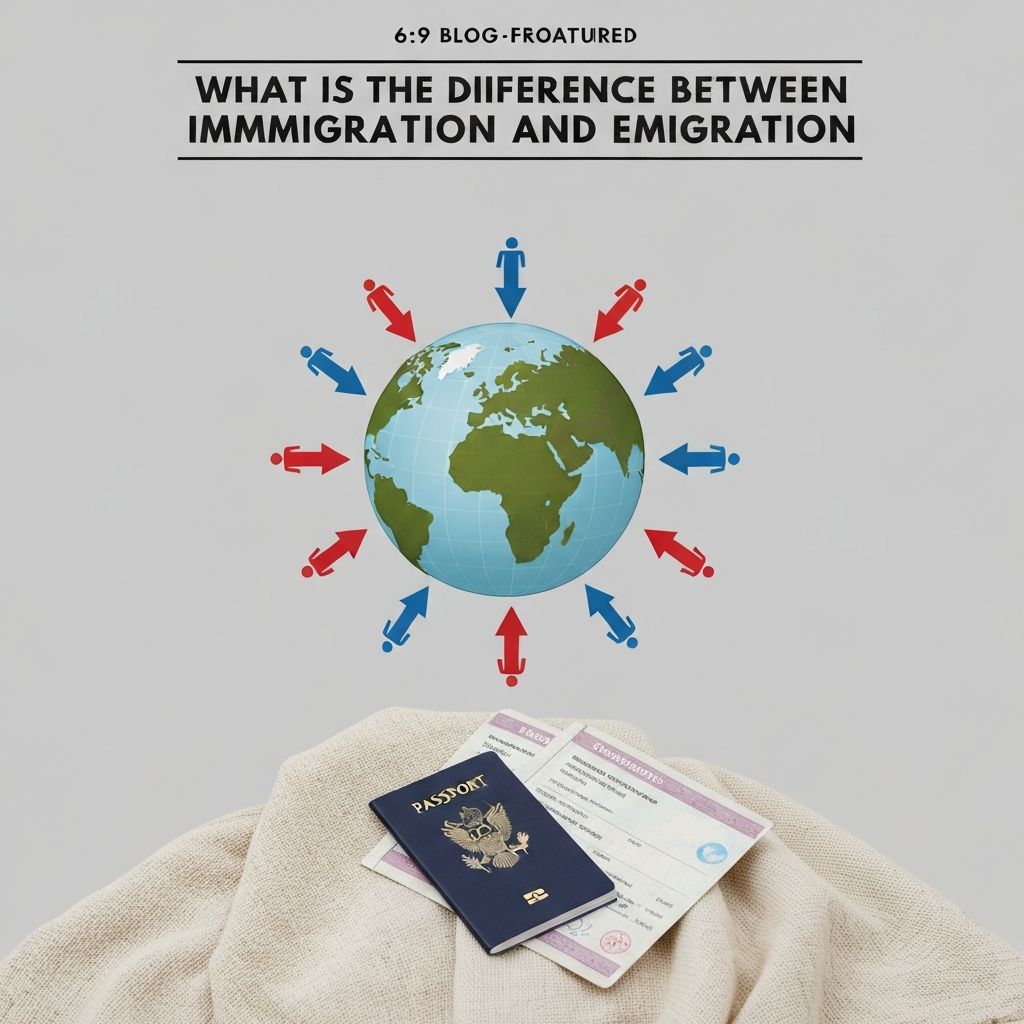
Immigration and emigration are two terms that describe the same phenomenon, the movement of people from one country to another, but from different perspectives. Immigration refers to the act of moving into a new country with the intention of settling there permanently or for an extended period. Emigration, on the other hand, refers to the act of leaving one's home country to live in another. A person who immigrates is called an immigrant, while a person who emigrates is called an emigrant.
The easiest way to remember the distinction is to think of the prefixes. The prefix "im" in immigration comes from the Latin word meaning "into," while the prefix "e" or "ex" in emigration means "out of." So immigration is coming into a country, and emigration is going out of a country. A single person making an international move is simultaneously an emigrant from their home country and an immigrant to their destination country. The difference is entirely a matter of perspective and reference point.
Real-World Examples to Illustrate the Difference
Consider a family from Mexico who moves to the United States to start a new life. From the perspective of the United States, this family has immigrated to the country, and they are immigrants. From the perspective of Mexico, this same family has emigrated from the country, and they are emigrants. The physical action is identical, but the terminology changes based on which country's viewpoint you are adopting.
Another example involves a software engineer from India who accepts a job offer in Germany. When this individual arrives in Germany, they are immigrating to Germany and are an immigrant in the German context. When their family in India describes their departure, they would say the engineer has emigrated from India. International organizations and governments use these terms carefully to describe migration patterns from their respective national viewpoints.
Why the Distinction Matters
The distinction between immigration and emigration is more than semantic. It has significant implications for policy, economics, demographics, and social understanding. Countries track immigration and emigration statistics separately because each has different effects on the nation. Immigration increases a country's population, potentially adds to the labor force, brings cultural diversity, and can create demands on public services. Emigration decreases the population, can lead to brain drain if skilled workers leave, but may also result in remittances that benefit the home economy.
Government policies related to immigration and emigration are often quite different. Immigration policies focus on controlling who enters the country, under what conditions, and what rights they receive upon arrival. These include visa systems, asylum processes, border controls, and naturalization pathways. Emigration policies, while less commonly discussed, involve issues such as exit visas in some countries, dual citizenship rules, taxation of citizens living abroad, and programs to encourage or discourage the departure of skilled workers.
Migration: The Umbrella Term
Migration is the broader term that encompasses both immigration and emigration. It refers to any movement of people from one place to another, whether within a country (internal migration) or across international borders (international migration). When discussing global population movements without specifying a particular country's perspective, the term migration is most appropriate.
Within the study of migration, researchers distinguish between several categories. Voluntary migration occurs when people choose to move for better economic opportunities, education, family reunification, or lifestyle preferences. Forced migration includes refugees fleeing persecution, war, or natural disasters, as well as people displaced by environmental changes like rising sea levels or desertification. Seasonal migration involves temporary movements, often for agricultural work, while chain migration describes the pattern where established immigrants help family members and community members follow them to the new country.
Historical Context of Immigration and Emigration
Throughout human history, immigration and emigration have shaped civilizations, economies, and cultures. The Great Migration from Europe to the Americas in the 19th and early 20th centuries saw millions emigrate from countries like Ireland, Italy, Germany, and Poland, while the United States, Canada, Brazil, and Argentina experienced massive immigration. This period fundamentally transformed both the sending and receiving countries, reshaping demographics, cultures, and economies on multiple continents.
In the modern era, global migration patterns have become increasingly complex and diversified. The traditional flow from developing to developed countries continues, but new patterns have emerged, including South-to-South migration between developing nations, circular migration where people move back and forth between countries, and digital nomadism facilitated by remote work technology. Understanding the distinction between immigration and emigration remains essential for analyzing these patterns and their implications for global development and international relations.
Common Misconceptions and Frequently Confused Terms
One common point of confusion is between immigrants and migrants. While these terms are sometimes used interchangeably in casual conversation, they have distinct meanings. An immigrant is specifically someone who moves to a new country to live permanently or long-term. A migrant is a broader term that can refer to anyone who moves, including seasonal workers, temporary residents, and people moving within their own country.
Another frequently confused pair is refugee and immigrant. A refugee is a person who has been forced to flee their country due to persecution, war, or violence and has been granted or is seeking legal protection in another country. While refugees do immigrate to new countries, their circumstances and legal status differ significantly from voluntary immigrants. Asylum seekers are people who have applied for refugee status but whose claims have not yet been determined. Understanding these distinctions is important for informed civic discourse and for developing compassionate and effective policies addressing the complex realities of global human movement.
