
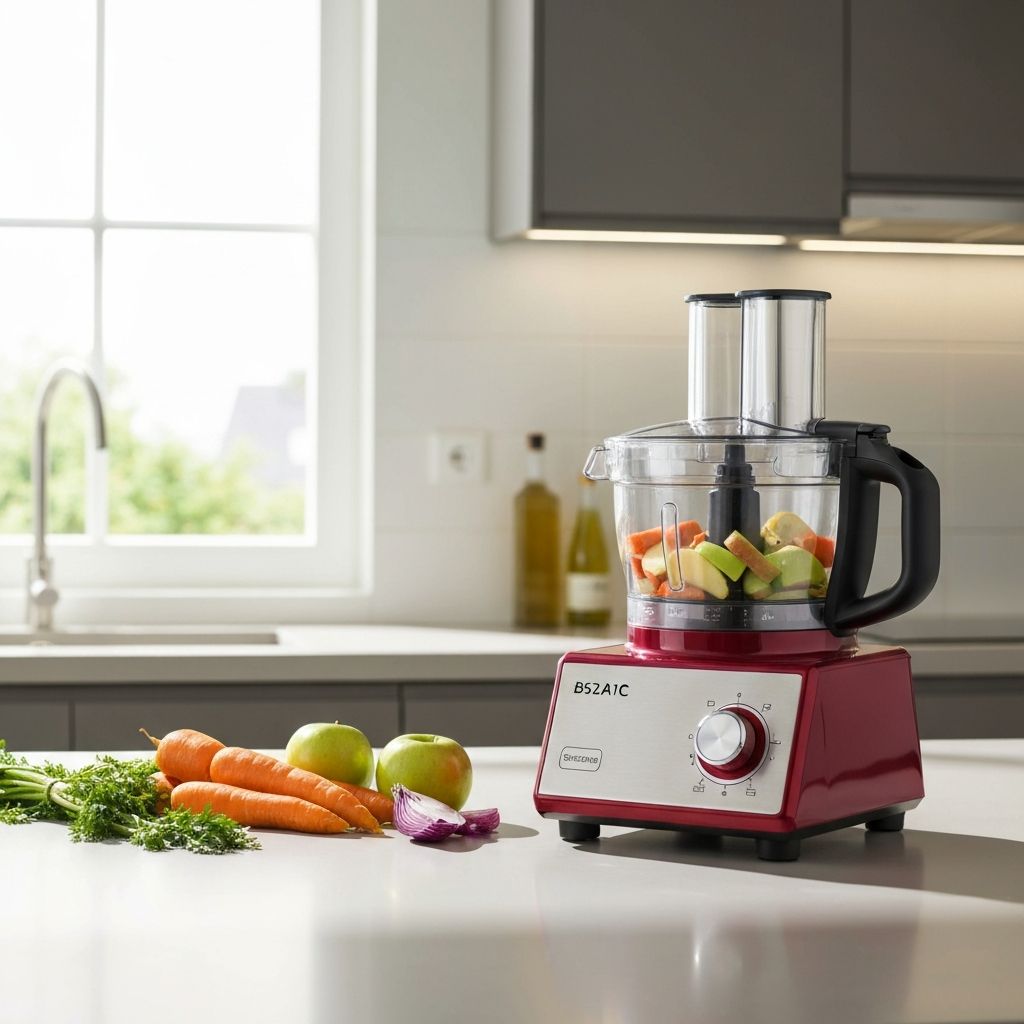
The Food Processor: Your Kitchen's Most Versatile Appliance
A food processor is an electric kitchen appliance designed to handle a wide range of food preparation tasks quickly and efficiently. Unlike a blender, which excels at processing liquids, or a stand mixer, which specializes in mixing and kneading, a food processor is built to handle both wet and dry ingredients in a variety of ways, including chopping, slicing, shredding, pureeing, mixing, kneading, and emulsifying. This versatility makes the food processor one of the most valuable tools in any kitchen, capable of performing tasks that would otherwise take significantly more time and effort by hand.
The modern food processor was invented by Pierre Verdon, the founder of Robot-Coupe, who introduced the first commercial food processor in France in 1960. The appliance was initially designed for professional chefs and restaurant kitchens, where the ability to quickly process large quantities of ingredients was a significant advantage. In 1973, Carl Sontheimer introduced the Cuisinart food processor to the American consumer market, and the appliance quickly became a kitchen essential in homes across the country.
How a Food Processor Works
A food processor consists of several key components that work together to process food. The motor base houses the electric motor that powers the appliance. Food processor motors typically range from 400 watts for compact models to over 1,000 watts for large, professional-grade units. The motor drives a central shaft that connects to various blades and discs inside the work bowl.
The work bowl is a clear, durable container (usually made from BPA-free plastic or, in some premium models, glass or Tritan) that sits on top of the motor base. The bowl has a central post where blades and discs attach, and it is designed with a wide, flat bottom that allows ingredients to be processed evenly. Work bowls come in various sizes, typically ranging from 3 cups for mini food processors to 16 cups or more for full-size models.
The lid locks onto the work bowl and includes a feed tube, an opening through which you can add ingredients while the processor is running. The feed tube is essential for tasks like shredding cheese or slicing vegetables, where ingredients are pushed down through the tube into the spinning blade or disc below. A pusher tool fits inside the feed tube and is used to guide ingredients toward the blade without putting your hands near the moving parts.
Blades and Attachments
The versatility of a food processor comes largely from its interchangeable blades and discs, each designed for specific tasks. The S-blade (also called the multipurpose blade or chopping blade) is the most commonly used attachment. This curved metal blade sits at the bottom of the work bowl and spins rapidly to chop, puree, mix, and emulsify ingredients. It handles everything from chopping onions and mincing garlic to making hummus, pesto, pie crust dough, and nut butter.
Slicing discs feature a sharp blade set at an angle across the disc surface. As ingredients are pushed through the feed tube, they pass over the spinning disc and are cut into uniform slices. Slicing discs are available in different thicknesses, allowing you to slice potatoes paper-thin for gratins or thick for roasting. Shredding discs have raised holes with sharp edges that shred ingredients into fine or coarse pieces. They are perfect for shredding cheese, carrots, cabbage, and other firm vegetables.
Many food processors also come with or offer optional accessories like a dough blade, which is typically a shorter, blunter plastic blade designed for kneading bread and pizza dough. Some models include an emulsifying disc for making mayonnaise and vinaigrettes, a julienne disc for cutting vegetables into thin matchstick-sized strips, a whipping disc for whipping cream or egg whites, and citrus juicing attachments.
What Can a Food Processor Do
The range of tasks a food processor can handle is remarkably broad. For chopping and mincing, it can process onions, garlic, herbs, nuts, chocolate, and other ingredients into precisely chopped pieces in seconds. For pureeing, it creates smooth purees for soups, sauces, baby food, hummus, and dips. For slicing, it produces uniform slices of vegetables, fruits, and meats for consistent cooking and professional-looking presentations.
For shredding, it quickly shreds cheese, vegetables, and other ingredients for salads, toppings, and baking. For making doughs, it can mix and knead pie crust, pizza dough, pasta dough, and cookie dough. For emulsifying, it creates stable emulsions for mayonnaise, aioli, and salad dressings. For grinding, it grinds meat, spices, coffee beans, and breadcrumbs. And for mixing, it combines ingredients for salsas, relishes, compound butters, and spreads.
Choosing the Right Food Processor
Selecting the right food processor depends on your cooking habits, kitchen space, and budget. Size is the first consideration. Mini food processors (2 to 5 cups) are ideal for small tasks like chopping a few cloves of garlic, making a small batch of salad dressing, or processing baby food. They are affordable, compact, and easy to store but are limited in capacity for larger tasks. Full-size food processors (7 to 16 cups) handle most home cooking tasks with ease. A 9 to 11 cup model is ideal for most home cooks, while serious home chefs and those who frequently cook for large groups may prefer a 14 to 16 cup model.
Motor power is another important factor. A 600 to 700 watt motor is sufficient for most home cooking tasks, while models with 1,000 watts or more can handle tougher tasks like kneading stiff bread dough or processing hard cheeses. Consider the number and type of blades and discs included, the ease of assembly and cleaning (dishwasher-safe parts are a significant convenience factor), the noise level, the build quality and warranty, and whether the brand offers additional accessories you might want to add later.
Tips for Getting the Most Out of Your Food Processor
To maximize the effectiveness of your food processor, cut ingredients into roughly uniform pieces before adding them to the bowl for more consistent results. Do not overfill the work bowl; process in batches if necessary, and leave at least an inch of space below the lid. Use the pulse button for more control over the final texture; pulsing in short bursts allows you to achieve a coarse chop without accidentally turning your ingredients into a puree.
When making doughs, use cold ingredients (cold butter, cold water) and pulse rather than running the processor continuously to avoid overworking the dough. When processing liquids, be aware of the maximum liquid fill line marked on most work bowls; overfilling with liquids can cause leaks around the central post. Clean your food processor promptly after use for easiest cleanup, and always handle the S-blade with care, as it is extremely sharp. With proper use and care, a quality food processor will serve as one of the hardest-working appliances in your kitchen for years to come.
