
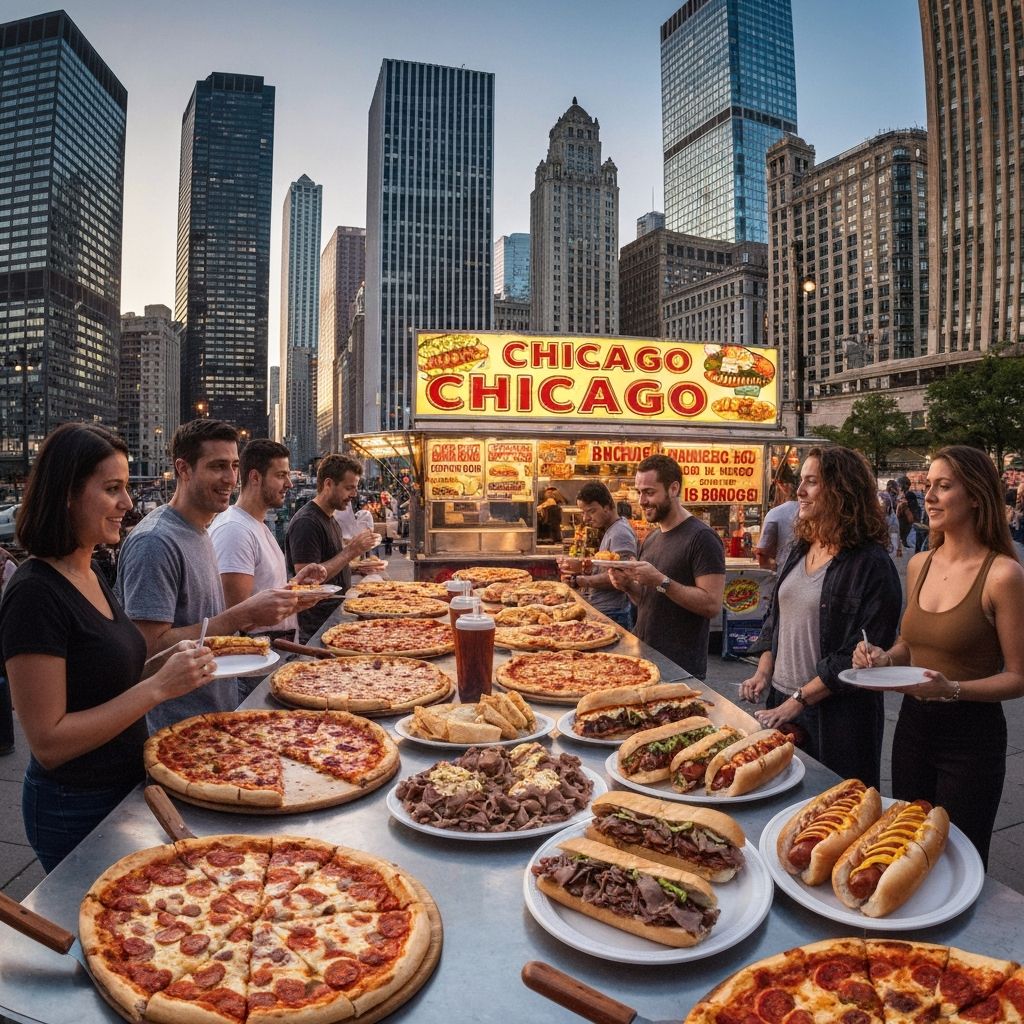
Chicago: A City Defined by Its Food
Chicago is a city with many identities: a center of architecture, a birthplace of the blues, a hub of industry, and a sports-obsessed metropolis on the shores of Lake Michigan. But for many visitors and residents alike, Chicago's most enduring identity is as one of America's greatest food cities. The Windy City has given the world some of the most iconic and beloved regional foods in American cuisine, from its famous deep-dish pizza to its uniquely dressed hot dogs. Chicago's food culture reflects its history as a melting pot of immigrant communities, its blue-collar work ethic, and its unwavering pride in doing things its own way.
What makes Chicago's food scene special is not just the quality of individual dishes but the depth of passion and tradition behind each one. Chicagoans do not just eat their signature foods; they fiercely debate the best places to find them, defend their preparation methods with religious fervor, and take genuine offense when outsiders get them wrong. This guide explores the iconic foods that define Chicago's culinary identity, from the universally famous to the delightfully obscure.
Deep-Dish Pizza
No discussion of Chicago food can begin anywhere other than deep-dish pizza, the city's most famous culinary creation. Invented in 1943 at Pizzeria Uno by Ike Sewell and Ric Riccardo (though the exact origin story is debated), Chicago deep-dish pizza turned the traditional pizza concept on its head, quite literally. Instead of a thin, flat crust topped with sauce and cheese, deep-dish pizza features a thick, buttery crust pressed into a deep, round pan, creating a vessel that holds generous layers of cheese, toppings, and chunky tomato sauce in that order, from bottom to top.
The crust is the foundation of great deep-dish pizza. Made with a higher proportion of butter or oil than traditional pizza dough, it has a rich, flaky, almost pastry-like quality that is distinct from any other style of pizza crust. The cheese, typically sliced mozzarella rather than shredded, goes directly on top of the crust, followed by any toppings such as Italian sausage, peppers, onions, or mushrooms. The chunky tomato sauce goes on top, which is the reverse of traditional pizza construction. This inverted layering is essential because it prevents the thick layer of cheese from burning during the longer baking time required for deep-dish pizza, typically 30 to 45 minutes.
Legendary deep-dish pizza establishments include Pizzeria Uno and Due (the originators), Lou Malnati's (famous for its buttery crust and exclusive use of fresh, never-frozen mozzarella), Giordano's (known for its stuffed deep-dish variation), and Pequod's (beloved for its caramelized crust edge). While deep-dish gets the most national attention, many Chicagoans actually prefer tavern-style thin-crust pizza for their everyday pizza eating, reserving deep-dish for special occasions and out-of-town guests.
The Chicago-Style Hot Dog
If deep-dish pizza is Chicago's most famous food, the Chicago-style hot dog may be its most beloved. The Chicago hot dog is a masterpiece of engineering, a perfectly constructed combination of flavors and textures that follows a strict set of rules. An all-beef frankfurter is placed in a steamed poppy seed bun and topped with yellow mustard, bright green sweet pickle relish, chopped white onion, a dill pickle spear, tomato slices or wedges, sport peppers (small, hot pickled peppers), and a dash of celery salt. Notice what is conspicuously absent from that list: ketchup.
In Chicago, putting ketchup on a hot dog is considered a culinary crime of the highest order. While the reasoning behind this prohibition varies depending on who you ask, the general sentiment is that ketchup's sweetness overwhelms the carefully balanced flavors of the Chicago dog's toppings. Visitors who request ketchup at a traditional Chicago hot dog stand may receive anything from a disapproving look to a good-natured lecture about proper hot dog etiquette.
Italian Beef Sandwiches
The Italian beef sandwich is perhaps Chicago's most underappreciated culinary treasure outside the city, but within Chicago, it inspires a devotion rivaling deep-dish pizza and hot dogs. The sandwich consists of thinly sliced, slow-roasted beef that has been simmered in a seasoned broth (called gravy or jus), piled onto a long Italian-style roll, and topped with sweet peppers (roasted green bell peppers) or hot giardiniera (a spicy pickled vegetable relish) or both.
What truly distinguishes an Italian beef sandwich is how you order the bread. You can order it dry (just the beef on the roll), wet or dipped (the entire sandwich is briefly dunked into the gravy), or soaked (the sandwich is fully submerged in gravy until the bread is completely saturated). Ordering your Italian beef dipped or soaked is the most popular choice and creates a gloriously messy eating experience that requires multiple napkins and a willingness to abandon all pretense of neat eating.
Garrett Popcorn and Chicago Mix
Garrett Popcorn Shops have been a Chicago institution since 1949, and the company's most famous creation, the Chicago Mix (a combination of caramel corn and cheddar cheese popcorn in the same bag), has become synonymous with the city. The combination of sweet caramel and savory cheese flavors may sound unusual, but the contrast is addictively delicious and has spawned countless imitators. Lines at Garrett's downtown locations routinely stretch out the door, particularly during the holiday season.
The Jibarito and Other Chicago Innovations
Chicago's food culture is not just about historic classics; the city continues to innovate and create new iconic foods. The jibarito, invented in 1996 at Borinquen Restaurant in the Humboldt Park neighborhood, replaces the bread in a traditional sandwich with flattened, fried green plantains. The original jibarito features steak, American cheese, lettuce, tomato, and garlic mayonnaise between the crispy plantain slaps, and it has become a beloved addition to Chicago's sandwich tradition.
The Maxwell Street Polish, a grilled or fried Polish sausage served on a bun with grilled onions and yellow mustard, originated from the legendary Maxwell Street Market on the city's near West Side. The rainbow cone, a five-flavor ice cream cone stacked in a specific order (chocolate, strawberry, Palmer House vanilla, pistachio, and orange sherbet) from the Original Rainbow Cone shop on the South Side, has been a summer tradition since 1926. And the Chicago-style gyro, a sandwich of seasoned ground lamb and beef sliced from a vertical rotisserie, has become so ubiquitous in the city that Chicago is often called the gyro capital of America.
The Influence of Immigrant Communities
Chicago's extraordinary food diversity is directly linked to the waves of immigration that have shaped the city since the 19th century. Polish communities brought pierogies, kielbasa, and paczki (filled doughnuts traditionally eaten before Lent). Mexican communities contributed tacos, tamales, elote, and an incredible array of regional Mexican cuisines. Greek communities established the city's numerous Greek restaurants and popularized the gyro. Italian immigrants brought their culinary traditions that evolved into Chicago's distinctive Italian-American cuisine, including Italian beef and deep-dish pizza. Chinese, Indian, Korean, Vietnamese, Ethiopian, and dozens of other immigrant communities continue to enrich Chicago's food landscape with authentic cuisines from around the world.
The Modern Chicago Food Scene
While Chicago's iconic classic foods remain the foundation of the city's culinary identity, the modern food scene has expanded to include world-class fine dining, innovative farm-to-table restaurants, and a thriving street food culture. Chicago is home to numerous Michelin-starred restaurants, including Alinea, which has earned three Michelin stars and is consistently ranked among the best restaurants in the world. The city's restaurant scene is known for its diversity, creativity, and an approach to dining that balances innovation with a deep respect for culinary tradition. Whether you are seeking a perfect deep-dish pizza slice or a multi-course tasting menu at a cutting-edge restaurant, Chicago offers one of the most rewarding and diverse food experiences of any city in the world.
