
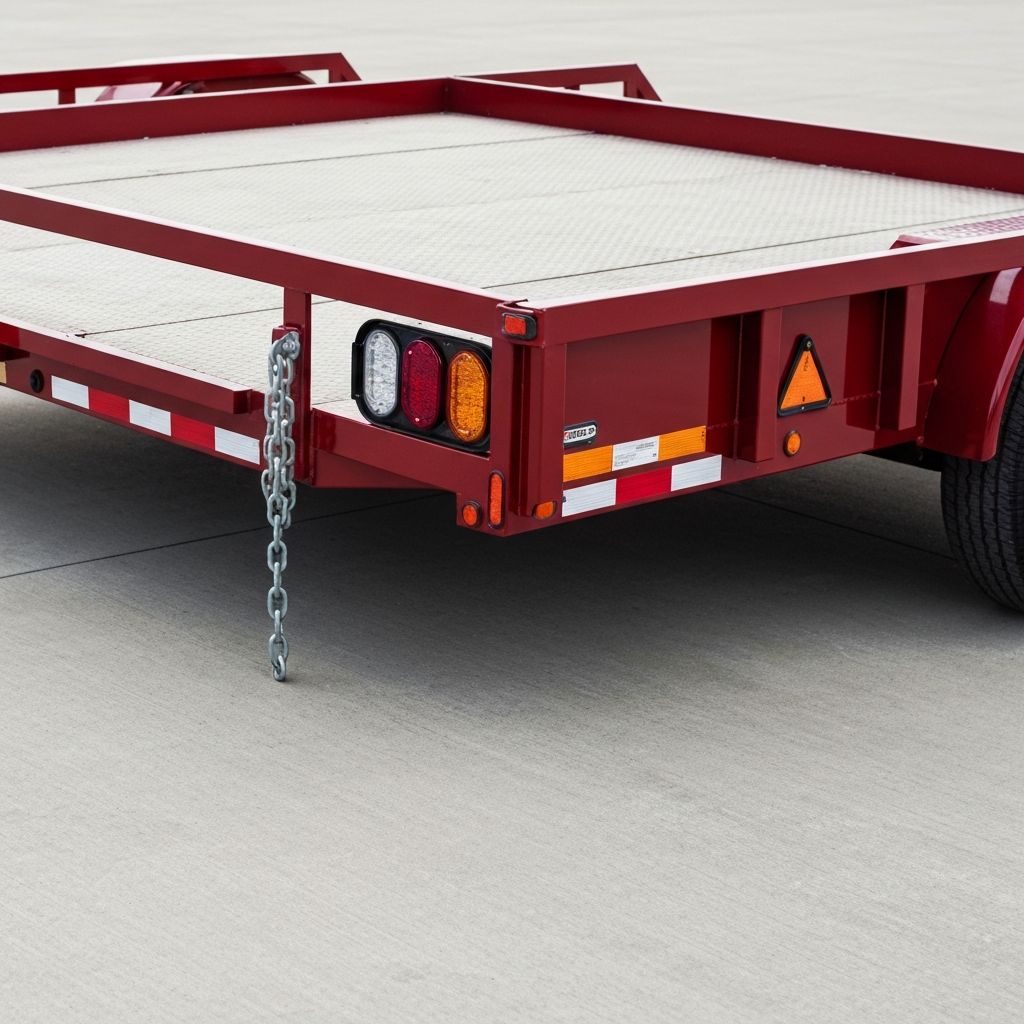
Understanding Trailer Equipment Requirements
Whether you're towing a small utility trailer to the hardware store or hauling a large enclosed trailer across the country, understanding the equipment required to be on your trailer is essential for legal compliance and, more importantly, for the safety of everyone on the road. Trailer equipment requirements are established by federal regulations through the Federal Motor Vehicle Safety Standards (FMVSS), as well as by individual state laws that may impose additional requirements. Failure to comply with these regulations can result in traffic citations, fines, impoundment of the trailer, and liability in the event of an accident.
The specific equipment required on a trailer depends on several factors, including the trailer's Gross Vehicle Weight Rating (GVWR), its width, its intended use, and the state in which it is registered and operated. Generally speaking, heavier and wider trailers require more extensive safety equipment than smaller, lighter ones. However, certain basic safety equipment is required on virtually all trailers that are operated on public roads, regardless of size. This guide covers the essential equipment that every trailer owner should understand and maintain.
Lighting Requirements
Proper lighting is one of the most critical safety requirements for any trailer, as it ensures that other drivers can see the trailer and understand the driver's intentions. Federal regulations require all trailers to be equipped with tail lights, brake lights, and turn signals that are visible from the rear of the trailer. These lights must be red in color for tail and brake lights and amber or red for turn signals, depending on their mounting position. The lights must be mounted symmetrically on each side of the trailer and must be visible from a distance of at least 500 feet under normal atmospheric conditions.
In addition to rear-facing lights, trailers wider than 80 inches are required to have clearance lights and side marker lights. Clearance lights are mounted at the widest points of the trailer to indicate its overall width to other drivers, while side marker lights are mounted along the sides to indicate the trailer's length. These lights must be amber in color when facing forward and red when facing rearward. Trailers over 30 feet in length are required to have intermediate side marker lights, providing additional visibility along the trailer's length. All trailer lighting must be connected to the tow vehicle's electrical system and must function in coordination with the vehicle's lights.
Reflectors and Reflective Tape
In addition to active lighting, trailers are required to have passive reflectors that make the trailer visible when illuminated by the headlights of other vehicles. At minimum, all trailers must have two red reflectors mounted on the rear of the trailer, visible from behind. These reflectors serve as a backup visibility measure in case the trailer's active tail lights fail, ensuring that the trailer remains visible to following vehicles even without powered lighting.
Trailers over 80 inches in width must also have amber reflectors on the front and sides, and red reflectors on the sides near the rear. For trailers and semi-trailers with a GVWR of 10,001 pounds or more, conspicuity tape (reflective tape) is required. This retro-reflective tape, which alternates between red and white segments, must be applied to the rear and sides of the trailer in specific patterns and quantities as defined by FMVSS 108. The tape significantly improves the visibility of large trailers at night and in low-visibility conditions, and studies have shown that it reduces nighttime rear-end collisions with trucks and trailers by approximately 44%.
Braking Systems
Trailer brake requirements vary significantly based on the trailer's weight and the state in which it is operated. Federal regulations do not mandate brakes on all trailers, but they do establish standards for brake performance when brakes are installed. Most states require brakes on trailers exceeding a certain weight threshold, typically between 1,000 and 3,000 pounds GVWR, though the specific threshold varies by state. Some states require brakes on all axles, while others require brakes on only one axle for lighter trailers.
The two most common types of trailer braking systems are electric brakes and surge (hydraulic) brakes. Electric brakes use electromagnets activated by a brake controller in the tow vehicle to apply the trailer's drum brakes. They require a brake controller installed in the tow vehicle and a compatible electrical connection (typically a 7-pin connector). Surge brakes use the momentum of the trailer pushing against the hitch during deceleration to activate a hydraulic master cylinder, which in turn applies the trailer's brakes. Surge brakes are self-contained and don't require a brake controller, making them popular for boat trailers and other applications where the tow vehicle may change frequently.
Safety Chains
Safety chains are one of the most basic and important safety requirements for towed trailers. Their purpose is to maintain a connection between the tow vehicle and trailer in the event that the primary hitch coupling fails, preventing the trailer from completely separating from the tow vehicle and becoming an uncontrolled hazard on the road. Federal and state regulations require that safety chains be used whenever a trailer is towed on public roads, with very limited exceptions.
Safety chains must be strong enough to hold the trailer's full loaded weight if the hitch fails, and they must be properly attached and adjusted. The correct method for attaching safety chains involves crossing the chains under the trailer tongue in an X pattern, which creates a cradle that catches the tongue if the coupling fails, preventing it from dropping to the ground and potentially causing the trailer to pole-vault. The chains should have enough slack to allow for turning without binding, but not so much slack that they drag on the ground. Each chain should be attached to the tow vehicle's frame or hitch using appropriate hardware—never to a bumper or other non-structural component.
Breakaway Systems
For trailers equipped with brakes, a breakaway system is typically required. A breakaway system is a safety device that automatically applies the trailer's brakes if the trailer separates from the tow vehicle. The system consists of a battery mounted on the trailer, connected to the brake system, and activated by a pull-pin switch. A cable or chain connects the pull-pin to the tow vehicle. If the trailer separates from the vehicle, the cable pulls the pin, completing the circuit and applying the trailer's brakes, bringing the trailer to a controlled stop.
Breakaway systems are required by federal law for all trailers with a GVWR of more than 3,000 pounds that are equipped with brakes. Many states also require breakaway systems on lighter trailers. The breakaway battery must be kept charged, which is typically accomplished through a charging wire connected to the tow vehicle's electrical system. Regular testing of the breakaway system is essential—pull the pin while the trailer is stopped and chocked to verify that the brakes engage firmly. A non-functional breakaway system is both a safety hazard and a legal violation.
Coupling and Hitch Equipment
The coupler is the mechanism on the trailer tongue that connects to the tow vehicle's hitch ball. The coupler must be properly sized to match the hitch ball diameter—common ball sizes are 1-7/8 inch, 2 inch, and 2-5/16 inch. Using a mismatched coupler and ball can result in the trailer disconnecting from the tow vehicle during towing, creating an extremely dangerous situation. The coupler must also include a locking mechanism, such as a latch, clamp, or pin, that secures the coupler to the ball and prevents accidental disconnection.
The hitch itself must be rated for the trailer's weight, and both the hitch and coupler must be in good working condition. A hitch or coupler that is worn, rusted, cracked, or otherwise damaged may fail under the stress of towing, leading to a separation event. The trailer jack, which supports the front of the trailer when it is not connected to the tow vehicle, is another essential piece of equipment. While not a safety requirement per se, a properly functioning jack is necessary for safe coupling and uncoupling of the trailer and prevents damage to the coupler when the trailer is parked.
License Plates and Registration
All trailers operated on public roads must be properly registered and display a valid license plate issued by the state in which they are registered. Registration requirements vary by state, but generally involve completing a registration application, providing proof of ownership (such as a title or manufacturer's certificate of origin), paying registration fees, and in some cases, having the trailer inspected. The license plate must be mounted on the rear of the trailer and must be illuminated by a license plate light so that it is legible at night.
Some states exempt very small trailers (such as those under a certain weight or used exclusively for agricultural purposes) from registration requirements, but these exemptions are limited and vary significantly by state. Even if your trailer is exempt from registration in your home state, it may not be exempt in other states you travel through, so it's generally advisable to register and plate any trailer that will be used on public roads. Failure to properly register and plate a trailer can result in citations, fines, and in some cases, impoundment of the trailer.
Tires, Wheels, and Fenders
Trailer tires must be in good condition, properly inflated, and appropriate for the trailer's load. Federal regulations require that tires have a minimum tread depth of 2/32 of an inch, though replacing tires before they reach this minimum is strongly recommended for safety. Trailer tires have specific load ratings, and the combined load rating of all tires on the trailer must meet or exceed the trailer's GVWR. Using undersized or under-rated tires can lead to blowouts, which are particularly dangerous on trailers because they can cause the trailer to sway or jackknife.
Fenders or mud flaps are required on trailer wheels in most states to prevent rocks, mud, and debris from being thrown onto following vehicles. The fenders must cover the width of the tire tread and extend from the front to the rear of the tire's contact area. For trailers with tandem or triple axles, the fenders must cover all tires. Spare tires are not legally required in most jurisdictions, but carrying a properly inflated spare tire and the tools needed to change a flat is strongly recommended, particularly for long-distance towing where a tire failure could leave you stranded far from assistance.
Additional State-Specific Requirements
Beyond the federal requirements outlined above, individual states may impose additional equipment requirements that trailer owners must comply with. Some states require periodic safety inspections of trailers, during which all required equipment is checked for compliance and proper function. Other states require additional safety equipment such as fire extinguishers for certain types of trailers, wheel chocks for trailers parked on grades, or warning flags or slow-moving vehicle emblems for trailers being towed at low speeds.
It's the trailer owner's responsibility to be familiar with the requirements of every state through which they plan to tow. The most restrictive requirements you'll encounter during your trip should be your minimum standard for equipping your trailer. Many state DMV websites publish trailer equipment requirements, and commercial truck stop chains often sell trailer safety equipment guides that summarize requirements by state. When in doubt, exceeding minimum requirements is always the safest approach—additional reflective tape, extra lighting, heavier-rated safety chains, and a well-maintained braking system protect not only you and your cargo but every other driver sharing the road with you.
