
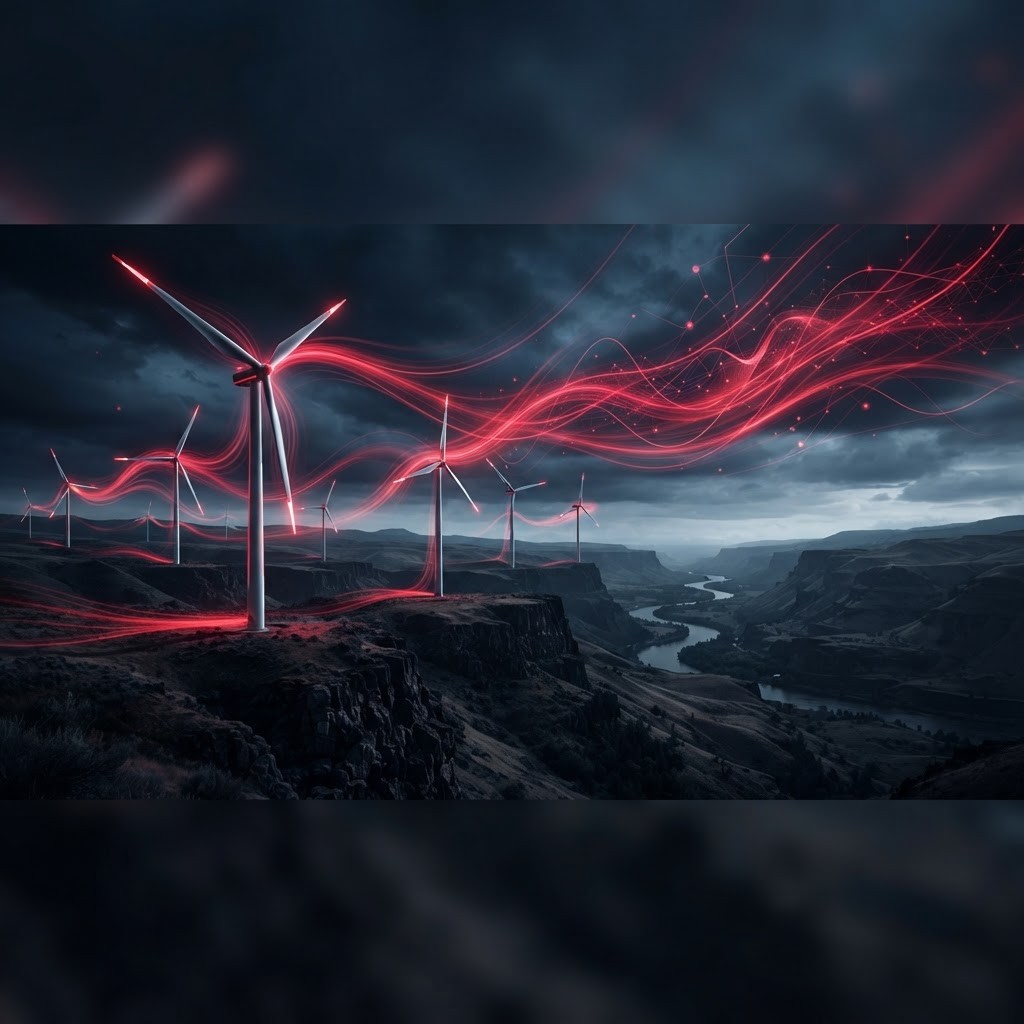
Why Washington Has Excellent Wind Resources
Wind development in Washington is a story about geography. The Cascade Range creates a persistent pressure differential between the marine air of Western Washington and the drier continental air to the east. Where the Columbia River cuts through that range, the resulting gorge acts as a natural wind funnel, producing consistent, high-quality wind at a scale unusual in the continental United States. Ridgelines in Kittitas County near Ellensburg and across Klickitat and Benton counties add further prime sites.
Just as important, these resources sit close to the transmission backbone built for Columbia River hydropower, and they pair unusually well with it. Hydro can be dispatched to fill gaps when wind output drops, while wind generation allows water to be held behind dams for later use. That complementarity made the Northwest one of the earliest large-scale wind markets in the country and continues to make new capacity valuable to system operators.
1. Puget Sound Energy Wind Portfolio
Puget Sound Energy owns and operates one of the largest utility wind portfolios in the Pacific Northwest, with major facilities in Kittitas and Benton counties supplying customers on the western side of the state. The company has invested in performance optimization and component upgrades across its fleet, and its long operating history provides some of the best available data on turbine performance in Washington's specific wind regime.
2. Klickitat Ridge Wind Partners
Klickitat Ridge Wind Partners develops and operates projects along the Columbia River Gorge's north side, an area with sustained wind and comparatively supportive local permitting. The firm focuses on projects in the mid-scale range, selling output through long-term agreements to utilities and corporate purchasers seeking regional clean energy attributes rather than distant, unbundled credits.
3. Kittitas Valley Wind Services
Rather than developing projects, Kittitas Valley Wind Services maintains them. The company provides scheduled maintenance, blade inspection and repair, gearbox and generator service, and unplanned outage response across Central Washington. As Washington's earliest turbines pass the fifteen- and twenty-year marks, independent service providers have become critical to keeping capacity factors high after original equipment warranties expire.
4. Columbia Gorge Renewables
Columbia Gorge Renewables specializes in repowering — replacing older nacelles, blades, and control systems on existing sites to raise output substantially without new land or transmission. Repowering has become one of the most attractive opportunities in the Northwest, since permitted sites with interconnection already in place are far easier to improve than to replicate.
5. Benton Wind Holdings
Benton Wind Holdings owns and manages operating wind assets in southeastern Washington, functioning primarily as a long-term asset owner rather than a developer. Its focus is on operational discipline: availability management, curtailment strategy, and hedging output against volatile wholesale prices in the Western energy market.
6. Cascadia Wind Development
Cascadia Wind Development handles early-stage work — resource assessment using meteorological towers and lidar, landowner agreements, environmental studies, and interconnection applications. The company is known for rigorous avian and bat impact studies, which have become central to permitting in a state where raptor migration corridors overlap with strong wind resources.
7. Rattlesnake Grid Solutions
Rattlesnake Grid Solutions provides the electrical infrastructure side of wind projects: collection systems, substations, protection and control, and interconnection engineering. Its work addresses the reality that a wind project's schedule is often determined by substation and transmission readiness rather than turbine delivery.
8. Northwest Turbine Logistics
Moving turbine components across Washington is a genuine engineering challenge — blades now exceed the length that ordinary highway geometry can accommodate, and mountain passes impose severe constraints. Northwest Turbine Logistics specializes in oversize transport planning, route surveys, permitting with state transportation authorities, and on-site crane coordination.
9. Salish Sea Offshore Wind Initiative
Offshore wind off Washington's coast remains at an early stage, constrained by deep water that requires floating foundations, fishing and tribal treaty considerations, and marine habitat protections. The Salish Sea Offshore Wind Initiative conducts feasibility assessment, stakeholder engagement, and technology evaluation. Even at a preliminary stage, the work matters because offshore wind would supply coastal load without crossing the Cascades.
10. Palouse Community Wind
Palouse Community Wind pursues smaller, locally owned projects with farms, cooperatives, and rural utilities in Eastern Washington. Distributed wind at this scale rarely competes on cost with utility projects, but it delivers landowner income, local resilience, and community support that large developments often struggle to earn.
Key Trends in Washington Wind
Repowering leads the near-term pipeline. Many Washington turbines were installed between 2005 and 2012, and replacing their drivetrains and rotors can increase annual production meaningfully while extending asset life for decades. Because the underlying sites are already permitted and interconnected, these projects avoid the delays that plague greenfield development.
Transmission is the binding constraint on new capacity. The strongest wind resources are east of the Cascades and the largest loads are west, and regional transmission expansion moves slowly. Interconnection queues across the West now stretch for years, and queue reform is arguably more consequential to Washington's clean energy targets than any single project.
Hybridization is also advancing. Co-locating batteries with wind allows generation to be shifted into evening peak hours and reduces curtailment when transmission is congested. And permitting has grown more complex, with Washington's state siting council playing a larger coordinating role in projects that face divided county-level support.
How to Work With a Wind Company
Landowners considering a lease should compare compensation structures carefully, since fixed annual payments, royalty arrangements, and hybrid models allocate risk differently. Review decommissioning security, access easements, and how the agreement affects ongoing farming or grazing. Corporate buyers should scrutinize how output shape aligns with their own load profile, because a contract that delivers energy at hours of low value provides less benefit than nameplate figures suggest. Utilities and asset owners should weigh operations and maintenance strategy explicitly: independent service providers often deliver better responsiveness than original manufacturers once warranties lapse.
Final Thoughts
Wind is the largest non-hydro renewable resource in Washington and will carry much of the load in meeting the state's clean electricity requirements. The companies above span the full value chain — development, ownership, operations, service, logistics, and emerging offshore assessment. As repowering accelerates and transmission expands, this segment of Washington's energy economy is likely to grow in both capacity and sophistication.
