
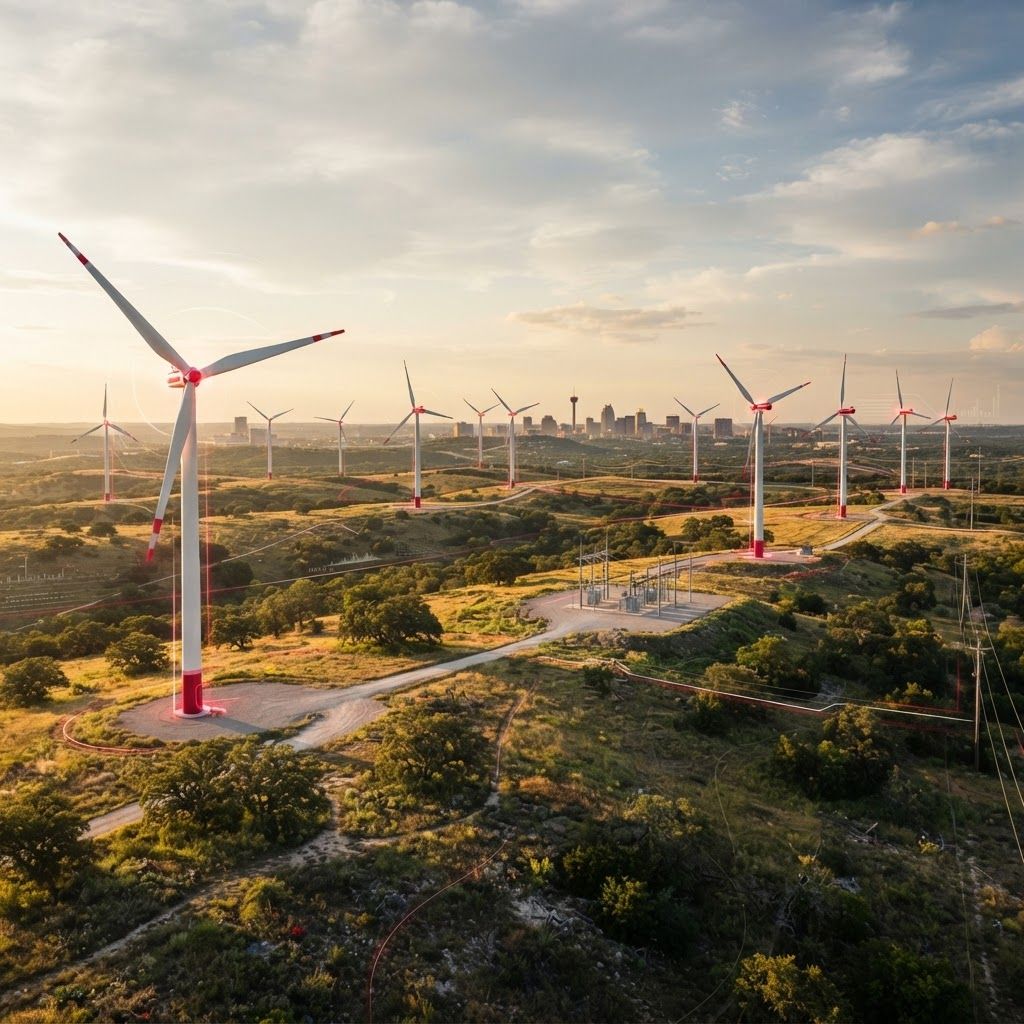
San Antonio's place in the Texas wind market
San Antonio may be better known for the River Walk and a large military presence, but it is also connected to one of the world's most active wind-power markets. West and South Texas wind farms feed the ERCOT grid, while local utilities, developers, engineers, and service firms help turn that generation into dependable electricity. The best company for a particular project depends on whether the need is utility-scale development, commercial procurement, engineering, construction, operations, or distributed renewable strategy.
The organizations below were selected for their relevance to San Antonio customers, Texas operating experience, technical capabilities, market reputation, or role in the regional clean-energy ecosystem. The list is a practical starting point rather than a rigid ranking. Availability, project economics, interconnection capacity, contract terms, and service territory should always be verified during procurement.
1. CPS Energy
CPS Energy is the municipally owned electric and natural-gas utility serving San Antonio. Its importance to local wind energy comes from its renewable procurement portfolio and its ability to integrate power purchased from Texas projects into service for homes and businesses. Customers evaluating renewable programs value the utility's local accountability, long planning horizon, and familiarity with San Antonio's rapid growth. CPS Energy is particularly relevant for organizations seeking utility programs rather than direct ownership of a wind farm.
2. OCI Energy
San Antonio-based OCI Energy is known for developing utility-scale renewable assets and maintaining close ties to the Texas market. Although its portfolio spans solar and energy storage as well as broader clean-energy development, its local development expertise makes it a useful company to watch as wind becomes increasingly paired with batteries and complementary generation. Its differentiator is the ability to navigate land, permitting, interconnection, financing, and offtake considerations within an integrated project-development process.
3. EDP Renewables North America
EDP Renewables North America has developed and operated wind projects across Texas and the United States. The company brings utility-scale experience in site assessment, project finance, construction oversight, operations, and long-term power sales. For San Antonio-area institutions exploring power purchase agreements or renewable-energy procurement, a developer of this scale can offer a mature operating platform and a broad portfolio. Its Texas experience is valuable because ERCOT congestion, basis risk, and transmission constraints require specialized analysis.
4. RWE Clean Energy
RWE Clean Energy is a major renewable developer and operator with a significant presence in the American wind sector. It combines development capabilities with asset management and market expertise, making it relevant to large commercial buyers and utilities. RWE's scale supports sophisticated forecasting, maintenance planning, and portfolio management. In the San Antonio market, those capabilities matter because strong wind resources are often located far from the final customer and must be managed within a complex wholesale grid.
5. Ørsted
Ørsted is widely recognized for renewable-energy development and has participated in the onshore wind market in Texas. The company is notable for disciplined project development, sustainability goals, and experience serving corporate energy buyers. Businesses comparing renewable contracts may appreciate its focus on long-term partnerships and environmental performance. As with any large developer, customers should examine delivery point, settlement structure, project status, and how renewable-energy certificates are handled.
6. Clearway Energy Group
Clearway Energy Group develops, owns, and operates clean-energy projects, including wind assets. Its combination of development and long-term operations can reduce handoff risk after construction. For San Antonio companies with ambitious emissions targets, Clearway's experience structuring corporate renewable agreements can be especially relevant. Buyers should still assess contract length, credit requirements, expected generation profile, curtailment provisions, and the relationship between project output and their own electricity load.
7. Apex Clean Energy
Apex Clean Energy develops utility-scale wind, solar, storage, and green-fuels projects across the country, including activity in Texas. Its strengths include early-stage development, resource analysis, community engagement, and commercial contracting. That multidisciplinary model is useful as Texas projects increasingly combine technologies. A San Antonio business considering a virtual power purchase agreement may benefit from Apex's corporate procurement experience, while landowners may value a clear approach to leases and community communication.
8. Invenergy
Invenergy is a privately held developer and operator active across wind, solar, storage, transmission, and other infrastructure. Its wind portfolio and in-house technical depth give it the ability to handle projects from site selection through operations. The company is relevant to San Antonio because the region's electricity demand is expanding alongside manufacturing and data-driven industries. Large loads need renewable solutions that account for reliability, transmission, and price exposure rather than treating wind certificates as a stand-alone purchase.
9. Vestas
Vestas is a leading wind-turbine manufacturer and service provider rather than a retail electricity supplier. Its turbines, digital monitoring tools, parts network, and long-term service agreements support projects throughout wind-rich markets such as Texas. Owners and developers evaluate Vestas for turbine technology, expected energy production, service availability, and lifecycle cost. Reliable maintenance is critical in the Texas heat, where remote sites and demanding operating conditions can amplify downtime.
10. GE Vernova
GE Vernova supplies wind turbines, grid technologies, and energy software. Its broad portfolio is particularly relevant as wind farms must satisfy increasingly detailed grid-performance requirements. Developers may consider the company for turbine platforms, controls, condition monitoring, and integration expertise. For the wider San Antonio energy ecosystem, GE Vernova represents the equipment and grid-technology layer that helps variable generation operate as part of a dependable power system.
How to choose a wind-energy company
Begin by defining the desired outcome. A local business seeking a greener electricity plan has different needs from a landowner considering a lease or a manufacturer evaluating a long-term virtual power purchase agreement. Compare proven Texas projects, financial strength, safety performance, expected generation, interconnection position, maintenance resources, and community practices. Contract reviews should address renewable certificate ownership, congestion and curtailment, production guarantees, escalation clauses, termination rights, and reporting.
San Antonio's future wind opportunities will increasingly involve hybrid portfolios. Batteries can shift renewable output, solar can complement nighttime wind, and demand management can reduce stress during extreme weather. Companies that explain these interactions clearly and model risk under multiple market scenarios are likely to provide the greatest value. A thoughtful selection process turns abundant Texas wind into a practical energy strategy built around cost, resilience, and measurable environmental progress.
