
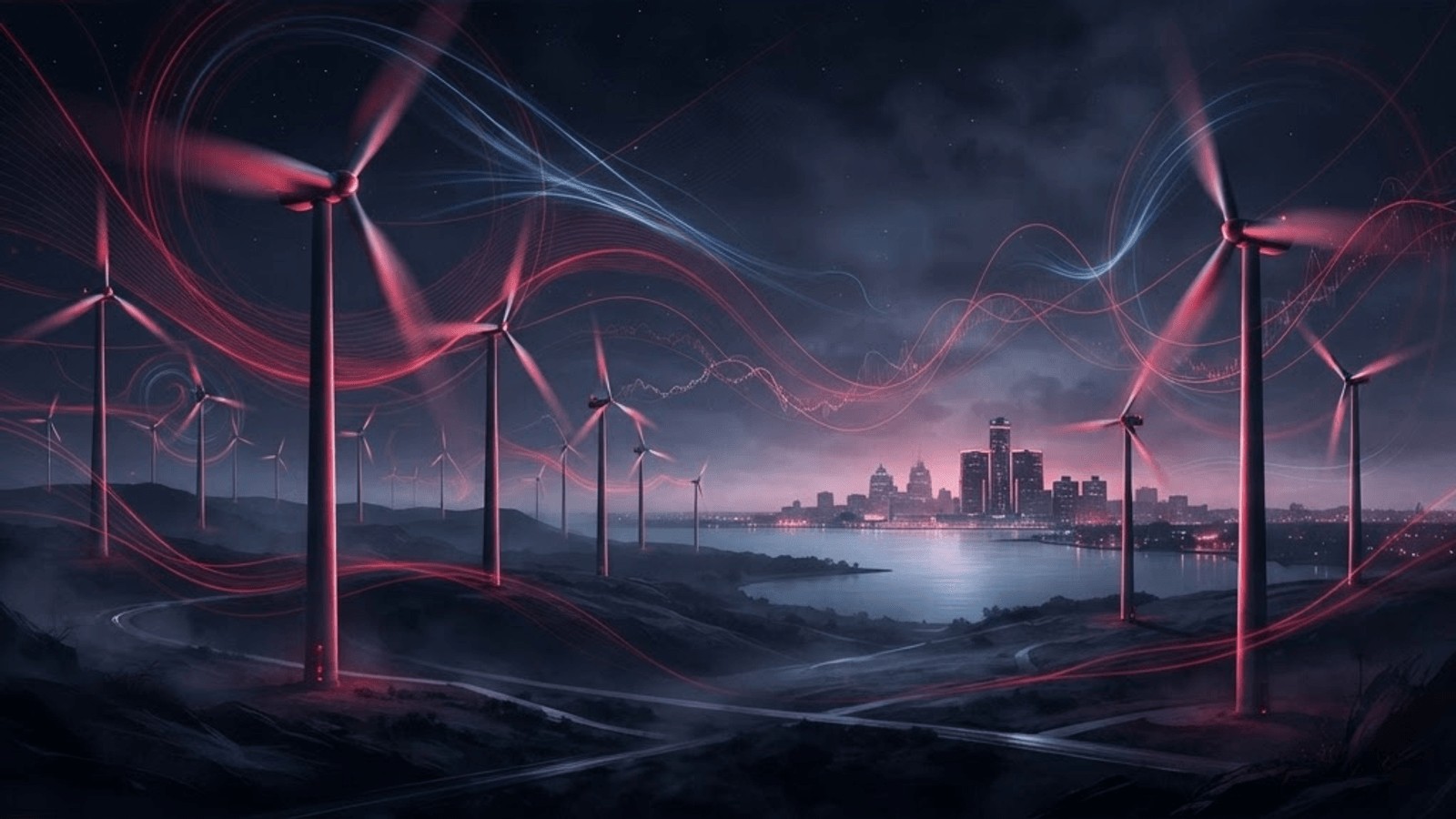
Wind Energy and the Detroit Advantage
Michigan ranks among the stronger wind states in the eastern half of the country, with excellent resources along the Thumb region, the Lake Michigan shoreline, and much of the state's agricultural interior. Detroit itself is not a turbine site, but it plays a central role nonetheless: the metro area supplies castings, gearboxes, bearings, fasteners, control electronics, and heavy fabrication, and it houses the engineering, finance, and service organizations that keep turbines spinning across the region.
This division of labor is a natural extension of Detroit's industrial DNA. A wind turbine nacelle contains thousands of precision components with tolerances familiar to any automotive machine shop, and the logistics of moving multi-ton assemblies mirror challenges the region's freight network has solved for decades. As a result, wind has become an important diversification path for Detroit manufacturers.
Understanding the Wind Value Chain
Buyers and partners often assume a single company handles everything, but wind projects involve several distinct disciplines. Developers secure land, permits, and interconnection rights. Original equipment manufacturers build turbines. Balance-of-plant contractors handle foundations, roads, and collection systems. Component suppliers feed the manufacturing chain. Operations and maintenance providers handle blade inspection, gearbox service, and uptime management. Detroit-area organizations participate meaningfully in nearly every one of these layers.
1. DTE Energy Wind Portfolio
DTE Energy owns and operates a large fleet of wind parks across Michigan, making it the most significant wind operator serving the Detroit region. Its wind generation supplies both regulated customers and voluntary renewable programs, and its long-term plans call for continued expansion of wind capacity as older fossil generation retires.
2. Consumers Energy Wind Operations
Consumers Energy operates substantial wind capacity in Michigan and continues adding projects as part of a broad clean generation strategy. For businesses in the greater Detroit area seeking documented renewable supply, its wind-backed programs offer a credible and auditable option.
3. Wind Turbine Component Manufacturers
Detroit's machining, forging, and casting shops produce hubs, main shafts, gear sets, bearing housings, and structural fasteners for turbine assemblies. These suppliers compete on metallurgical quality, dimensional precision, and certification rigor, and many hold the same quality accreditations required by automotive and aerospace customers.
4. Gearbox and Drivetrain Specialists
Drivetrain reliability determines a turbine's lifetime economics, and southeast Michigan hosts specialists in gear design, heat treatment, lubrication systems, and drivetrain remanufacturing. Their capability to rebuild rather than replace major assemblies delivers substantial value to operators managing aging fleets.
5. Blade Inspection and Repair Contractors
Blade damage from erosion, lightning, and delamination is one of the most common causes of lost production. Regional contractors deploy rope-access technicians, drones, and composite repair crews to inspect and restore blades in the field. Their seasonal scheduling around Michigan weather is a specialized logistics discipline in its own right.
6. Balance-of-Plant and Civil Contractors
Heavy civil contractors based in and around Detroit build turbine foundations, access roads, crane pads, and underground collection systems. Their experience with Michigan soils, frost depth requirements, and agricultural land restoration is essential to keeping projects on schedule and landowners satisfied.
7. Electrical and Substation Engineering Firms
Connecting a wind park to the grid requires collection systems, transformers, protective relaying, and substation construction. Detroit-area electrical engineering firms design and commission this infrastructure, coordinating closely with utilities and regional transmission operators on interconnection studies and protection schemes.
8. Wind Resource Assessment and Consulting Practices
Before capital is committed, independent consultants measure wind resources, model energy yield, assess wake losses, and evaluate noise and shadow flicker impacts. Consulting practices serving the Detroit market provide these studies along with permitting support and community engagement planning, which frequently determines whether a project advances.
9. Small and Distributed Wind Providers
Beyond utility-scale projects, a niche of providers installs small wind turbines for farms, rural businesses, and educational institutions in the counties surrounding Detroit. These systems are best suited to open sites with sustained wind, and reputable providers are candid about when a location does not justify the investment.
10. Workforce Training and Technical Programs
Community colleges and technical training organizations in the Detroit region prepare wind technicians in electrical systems, hydraulics, fall protection, and composite repair. These programs supply the skilled labor the industry depends on and give Michigan residents access to well-paid technical careers.
Great Lakes Wind and the Offshore Question
The Great Lakes hold an enormous theoretical wind resource, and offshore development has been studied repeatedly. Progress has been slow due to freshwater ice loading, viewshed concerns, ecological considerations, and complex jurisdictional questions. For Detroit's manufacturers, however, offshore wind anywhere in North America represents a potential market for heavy fabrication, cabling, and specialized vessels, which is why regional suppliers continue tracking the sector closely.
Trends Shaping Wind Energy
Turbines continue growing in rotor diameter and hub height, which increases capacity factors but complicates transportation and installation. Repowering has emerged as a major activity, with operators replacing nacelles and blades on existing foundations to boost output from permitted sites. Predictive maintenance using vibration analysis and machine learning is reducing unplanned downtime, and hybrid projects combining wind, solar, and storage are becoming more common as interconnection capacity grows scarce.
Choosing a Wind Energy Partner
For component buyers, prioritize suppliers with documented quality systems, traceable materials, and proven capacity to hold tolerances at scale. For project owners, evaluate developers on permitting track record, community relationships, and financial depth. For operators, judge service providers on response time, technician certification, and transparent reporting. In every case, references from projects that have run for several years reveal far more than a polished capability presentation.
Final Thoughts
Wind energy in Michigan has matured from a policy experiment into core infrastructure, and Detroit sits at the industrial center of that story. Whether you are sourcing precision components, planning a project, or purchasing renewable electricity, the depth of expertise concentrated in the metro area makes it a strong place to build a wind strategy.
