
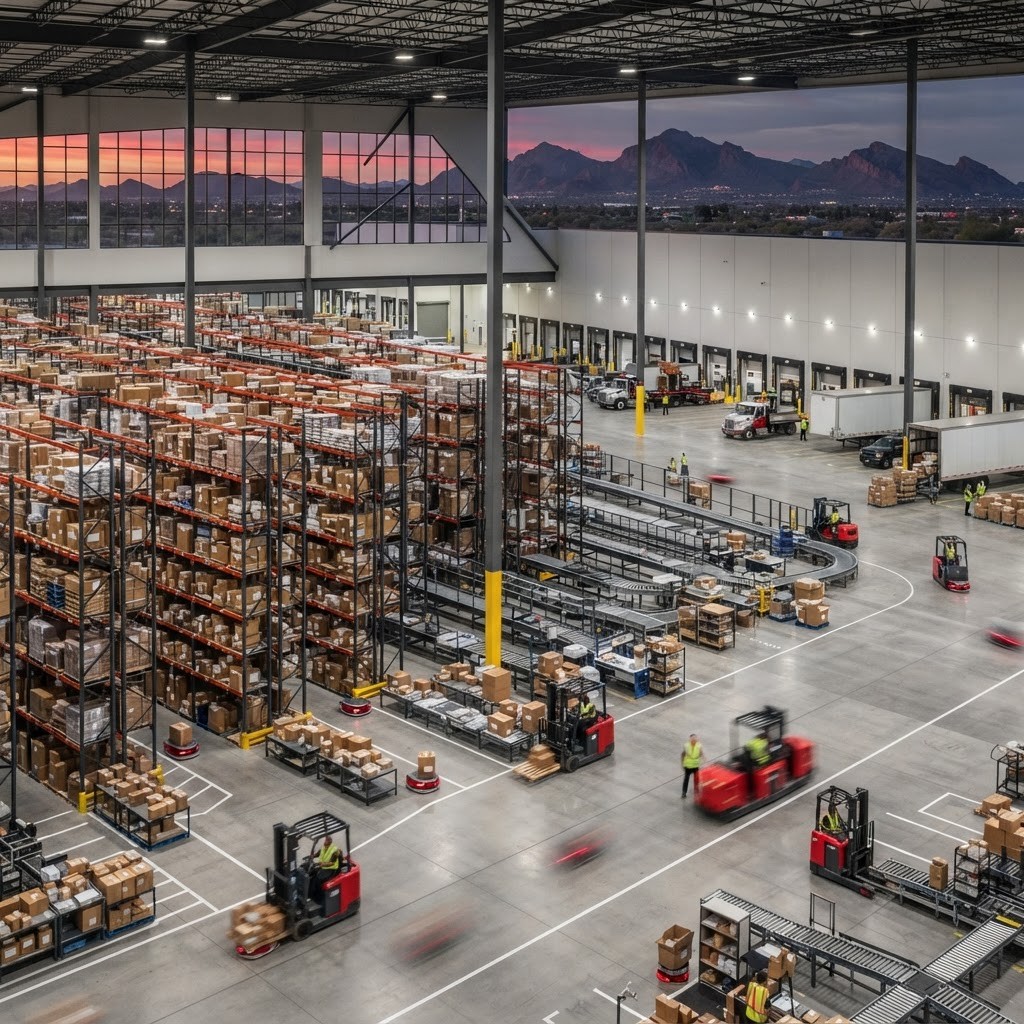
Phoenix as a Distribution Hub
Metro Phoenix has gained attention as companies diversify supply chains and seek alternatives to coastal distribution costs. Interstate access, proximity to Southern California, population growth, and expanding industrial corridors make the region attractive for inventory placement. Warehousing needs differ widely, however: bulk storage, e-commerce fulfillment, food-grade handling, cross-docking, and contract logistics require different facilities and systems.
1. Ryder Supply Chain Solutions
Ryder provides warehousing, distribution, transportation, and managed logistics. Its integrated capabilities can help Phoenix businesses connect inventory storage with inbound and outbound transport. The company is relevant to organizations seeking scalable operations, established processes, and visibility across multiple supply-chain functions.
2. DHL Supply Chain
DHL Supply Chain operates contract logistics solutions for industries including retail, consumer, healthcare, and technology. It brings global operating experience, automation expertise, and structured performance management. Large or complex Phoenix operations may value its ability to design dedicated or shared warehouse programs.
3. GXO Logistics
GXO focuses on contract logistics and technology-enabled warehousing. Automation, analytics, and process engineering are central to its approach. It is a strong candidate for high-volume businesses that need sophisticated fulfillment, returns management, or labor-efficient operations rather than simple pallet storage.
4. NFI
NFI provides distribution, transportation, and real-estate-related logistics capabilities. Its service range supports businesses looking to coordinate warehouse operations with trucking capacity. Phoenix customers can consider NFI for dedicated distribution programs and multi-market supply chains requiring consistent operational standards.
5. Kuehne+Nagel
Kuehne+Nagel combines contract logistics with international forwarding and customs expertise. This is valuable for importers whose Phoenix inventory arrives through ports, airports, or border gateways. A single provider can coordinate upstream transportation, warehousing, order processing, and distribution while maintaining shipment visibility.
6. DB Schenker
DB Schenker offers global logistics, including warehousing and value-added services. Manufacturers and international brands may use its network for inventory management, packaging, sequencing, and distribution. Its multi-modal background helps connect a Phoenix facility to broader domestic and overseas supply chains.
7. Saddle Creek Logistics Services
Saddle Creek specializes in omnichannel fulfillment, warehousing, transportation, and packaging. Its capabilities suit retail and e-commerce businesses that ship both individual orders and wholesale replenishment. Customers should evaluate order accuracy, cutoffs, returns processing, and integrations with commerce platforms.
8. Penske Logistics
Penske Logistics provides distribution center management, transportation, and supply-chain solutions. It is particularly relevant where warehouse performance depends on coordinated dedicated trucking or inbound management. Process engineering and operational reporting can support companies seeking measurable improvement rather than storage alone.
9. CEVA Logistics
CEVA Logistics manages contract logistics and freight across a global network. Industry-focused solutions can accommodate automotive, technology, healthcare, consumer, and industrial requirements. Phoenix companies with international sourcing may appreciate a provider capable of managing multiple stages from origin to regional distribution.
10. Quiet Logistics
Quiet Logistics is associated with technology-supported fulfillment for consumer brands. Operations built around direct-to-consumer orders can help growing merchants improve shipping speed and customer experience. Brands should examine system integrations, peak capacity, packaging customization, and returns workflows before selecting a fulfillment partner.
Evaluating Warehouse Capabilities
Begin with a detailed volume profile covering pallets, stock-keeping units, order lines, storage turns, seasonality, returns, and special handling. Ask whether rates include receiving, put-away, storage, picking, packing, materials, account management, and technology. Minimum charges and peak surcharges can significantly change the economics for smaller businesses.
A warehouse management system should provide accurate, timely inventory data and integrate with order, transportation, or commerce systems. Review cycle-count procedures, lot and serial tracking, expiration controls, user permissions, and outage plans. Physical security, fire protection, pest control, insurance, and disaster recovery deserve the same attention as software.
Phoenix Operating Considerations
Extreme heat may affect food, cosmetics, chemicals, batteries, electronics, and packaging materials. Confirm whether the building is climate-controlled and how temperatures are monitored. Location also matters: a facility near customers may reduce final-mile cost, while one near an interstate can improve regional truck efficiency. Labor availability and carrier pickup schedules influence late-order cutoffs.
Making a Confident Choice
Before committing, create a short list based on the needs that matter most, then compare each option using the same questions. Confirm current availability, policies, pricing, qualifications, and service details because organizations and programs change over time. Recent feedback can reveal patterns, but individual reviews should be considered alongside direct conversations and documented information. Phoenix is a large, fast-growing metropolitan area, so location, traffic, seasonal demand, and extreme heat may affect the practical experience as much as headline features. A thoughtful decision weighs quality, convenience, transparency, long-term value, and the ability to respond when circumstances change.
Final Thoughts
The best Phoenix warehousing company aligns facility design, technology, labor, and transportation with the customer’s exact order profile. Global providers bring scale, while fulfillment specialists offer focused direct-to-consumer capabilities. A site visit, systems demonstration, reference review, and carefully modeled pricing comparison can reveal which partner is prepared to support both normal operations and peak demand.
