
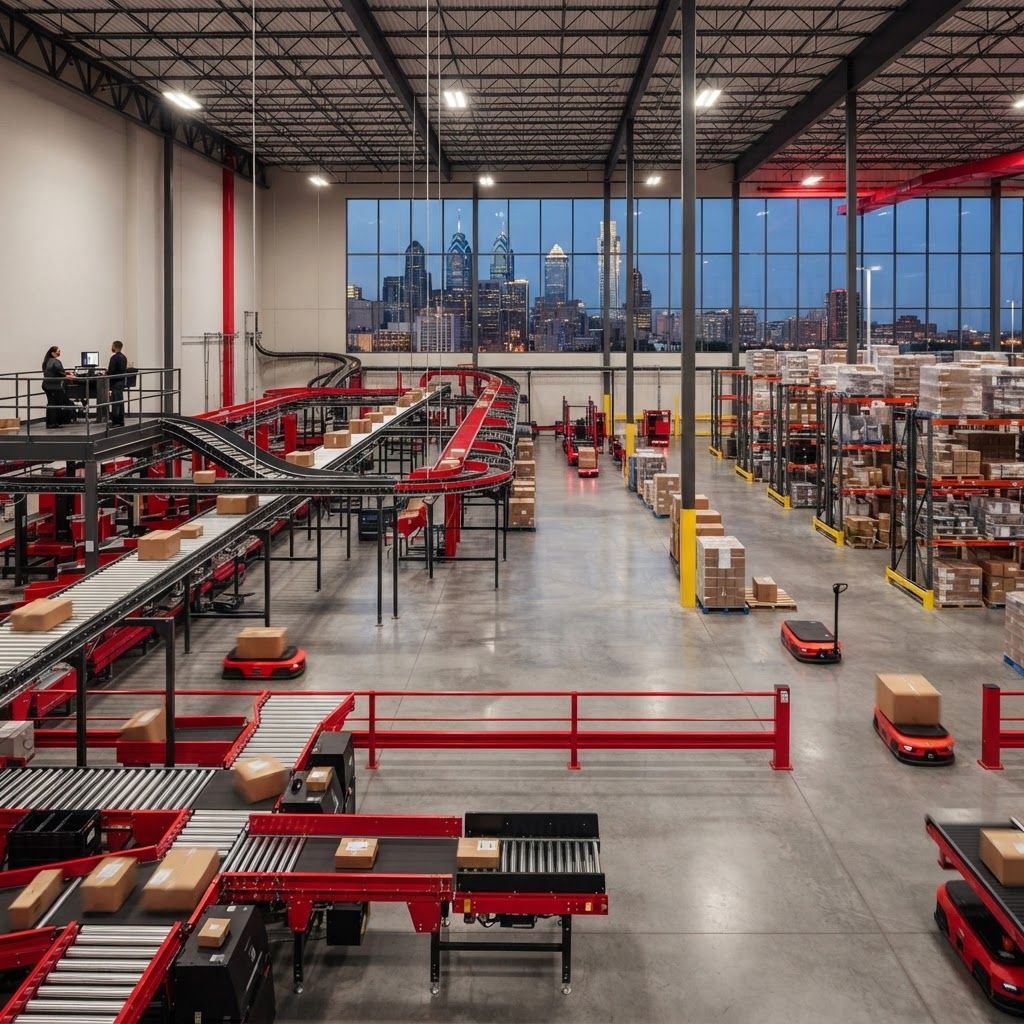
Philadelphia's Warehousing Advantage
Philadelphia sits at the center of one of America's most valuable logistics corridors. Companies operating here can reach major markets from New York to Washington while using the Port of Philadelphia, Philadelphia International Airport, rail connections, and interstates 76, 95, and 276. The region supports food, pharmaceutical, retail, industrial, and e-commerce supply chains, so the best provider depends on a shipper's product, compliance requirements, order profile, and growth plans.
1. NFI Industries
Camden-founded NFI Industries has deep roots in the Philadelphia metropolitan area and offers integrated warehousing, transportation, distribution, and supply-chain design. Its scale suits businesses seeking a partner that can coordinate storage with dedicated transportation and final-mile activity. Technology-supported inventory visibility and broad industry experience are important differentiators.
2. Holt Logistics
Holt Logistics is closely associated with marine-terminal and distribution activity along the Delaware River. The company is particularly relevant for importers, exporters, food businesses, and organizations that need port-adjacent handling. Its regional infrastructure and understanding of cargo movement help simplify transfers between vessel, storage facility, rail, and truck.
3. Kane Logistics
Kane Logistics, part of ID Logistics, serves the broader Pennsylvania market with contract logistics and distribution services. It is known for customized operations rather than a one-size-fits-all model. Consumer goods, retail, and manufacturing companies may value its emphasis on process engineering, labor management, and scalable fulfillment.
4. Performance Team
Performance Team, a Maersk company, combines warehousing with international logistics capabilities. For Philadelphia businesses managing global sourcing, that connection can support a more coordinated flow from port arrival to regional distribution. Its network is designed for high-volume retail, consumer, and e-commerce operations.
5. ShipMonk
ShipMonk focuses on technology-enabled fulfillment for growing e-commerce brands. Its services typically include inventory storage, pick-and-pack operations, order management, returns, and integrations with major commerce channels. Merchants should evaluate order minimums, packaging needs, peak-season capacity, and the fit between its network and their customer geography.
6. Quiet Platforms
Quiet Platforms provides fulfillment capabilities developed around modern retail and direct-to-consumer requirements. Its model emphasizes connected logistics, distributed inventory, and delivery performance. Philadelphia-area brands looking to compete on shipping speed may find the network approach useful, particularly when demand extends beyond the Mid-Atlantic.
7. UPS Supply Chain Solutions
UPS Supply Chain Solutions offers contract logistics backed by a major transportation network. Services can include distribution, freight forwarding, customs support, and returns management. This breadth is valuable for companies that prefer fewer handoffs, although businesses should still compare facility location, service-level commitments, and account support.
8. DHL Supply Chain
DHL Supply Chain operates large, sophisticated contract-logistics programs across many industries. Its strengths include automation, operational engineering, data analysis, and experience with regulated or complex supply chains. It is generally best suited to organizations with sufficient scale and a need for a highly structured, long-term solution.
9. Ryder Supply Chain Solutions
Ryder combines warehousing with transportation, fleet, and distribution expertise. That integrated model can benefit manufacturers and retailers seeking predictable movement between plants, warehouses, stores, and customers. Its engineering resources also support network redesign and continuous operational improvement.
10. GXO Logistics
GXO is a major contract-logistics specialist recognized for automation and high-throughput fulfillment. Its capabilities are relevant to complex consumer, technology, and omnichannel operations. Businesses considering GXO should assess implementation scope, systems integration, volume forecasts, and the expected return from advanced automation.
How to Choose a Philadelphia Warehouse
Begin with practical requirements: temperature control, food or pharmaceutical compliance, pallet storage, parcel fulfillment, kitting, returns, or port drayage. Ask each provider about inventory accuracy, security, disaster recovery, labor availability, peak capacity, reporting, and integration with existing systems. Tour the proposed facility and review measurable service levels before signing. The strongest choice is not simply the largest company; it is the operator whose location, people, technology, and processes align with the way your customers buy.
