
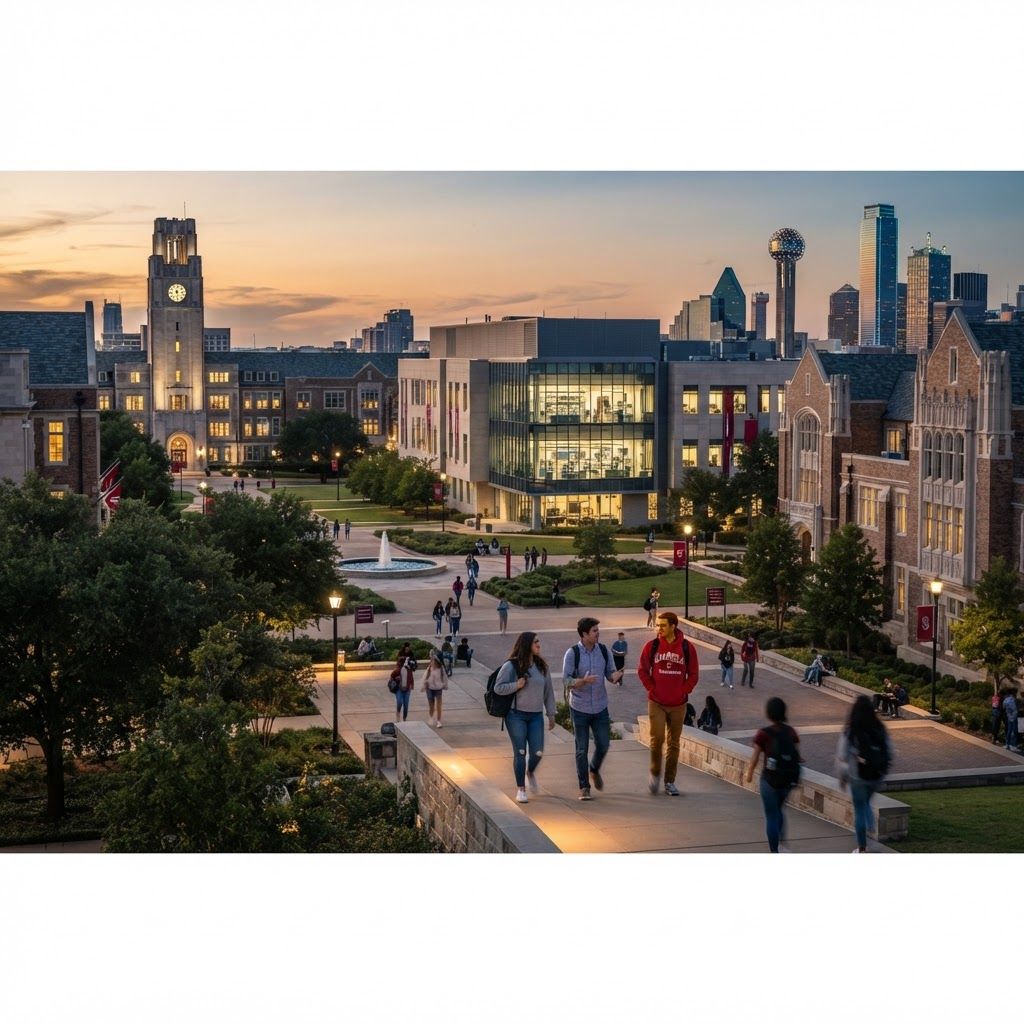
Higher Education Across Dallas-Fort Worth
The Dallas region is home to research universities, private institutions, faith-based campuses, and specialized professional schools. Students benefit from connections to industries including finance, technology, healthcare, defense, logistics, energy, education, and the arts. Yet the Metroplex is geographically large, and two universities described as being in Dallas may offer very different daily experiences.
This guide considers recognized universities in Dallas and nearby communities that form the region's education market. It is not an absolute ranking. Students should compare the specific department, faculty, research, costs, campus environment, and career outcomes associated with their intended program.
1. University of Texas at Dallas
The University of Texas at Dallas in Richardson is a public research university known for computer science, engineering, business, behavioral sciences, and interdisciplinary research. Its location near the Telecom Corridor supports employer connections. The campus attracts a diverse, academically focused population and continues to expand.
2. Southern Methodist University
Southern Methodist University is a private research institution with prominent programs in business, engineering, arts, humanities, sciences, and law. Its location near central Dallas offers access to internships and cultural life. A residential campus and extensive alumni network are strengths, while net cost deserves close analysis.
3. University of North Texas
The University of North Texas in Denton is a large public research university with broad academic options and nationally visible music programs. It offers the energy and resources of a major campus. Denton has its own college-town identity, so students should not assume the experience resembles living in central Dallas.
4. University of Texas at Arlington
The University of Texas at Arlington is a major public research university positioned between Dallas and Fort Worth. Engineering, nursing, business, science, and urban research are notable areas. Its central Metroplex location and substantial commuter population suit many students, though travel time depends heavily on residence and schedule.
5. Texas Christian University
Texas Christian University in Fort Worth is a private institution offering a residential experience with programs across business, sciences, humanities, fine arts, communication, education, and health fields. Athletics and campus traditions contribute to student life. Applicants should compare aid and consider whether its culture fits their goals.
6. Texas Woman's University
Texas Woman's University, headquartered in Denton, is a public university recognized for health sciences, nursing, education, and its historical mission of serving women, while enrolling students of all genders. It can be particularly compelling for healthcare and service-oriented fields. Clinical placements and program locations should be verified.
7. University of North Texas at Dallas
UNT Dallas provides a public-university option within Dallas city limits. Its programs and student support are shaped by an urban mission, with many commuter, transfer, and first-generation learners. Students seeking smaller scale than a flagship campus may value its environment and proximity to southern Dallas communities.
8. Dallas Baptist University
Dallas Baptist University offers a Christian educational setting with undergraduate, graduate, and doctoral options. Its scenic campus creates a more traditional atmosphere within the city. Business, education, ministry, and professional studies attract many students who want academics integrated with faith and service.
9. University of Dallas
The University of Dallas in Irving is a private Catholic university known for its core curriculum, liberal arts tradition, business education, and Rome program. It suits students drawn to rigorous discussion and a cohesive intellectual framework. Its identity is distinctive, so a campus visit can clarify fit.
10. Texas A&M University School of Dentistry
Texas A&M University School of Dentistry is a specialized Dallas institution educating dental professionals and supporting clinical care and research. It is not a broad undergraduate university, but it is an important part of the city's academic landscape. Admission is highly program-specific and requires careful prerequisite and professional planning.
Research, Internships, and Career Access
Research opportunities vary by department. Prospective students should ask whether undergraduates can join laboratories, when participation typically begins, and whether projects lead to mentoring or publication. Graduate applicants should identify potential faculty advisers and funding rather than relying solely on university-wide reputation.
Dallas employers create substantial internship potential, but opportunity is not automatic. Investigate career fairs, cooperative education, alumni mentoring, employer partnerships, and internship participation in the chosen major. Location near a business district can help, although remote and hybrid work have broadened access.
Cost, Campus Life, and Fit
Compare net price, not sticker price, and renewability conditions for scholarships. Public in-state tuition may offer value, while private universities sometimes provide enough aid to compete. Housing, parking, transportation, fees, and summer requirements belong in the calculation.
Visit classes, residence halls, libraries, and the surrounding community. Ask about advising, course availability, mental-health services, accessibility, safety, clubs, and support for transfer or international students. The best Dallas university is the one where strong academic resources meet a sustainable financial plan and an environment in which the student will participate fully.
Practical Next Steps
Before making a final decision, create a short list of priorities and compare each option using the same questions. Confirm current services, availability, policies, and costs directly, because offerings can change over time. Recent customer experiences can reveal useful patterns, but they should be considered alongside verified capabilities and personal fit. A thoughtful comparison helps Dallas residents and businesses choose confidently, avoid preventable surprises, and find a provider or program that supports both immediate needs and longer-term goals.
