
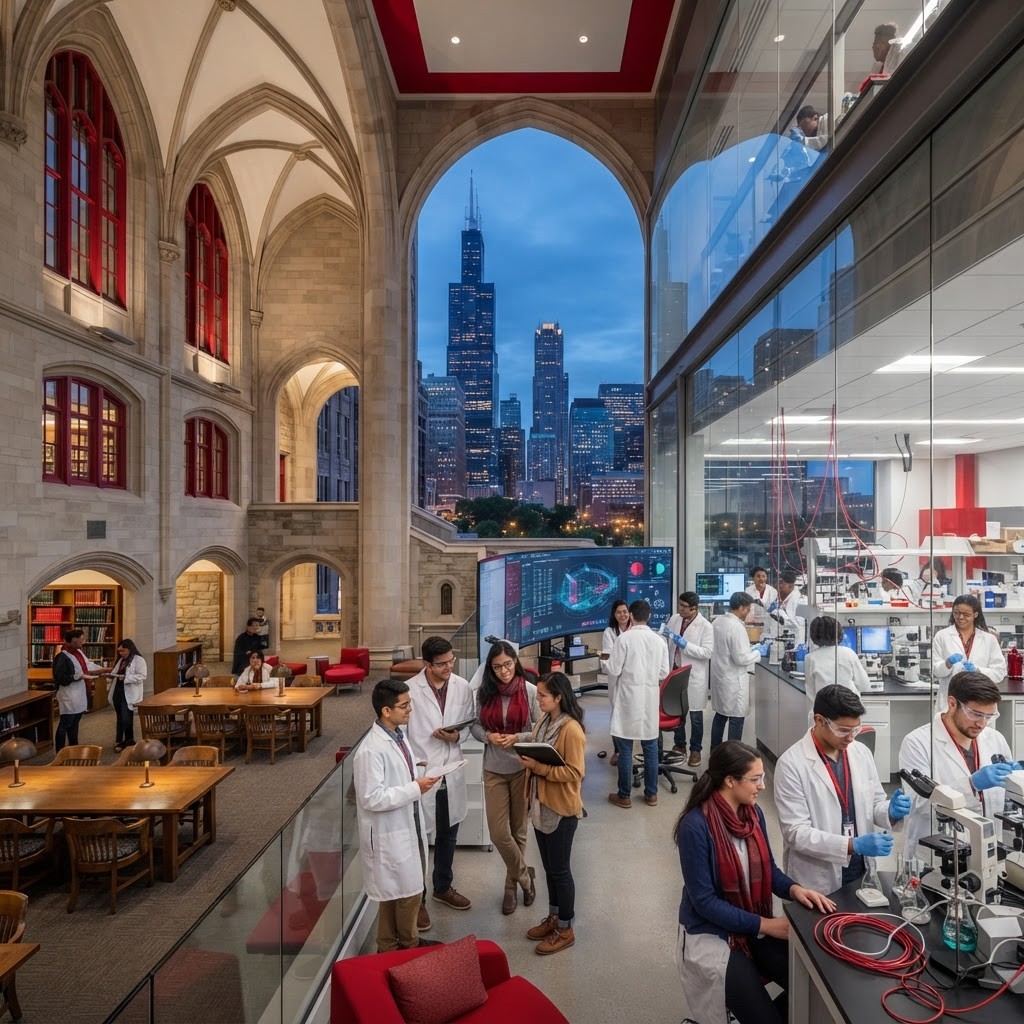
Chicago as a University City
Chicago gives university students access to far more than classrooms. Hospitals, laboratories, corporations, schools, museums, civic organizations, startups, and global nonprofits create an enormous network for research and experiential learning. The region includes elite private research universities, a major public university, faith-based institutions, and schools with specialized technical or professional missions.
No single university is best for everyone. Prospective students should evaluate the strength of their intended program, faculty access, research opportunities, financial aid, campus culture, housing, and career outcomes. The institutions below represent notable choices in Chicago and the immediately connected metropolitan area.
1. University of Chicago
The University of Chicago is renowned for scholarship in economics, law, business, medicine, sciences, humanities, and social thought. Its culture prizes rigorous inquiry and evidence-based debate. Graduate and undergraduate students benefit from major research institutes and the intellectual resources of Hyde Park, though the demanding environment calls for strong self-direction.
2. Northwestern University
Northwestern University combines broad research capacity with strengths in engineering, medicine, journalism, communication, law, and management. Its principal campus in Evanston offers a lakeside collegiate setting, while downtown facilities connect professional programs to Chicago. Interdisciplinary study is a major differentiator.
3. University of Illinois Chicago
University of Illinois Chicago is Chicago's largest public research university and an essential contributor to the city's healthcare and professional workforce. Its colleges span medicine, dentistry, pharmacy, engineering, business, architecture, education, and liberal arts. Diversity and urban engagement are central strengths, along with public-sector value.
4. Loyola University Chicago
Loyola University Chicago follows a Jesuit educational tradition that joins academic development with ethics and service. It offers significant programs in healthcare, business, law, social work, environmental sustainability, and the liberal arts. Multiple Chicago-area campuses support both residential undergraduate life and professional study.
5. DePaul University
DePaul University is a large private institution with especially strong ties to Chicago employers. Programs in business, computing, communication, education, law, and the arts emphasize practical application. Its Lincoln Park and Loop campuses offer different settings within one university, giving students direct access to neighborhood and downtown life.
6. Illinois Institute of Technology
Illinois Institute of Technology is a technology-centered research university in Bronzeville. Engineering, computer science, architecture, design, and applied sciences are core strengths. The institution's industry partnerships and project focus appeal to students who want to solve technical problems in an urban setting.
7. Rush University
Rush University is a health sciences institution integrated with a major academic medical center. It prepares professionals in medicine, nursing, biomedical research, and allied health fields. Students seeking clinical immersion and interprofessional learning may value its concentrated mission and proximity to Chicago's medical district.
8. Rosalind Franklin University of Medicine and Science
Located in North Chicago, Rosalind Franklin University specializes in medicine, pharmacy, podiatry, psychology, biomedical sciences, and health professions. Its interprofessional model encourages students from different disciplines to learn together. The specialized graduate environment is particularly relevant to students committed to healthcare careers.
9. National Louis University
National Louis University has longstanding expertise in education and also offers programs in business, psychology, health, and applied social sciences. Flexible formats and career-focused pathways serve working adults as well as traditional students. Its practical orientation is a differentiator in a market filled with research-intensive institutions.
10. Northeastern Illinois University
Northeastern Illinois University is a public institution serving a highly diverse student population. It offers accessible programs across education, business, sciences, and liberal arts. Smaller classes and a community-oriented mission can appeal to students who want public-university affordability with a more personal academic environment.
Making a Well-Informed Decision
Start by investigating the intended department, not only the university's overall reputation. Compare required courses, faculty research, accreditation, assistantships, internship pipelines, and recent graduate outcomes. For graduate programs, advisor compatibility and funding can be decisive. Undergraduates should also assess advising, retention, campus organizations, and flexibility to change majors.
Chicago's universities differ in atmosphere, from residential lakefront campuses to downtown buildings integrated into the business district. A visit can reveal whether a student wants a defined campus or an independent city experience. When academic fit, affordability, and personal wellbeing align, Chicago can provide an education enriched by one of the world's great urban laboratories.
Research and Career Connections
Applicants interested in research should look beyond broad expenditure figures and ask whether students at their level can actually join laboratories, archives, field projects, or faculty teams. Career-minded learners can compare internship funding, cooperative education, employer events, and alumni participation within their intended field. Chicago's scale creates opportunity, but access is strongest where a university has dedicated staff and longstanding partnerships. Reviewing detailed sample student pathways often reveals more than promotional language and helps candidates understand how classroom learning becomes meaningful professional experience.
