
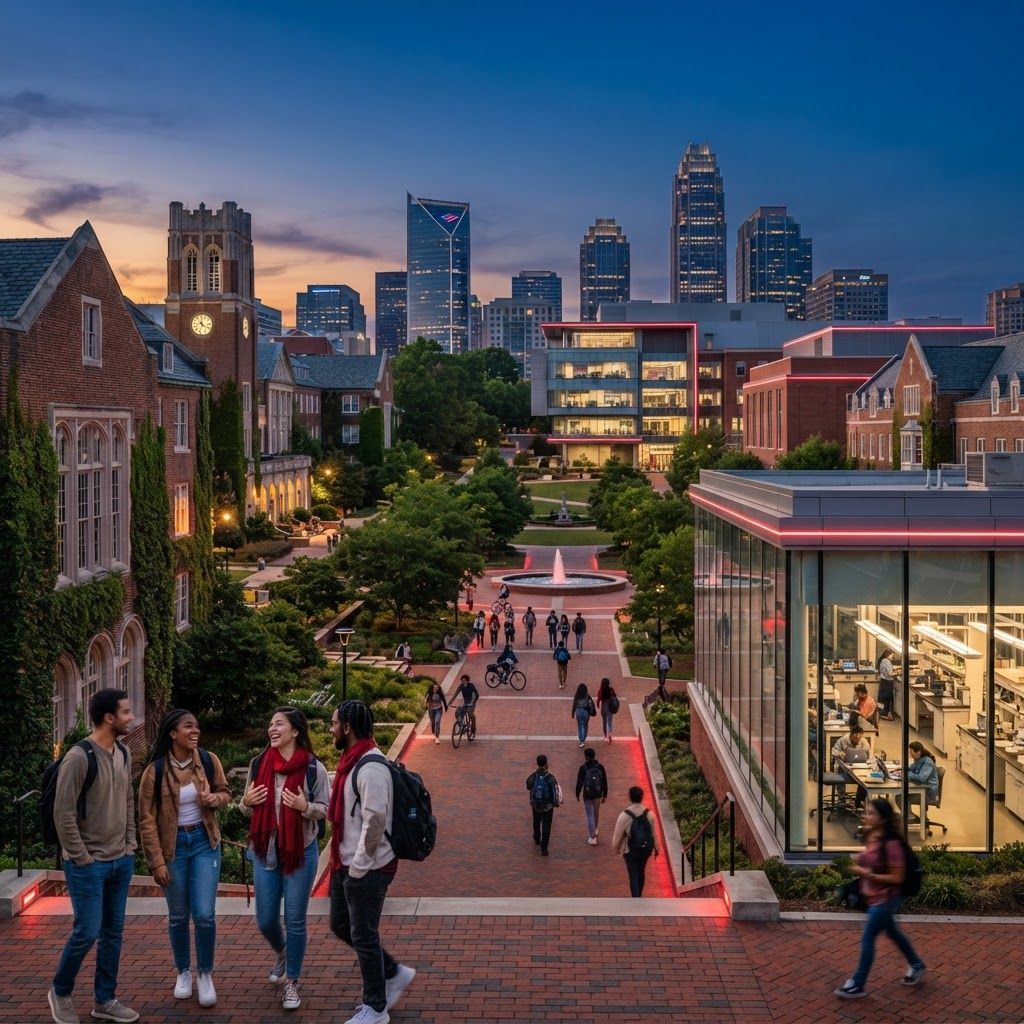
A Growing University Landscape
As one of the nation's fastest-growing cities, Charlotte has cultivated a strong university presence that fuels innovation, research, and workforce development. The region's universities range from large public research institutions to specialized private and professional schools, offering undergraduate, graduate, and doctoral programs across countless disciplines. These universities not only educate tens of thousands of students but also drive economic growth by supplying talent to Charlotte's finance, healthcare, energy, and technology sectors.
The best universities in and around Charlotte are defined by academic rigor, research impact, and deep engagement with the surrounding community.
Leading Research and Public Universities
The University of North Carolina at Charlotte stands as the region's flagship public research university, enrolling a large and diverse student body and offering a broad spectrum of programs, from engineering and computing to business and the arts. Its expanding research portfolio and downtown campus reinforce its role as an economic engine. Nearby institutions such as Winthrop University in Rock Hill and the University of North Carolina system partners extend additional public options within easy reach of the metro area.
Private and Specialized Universities
Charlotte's private universities add depth and variety to the higher education scene. Queens University of Charlotte offers respected graduate programs in business, communication, and nursing alongside its undergraduate strengths. Johnson and Wales University provides distinctive professional education, while Wingate University, Pfeiffer University, Gardner-Webb University, Montreat College, Belmont Abbey College, and Charlotte School of Law legacy programs contribute specialized offerings in health sciences, education, and professional studies. Together they create a rich mosaic of academic opportunity.
Research, Innovation, and Economic Impact
Universities in Charlotte are increasingly recognized for research that addresses real-world challenges in areas such as data science, energy, urban development, and public health. Partnerships with local corporations and startups provide students with internships, applied projects, and employment pipelines. Research centers and innovation hubs help translate academic discoveries into economic value, strengthening Charlotte's reputation as a center of ideas and enterprise.
Trends Shaping University Education
Charlotte universities are responding to shifting demands with flexible degree formats, online graduate programs, and interdisciplinary studies that blend fields like technology and business. Emphasis on experiential learning, undergraduate research, and industry certifications prepares graduates for competitive careers. Universities are also investing in student wellness, diversity initiatives, and support services to ensure success for an increasingly varied student population.
Choosing the Right University
Selecting a university involves evaluating academic reputation, program offerings, research opportunities, campus resources, and career outcomes. Prospective students benefit from visiting campuses, connecting with faculty, and researching graduate employment and further-study rates. Considering location, cost, financial aid, and available support services helps ensure a strong fit. Aligning institutional strengths with personal aspirations is key to a rewarding academic journey.
Conclusion
Charlotte's universities form a powerful foundation for education, research, and economic advancement in the region. With options spanning major public research institutions and distinctive private universities, students can pursue ambitious goals in a city brimming with opportunity. By choosing an institution that matches their aspirations, learners gain the knowledge, skills, and connections to thrive in a rapidly evolving world.
