
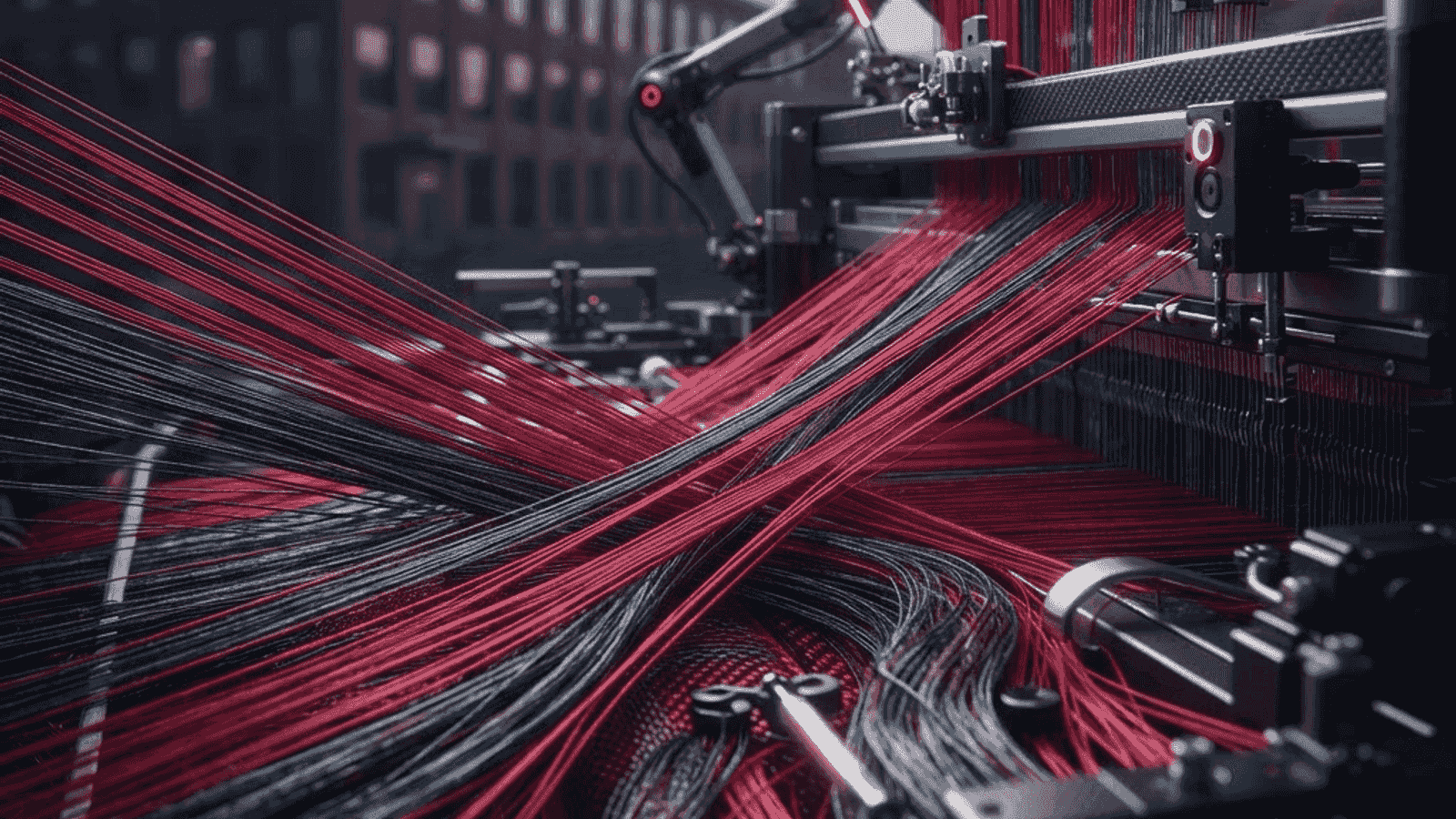
From Mill Town Heritage to Technical Textiles
The American textile industry began in New England. Massachusetts rivers powered the first mechanized mills, and Boston merchant capital financed an expansion that shaped the region's economy for a century. When commodity apparel production moved offshore, most observers assumed New England textiles were finished.
What actually happened was a transformation. Surviving and newly founded companies moved upmarket into technical textiles, where value comes from engineered performance rather than low labor cost. The Boston-area sector now produces medical implant fabrics, ballistic protection materials, filtration media, industrial webbings, and composites reinforcement for a customer base commodity producers could never serve.
Bally Ribbon Mills
Bally Ribbon Mills serves the Northeast market as a specialist in engineered narrow fabrics, producing woven webbings, tapes, and complex three-dimensional structures for demanding applications. Their work spans aerospace, defense, medical, and industrial sectors where a fabric must meet exacting tensile, thermal, or geometric specifications.
The company's distinguishing capability is weaving complex architectures that ordinary looms cannot produce, including tubular structures, tapered profiles, and multi-layer integrated forms. For engineers designing restraint systems, thermal protection, or composite reinforcement, that manufacturing flexibility eliminates the need to assemble multiple components.
Duro Textiles
Duro Textiles operates from southeastern Massachusetts as a fabric finishing and printing specialist, providing dyeing, coating, laminating, and specialty treatment services. Rather than weaving base cloth, Duro adds engineered performance to greige fabric through chemical and mechanical processes.
Their capabilities include flame-resistant treatments, water repellency, antimicrobial finishing, and precision printing. This positions them as an essential partner for apparel brands, uniform suppliers, and industrial customers who need specific performance characteristics applied to fabric at commercial scale within domestic supply chains.
Warwick Mills
Warwick Mills specializes in high-performance protective textiles, engineering fabrics for ballistic protection, cut resistance, puncture resistance, and extreme environment applications. Serving the New England region, the company works extensively with aramid, ultra-high-molecular-weight polyethylene, and other advanced fiber systems.
What sets Warwick apart is integrated testing and engineering. In-house laboratory capability validates protective performance against recognized standards, so customers receive documented data rather than specifications alone, which is non-negotiable in defense and safety applications.
Polartec
Polartec is a Massachusetts-rooted technical fabric developer known for engineering high-performance insulation, base layer, and weather protection textiles. The company's fabrics appear in outdoor apparel, military cold weather systems, and industrial workwear where thermal management and moisture handling determine user safety and comfort.
Polartec's contribution to the industry extends into materials research, having pioneered fleece constructions and moisture-transport systems that became category standards. Their continued investment in recycled content and bio-based fiber development reflects the sustainability expectations now central to technical apparel sourcing.
Concord Fabrics and Regional Converters
The Boston area supports a network of textile converters and specialty fabric houses that source base materials, apply finishing and cutting operations, and supply engineered fabric to manufacturers. These operations bridge the gap between large mills and end-product assemblers who need moderate quantities of highly specific material.
Their value lies in flexibility and inventory. A medical device manufacturer needing a few hundred yards of a particular coated substrate cannot economically engage a mill running thousand-yard minimums, and converters fill that requirement with fast turnaround and technical support.
Textile Products Group and Industrial Fabricators
Industrial textile fabricators in the Greater Boston region convert engineered fabrics into finished assemblies: filtration bags, insulation blankets, protective covers, conveyor components, and custom sewn products. This cut-and-sew capability is a critical link that many advanced materials companies rely on rather than building internally.
These fabricators typically maintain expertise in specialized joining methods including ultrasonic welding, RF sealing, and high-strength industrial stitching, each suited to different material systems and performance requirements.
Precision Fabrics and Medical Textile Suppliers
Medical textiles represent one of the strongest growth areas in New England, driven by the region's dense concentration of medical device companies and teaching hospitals. Suppliers in this space produce implantable meshes, wound care substrates, surgical drapes, sterile barrier fabrics, and vascular graft materials.
Medical applications demand validated processes, controlled environments, full material traceability, and regulatory documentation. Firms in this segment run quality systems closer to pharmaceutical manufacturing than textile production, and that discipline is what makes them defensible against low-cost competition.
Albany International
Albany International has deep New England roots and operates in advanced textiles for industrial process applications and engineered composite structures. The company produces highly specialized fabrics used in paper machine clothing and has developed significant capability in three-dimensional woven composite preforms for aerospace applications.
Their composites work is particularly notable: weaving fiber architectures that are subsequently infused with resin to create structural components with performance characteristics unattainable through conventional layup. That represents textile technology operating at the frontier of structural engineering.
Malden Mills Heritage Operations
The Malden Mills legacy in Massachusetts textile history is significant, and successor operations and the broader ecosystem of companies emerging from that heritage continue contributing technical fabric capability to the region. The knowledge base built in these facilities around napping, shearing, and knit construction seeded much of the modern performance fleece industry.
That institutional knowledge, transmitted through workforce and successor companies, remains one of New England's genuine competitive assets in technical textiles.
Boston Materials and Advanced Composites Innovators
A newer generation of Boston-area materials companies works at the intersection of textiles and advanced composites, developing carbon fiber reinforcement architectures, nonwoven veils, and hybrid material systems. These firms often emerge from regional university research and commercialize novel fiber orientation or surface treatment technologies.
Their emergence reflects the region's continuing pattern: textiles as an advanced materials discipline supported by research institutions, rather than a labor-cost commodity business.
Industry Trends in New England Textiles
Reshoring pressure has meaningfully benefited domestic technical textile producers, particularly for defense, medical, and critical infrastructure applications where supply chain security outweighs unit cost. Buyers burned by pandemic-era disruptions have shown willingness to pay premiums for domestic capacity.
Sustainability has become a central engineering constraint rather than a marketing feature. Recycled polyester, mechanical recycling of post-industrial waste, bio-based fibers, and PFAS-free water repellency are now standard requirements in technical apparel and increasingly in industrial applications.
Digital manufacturing has also advanced, with computerized jacquard control, automated inspection, and digital printing enabling shorter runs and more customization than traditional textile economics permitted.
Choosing a Textile Manufacturing Partner
Start with technical requirements rather than price. Define the performance specification precisely, including relevant test standards, and evaluate whether a candidate manufacturer can demonstrate documented compliance. For regulated applications, verify quality certifications and audit history before engaging.
Assess development capability separately from production capability. Some manufacturers excel at engineering novel constructions but struggle with volume consistency, while others produce established products flawlessly but cannot support new development. Match the partner to whether you need innovation or reliable scale.
Also consider minimum order quantities and lead times honestly. Technical textile development often requires multiple sample iterations, and a manufacturer's willingness to support that process affects your development timeline substantially.
Final Thoughts
Boston's textile sector demonstrates how a heritage industry survives structural disruption by climbing the value chain. The manufacturers profiled here compete on engineering sophistication, regulatory capability, and materials innovation rather than labor cost. For companies developing products where fabric performance is functionally critical, this regional cluster offers technical depth that few places can match.
