
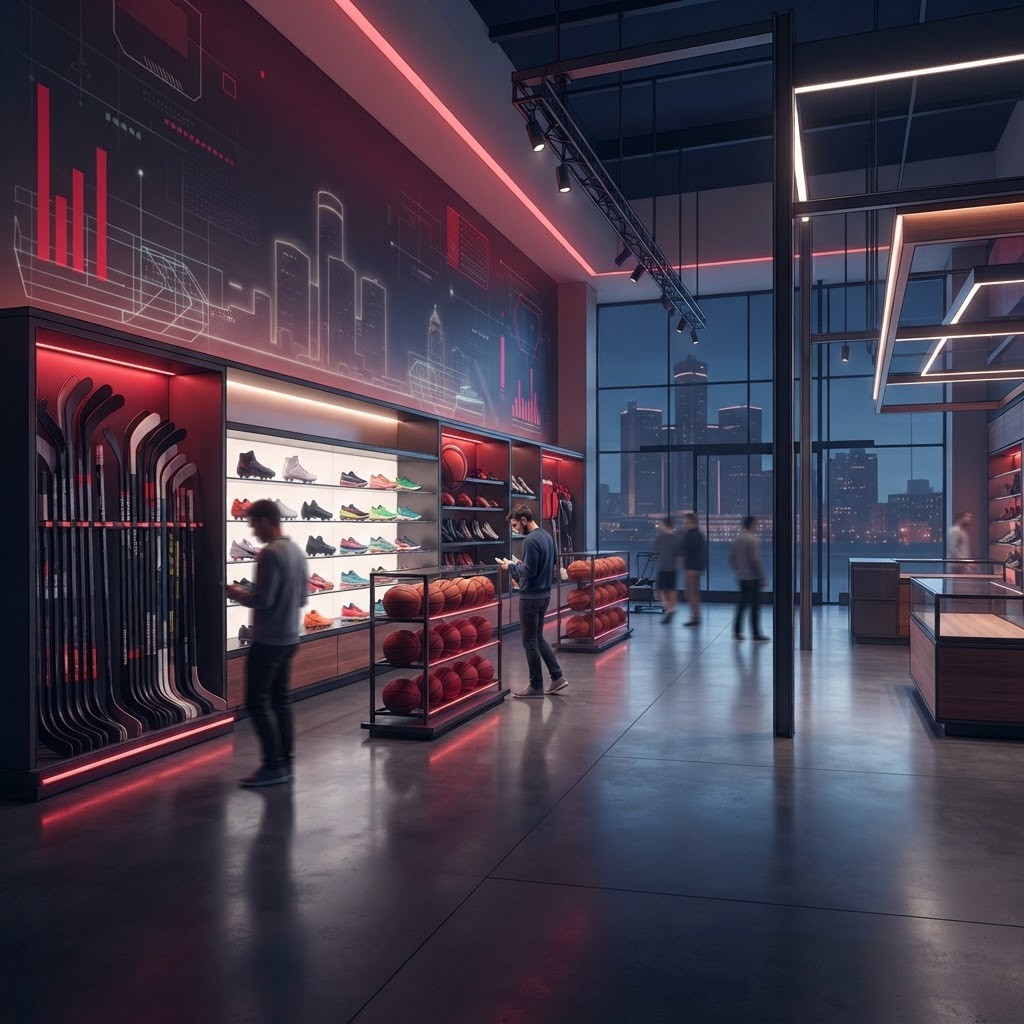
A Retail Market Shaped by Michigan Sports Culture
Detroit's sporting goods retail landscape reflects the region's athletic priorities. Hockey holds unusual depth here, supported by hundreds of youth and adult programs across the metro area, and that demand sustains specialty pro shops with skilled skate technicians. Football and basketball participation remains strong through school and community programs, while running culture has grown steadily around the region's marathon and an expanding calendar of local races. Add golf, baseball, and a robust outdoor and fishing market, and the result is a retail scene with genuine specialization rather than uniform big-box inventory.
What differentiates strong local retailers is service. Equipment fit affects performance and injury risk, and the stores that thrive are those where staff can assess a skate boot, measure a bat drop appropriately for a young hitter, or identify overpronation in a runner's stride.
The Top 10 Sports Equipment Stores in Detroit
1. Motor City Hockey Supply is a destination pro shop known for heat-molded skate fitting, professional blade sharpening, and deep stick inventory across flex and curve options for players at every level.
2. Great Lakes Team Sports focuses on team outfitting, handling uniforms, custom decoration, and bulk equipment orders for schools, leagues, and travel programs with managed delivery timelines.
3. Detroit Running Company built its reputation on gait analysis and staff who log serious mileage themselves. The shop stocks a wide range of stability and neutral shoes and supports local training groups.
4. Riverfront Sporting Goods operates as a broad general retailer covering baseball, basketball, soccer, and football, valued for accessible pricing and a strong youth equipment selection.
5. Northline Golf & Racquet combines club fitting with launch-monitor analysis and racquet stringing services, serving golfers and tennis players from a single technical service bench.
6. Belle Isle Outdoor Outfitters caters to fishing, kayaking, camping, and cycling, an important niche given the region's waterfront access and expanding trail network.
7. Corktown Cycle & Fitness stocks road, gravel, and commuter bicycles alongside in-house repair, wheel building, and professional bike fitting for endurance athletes.
8. Rust Belt Strength Equipment supplies barbells, plates, racks, and conditioning gear to home gyms and small training facilities, filling a gap left by general retailers.
9. Anchor Bay Baseball Depot specializes in bats, gloves, and catching gear, offering glove relacing and steaming services that extend equipment life for serious players.
10. Skyline Sports Exchange deals in quality used and consignment gear, an increasingly popular option for growing youth athletes and families managing multi-sport costs.
Where Expert Fitting Makes the Difference
Three categories reward in-person shopping most clearly. Hockey skates require sizing that differs meaningfully from shoe size, plus heat molding and blade profiling to match a player's stride. Running shoes should be selected based on foot strike, arch behavior, and mileage goals rather than model popularity. Bicycles demand frame sizing and saddle-to-bar fit, which determines comfort far more than component tier.
Youth equipment adds another dimension. Helmets, pads, and mouthguards must fit correctly to function as protective gear, and certification standards change periodically. Retailers who track those standards protect families from buying outdated protection at a discount.
Trends in Sporting Goods Retail
Local retailers have adapted to online competition by leaning into services that require physical presence. Repair benches, stringing services, glove restoration, ski and skate tuning, and fitting appointments now generate meaningful revenue and drive repeat visits. Many shops also run team dealer programs, where recurring institutional orders provide stability independent of walk-in traffic.
Sustainability has emerged as another growth channel. Consignment and trade-in programs help families manage the cost of youth sports, where equipment is outgrown before it wears out. Meanwhile, sport-specific technology sales, including launch monitors, smart trainers, and wearable performance devices, have become a category unto themselves.
How to Choose a Store
Judge retailers on the depth of questions their staff ask. A knowledgeable associate will ask about playing level, position, frequency, injury history, and goals before recommending products. Ask about return policies on fitted items, warranty handling, and whether services like sharpening or stringing are performed in-house or shipped out. In-house service means faster turnaround during a season.
For teams and organizations, evaluate lead times and decoration capabilities before ordering. Uniform delays are among the most common complaints in youth sports, and dealers with local production partners typically outperform those relying entirely on distant suppliers.
Final Thoughts
Detroit's sporting goods retailers compete on knowledge, not just inventory. The stores on this list have earned loyalty by fitting equipment properly, servicing gear locally, and supporting the leagues that make the region a genuine sports community. Visit during a weekday when staff have time to fit you correctly, and treat the relationship as part of the equipment investment.
