
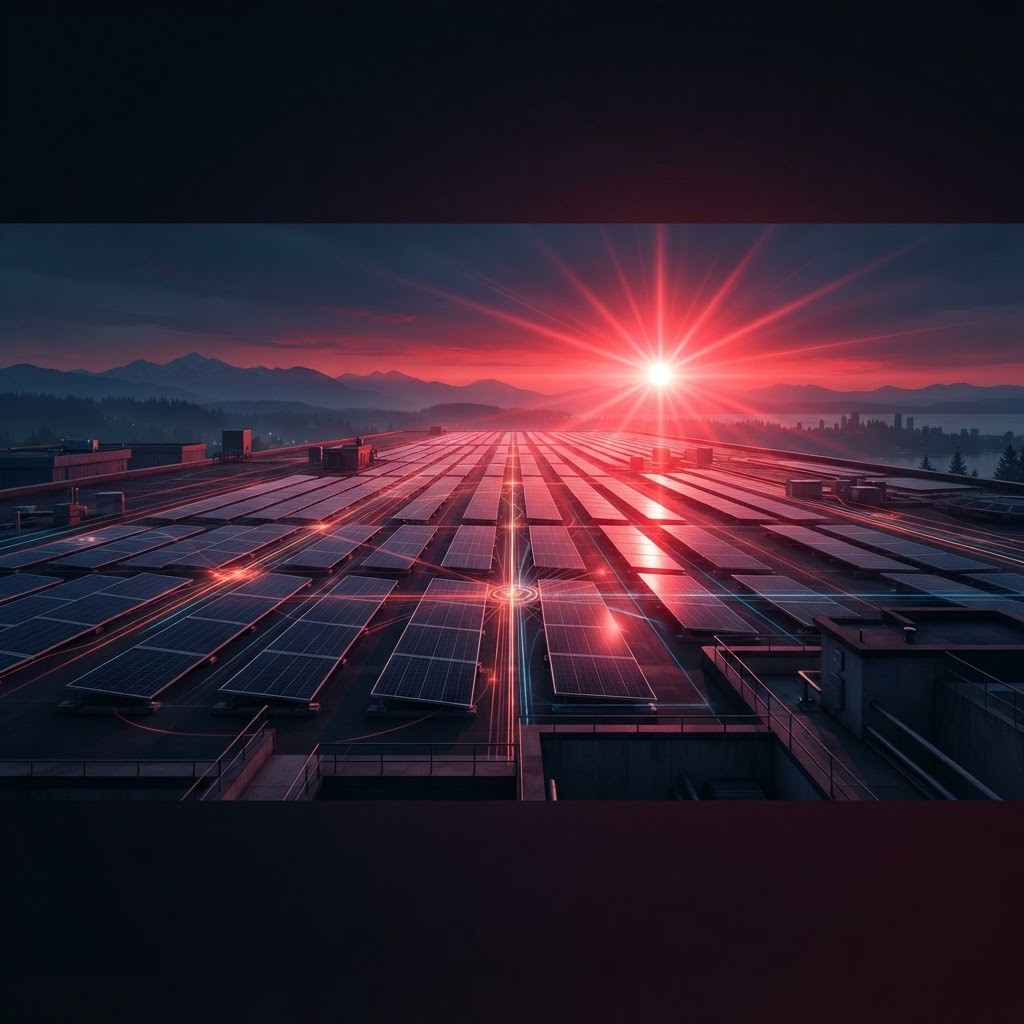
Does Solar Really Work in Washington?
It is the first question every installer in the state hears, and the answer is more favorable than the region's reputation for grey skies suggests. Solar panels convert light, not heat, and they actually operate more efficiently at cooler temperatures. Western Washington receives roughly comparable annual solar resource to Germany, which built one of the largest solar fleets in the world. East of the Cascades, in Spokane, the Tri-Cities, and Yakima, the resource is genuinely strong — comparable to parts of the American Southeast.
The seasonal profile is the real distinguishing factor. Washington solar production is heavily concentrated between April and September, with long summer days at northern latitudes delivering excellent output, and short overcast winter days delivering very little. Net metering is what makes the arithmetic work: excess summer generation earns credits that offset winter consumption, so systems are sized against annual usage rather than any single month.
Incentives and Policy Context
Several mechanisms improve solar economics in Washington. The state exempts qualifying solar equipment and installation labor from sales tax for systems under a specified capacity threshold, which removes a meaningful cost at purchase. The federal residential and commercial investment tax credits reduce net installed cost substantially. Net metering rules require utilities to credit exported generation, and many utilities offer additional community solar or incentive programs. Because these provisions change over time and vary by utility, confirming current terms with both your installer and your utility before signing is essential.
1. Sunergy Northwest
Sunergy Northwest is among the most established residential installers in the Puget Sound region, handling design, permitting, installation, and utility interconnection in-house rather than subcontracting. The company is frequently noted for thorough shading analysis and for producing conservative production estimates, which reduces the gap between projected and actual savings that frustrates many solar owners.
2. Artisan Electric
A Seattle-based electrical contractor with a dedicated solar division, Artisan Electric brings full electrical expertise to projects involving older housing stock, panel upgrades, and complex roof geometry. That matters in Seattle neighborhoods where century-old homes often need service upgrades before a solar array can be interconnected safely.
3. Cascadia Solar Works
Cascadia Solar Works serves both residential and small commercial customers across Snohomish and Skagit counties, with particular strength in battery-integrated systems. Rising interest in outage resilience after winter windstorms has made storage a common addition rather than a luxury, and the company specializes in properly sizing backup loads rather than overselling capacity.
4. Inland Empire Solar
Based in Spokane, Inland Empire Solar covers Eastern Washington, where higher solar irradiance and larger lot sizes support both roof-mounted and ground-mounted arrays. The company works extensively with agricultural clients on irrigation pumping and farm operation loads, where daytime consumption aligns naturally with solar production and delivers strong economics without storage.
5. Puget Sound Solar
One of the longest-operating solar contractors in the state, Puget Sound Solar has completed thousands of installations across residential, commercial, and nonprofit sectors. Its longevity is itself a differentiator in an industry with high company turnover — a twenty-five-year performance warranty is only as good as the company standing behind it.
6. Rainshadow Renewables
Serving the Olympic Peninsula and Kitsap County, Rainshadow Renewables focuses on off-grid and grid-tied hybrid systems for rural properties where utility service is expensive or unreliable. The company handles the design complexity that comes with generator integration, large battery banks, and long service runs on wooded parcels.
7. Columbia Basin Photovoltaic
Columbia Basin Photovoltaic develops mid-scale commercial and agricultural solar projects in Central Washington, including carport canopies, warehouse rooftops, and ground arrays on marginal farmland. Its work reflects a growing category between residential rooftops and utility-scale farms, often financed through third-party ownership structures that require no upfront capital from the host.
8. Evergreen Solar Collective
Evergreen Solar Collective concentrates on community solar, enabling renters, condominium residents, and owners of shaded properties to subscribe to shared arrays and receive bill credits. This model addresses the roughly half of households that cannot install on-site solar, and it has become an important equity mechanism in Washington's clean energy programs.
9. Northwest Mechanical & Solar
This firm pairs solar installation with heat pump and HVAC work, an increasingly logical combination. Electrifying space and water heating raises household electricity consumption, which changes optimal array sizing, and coordinating both projects avoids the common mistake of installing a system that is undersized within two years.
10. Tri-Cities Solar Solutions
Serving Richland, Kennewick, and Pasco, Tri-Cities Solar Solutions operates in one of the sunniest parts of the state. Its portfolio spans residential rooftops, small commercial buildings, and municipal facilities, and the company is known for straightforward cash-purchase pricing rather than complex lease arrangements.
How to Evaluate Solar Proposals
Compare quotes on a cost-per-watt basis after incentives, not on total price, since system sizes differ. Scrutinize production estimates: reputable installers model shading with site-specific tools and disclose assumptions about degradation and inverter efficiency. Confirm equipment specifics — module manufacturer, inverter type, and racking — along with each warranty term, distinguishing product warranties from workmanship and production guarantees.
Verify licensing, bonding, and insurance, and ask how many installations the company completed in your specific utility territory, because interconnection processes vary. Understand who handles permitting and inspection. If storage is proposed, ask which circuits will actually be backed up and for how long, as expectations here are frequently mismatched with reality. Finally, be cautious with financing: long-term leases and power purchase agreements can complicate a future home sale, and dealer fees embedded in zero-down loans are often substantial.
Emerging Trends
Battery attachment rates are climbing sharply as resilience concerns grow. Bifacial modules and higher-efficiency panels are improving output on the constrained roof areas typical of Pacific Northwest housing. Electric vehicle charging integration is now a standard part of design conversations, with load management devices allowing solar, charging, and heat pumps to coexist without expensive service upgrades. Agrivoltaics — combining solar generation with continued agricultural use — is drawing serious interest in Central Washington as a way to reduce siting conflict.
Final Thoughts
Solar in Washington is a long-horizon investment that rewards careful sizing, honest production modeling, and an installer likely to remain in business through the warranty period. The companies profiled above cover the full geography and range of the market, from urban retrofits in Seattle to irrigation-scale arrays in the Columbia Basin. With realistic expectations and multiple detailed quotes, most Washington property owners with reasonable roof exposure can make solar work economically.
