
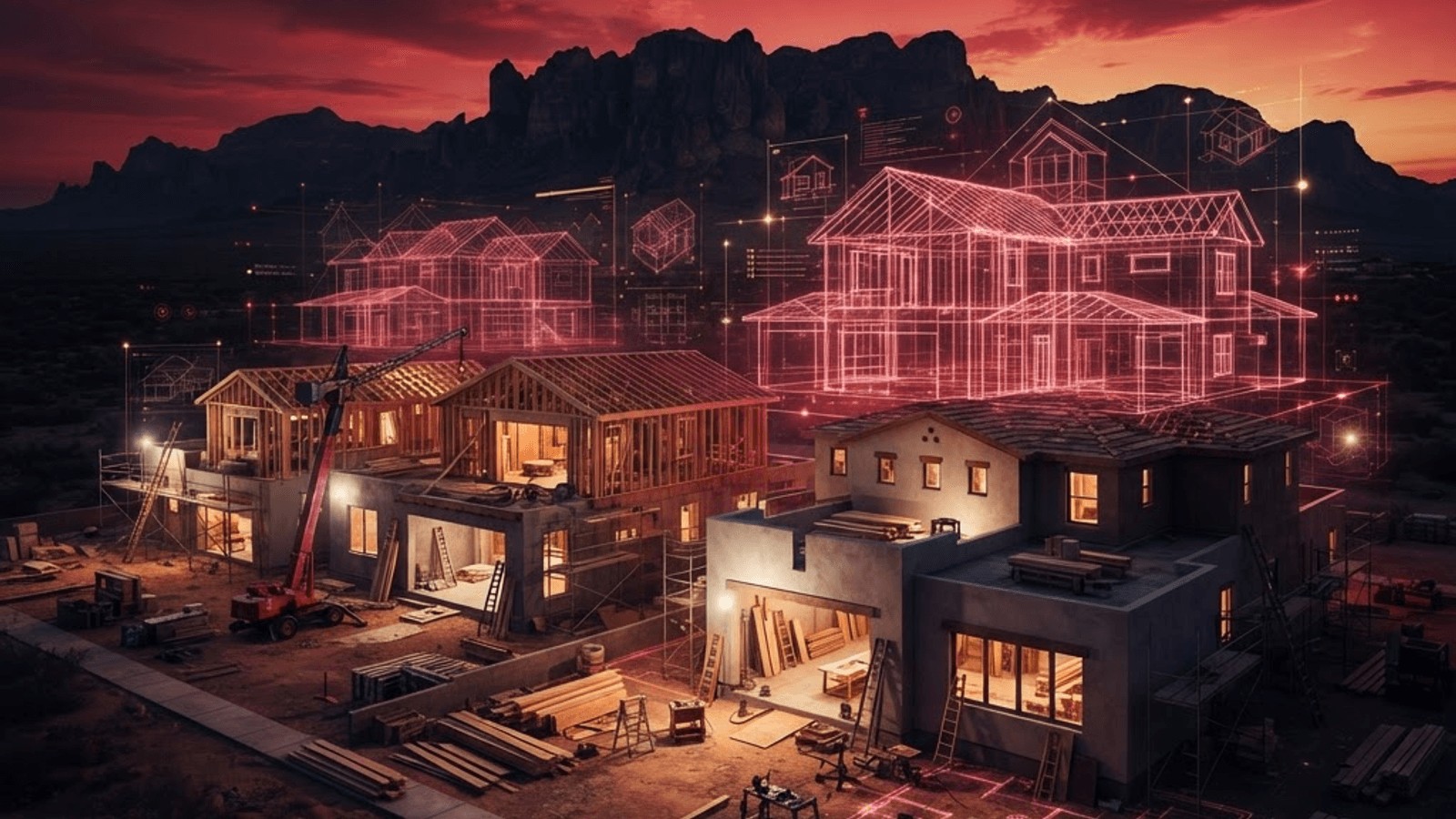
Building a Home in a Desert City
El Paso residential construction is defined by sun, soil, and water. Summer design temperatures push cooling systems hard, winter nights can drop below freezing, humidity is low most of the year, and rainfall arrives in short intense bursts. Those conditions reward homes with tight air sealing, generous attic insulation, high-reflectance roofing, shaded west-facing glass, and mechanical systems sized correctly rather than oversized. They punish homes built to generic national templates without local adaptation.
The region's growth pattern also matters. Development continues eastward toward Horizon City and northeast toward the Franklin foothills, while infill and custom projects reshape the Upper Valley and older central neighborhoods. Each area has distinct lot conditions, utility access, and subdivision requirements, so builder familiarity with a specific area is a real advantage.
Foundations and Site Work
Soil is the first technical decision. Caliche layers can make excavation slow and expensive, while expansive clays require engineered slabs, proper moisture control, and careful drainage away from the structure. A geotechnical report is money well spent on custom homes; production builders typically have area-specific engineering already established. Site grading deserves equal attention, since monsoon runoff that collects near a foundation causes far more damage than the total annual rainfall would suggest.
Envelope and Comfort Strategy
The most cost-effective comfort investments in El Paso are structural rather than mechanical. Continuous insulation and rigorous air sealing reduce load before a single ton of air conditioning is specified. Radiant barriers and light-colored roofing lower attic temperatures dramatically. Low-emissivity windows with appropriate solar heat gain coefficients, deep overhangs, and porch shading cut peak load on west and south exposures. Ducts located inside conditioned space rather than a superheated attic can meaningfully improve efficiency. Many builders now pair these measures with solar-ready roof framing and conduit so homeowners can add photovoltaics later without demolition.
Water efficiency has become standard rather than optional. Drought-tolerant landscaping, drip irrigation, permeable hardscape, and efficient fixtures reduce operating cost and align with regional conservation expectations.
Custom, Semi-Custom, and Production Building
Production builders offer defined floor plans, predictable pricing, and shorter schedules, which suits buyers who value certainty. Semi-custom builders allow plan modifications and upgraded finishes within an established system. Full custom builders start from an architect's design and a specific lot, offering maximum control at higher cost and longer timelines. There is no universally better path, only a better match to your budget tolerance and appetite for decision making.
Budgeting Realistically
Ask every builder for a specification sheet, not just a price per square foot, because allowances for cabinetry, flooring, countertops, and fixtures drive enormous cost variation. Confirm what site costs are included: utility connections, driveway length, retaining walls, and fill. Build a contingency of roughly five to ten percent for custom work. Understand the draw schedule if you are using construction financing, and clarify who handles inspections, warranty service, and post-closing punch items.
The Top 10 Residential Construction Companies in El Paso
1. Sun City Custom Homes — A custom builder recognized for desert-appropriate design, high-performance envelopes, and detailed client communication throughout construction.
2. Franklin Foothills Home Builders — Specializes in hillside and view lots where retaining walls, drainage, and engineered foundations demand real expertise.
3. Desert Vista Residential Group — Builds semi-custom homes with strong energy-efficiency packages and a reputation for finishing on schedule.
4. Rio Grande Home Construction — Serves the Upper Valley with custom and infill projects, blending traditional southwestern architecture with modern systems.
5. Eastlake Family Homes — A production-oriented builder on the growing east side offering efficient plans, transparent pricing, and clear warranty service.
6. Borderland Craft Builders — Focused on smaller volumes and higher finish quality, with careful millwork, tile, and plaster detailing.
7. Mission Valley Homes — A Lower Valley builder with deep subcontractor relationships and a practical approach to affordable, durable construction.
8. Northeast Ridge Residential — Known for single-family and small multifamily work with in-house framing crews that improve schedule reliability.
9. Pass City Green Build — Emphasizes energy modeling, solar readiness, water-wise landscaping, and verified performance testing on every home.
10. Horizon Sunrise Construction — Serves Horizon City and far east developments with flexible plan modifications and strong community references.
Questions Worth Asking Before You Sign
How many homes does the builder complete each year, and who will be your daily point of contact? Which trades are in-house versus subcontracted? What third-party testing, such as blower-door or duct-leakage testing, is performed? What is the warranty structure for the first year, and what covers structural elements longer term? How are change orders priced and approved? Builders who answer these clearly tend to run organized projects.
Final Thoughts
The best residential construction companies in El Paso build for the desert deliberately: solid foundations engineered for local soils, envelopes that keep heat out, mechanical systems sized to a reduced load, and landscaping that respects a limited water supply. Choose a builder who explains those decisions rather than glossing over them, and your home will be more comfortable, less expensive to operate, and more durable for decades.
