
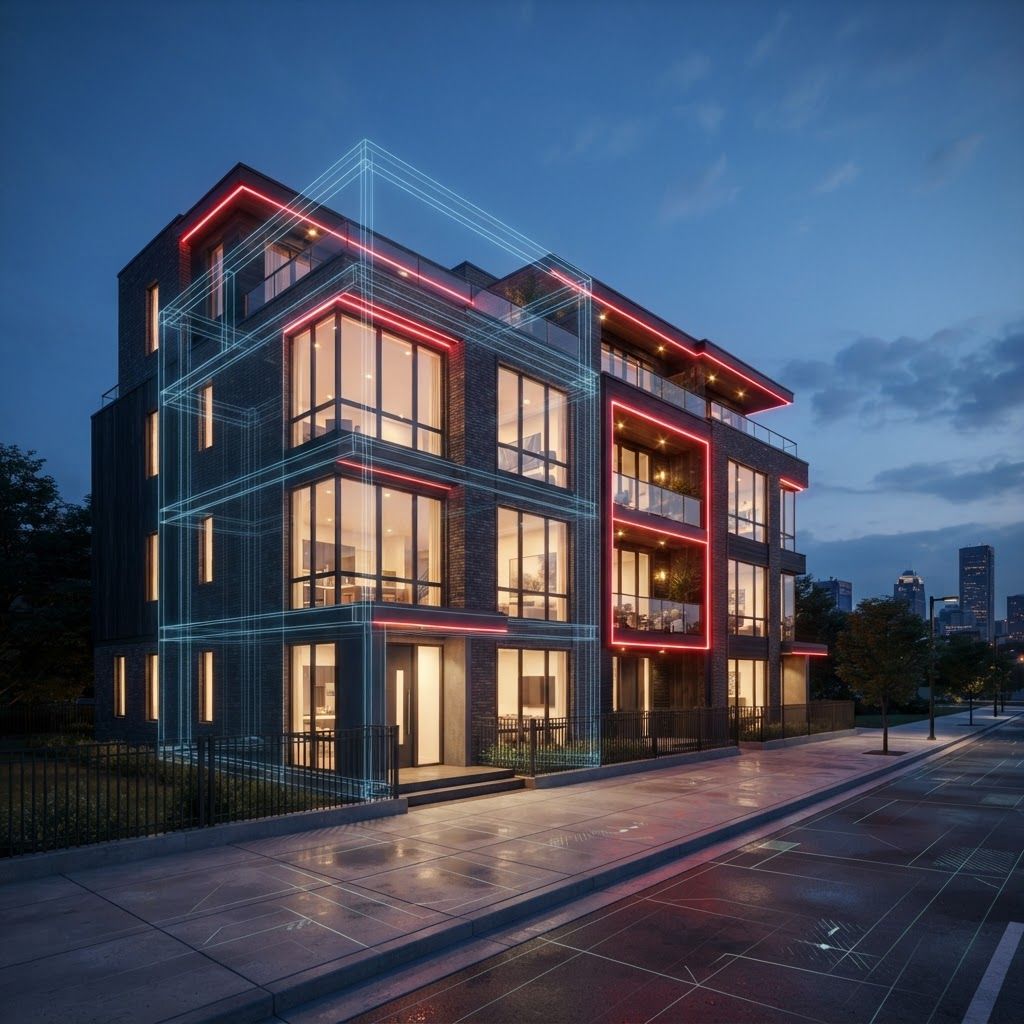
Residential Building in a Historic City
Residential construction in Baltimore is defined by constraint. Within the city itself, land is largely built out, so new housing arrives as infill on narrow vacant lots, as gut renovation of existing rowhouses, or as multifamily development on former industrial parcels. Lots are often twelve to eighteen feet wide with shared party walls, no side yard access and utility connections dating back generations. Builders working in this context need skills that suburban production builders rarely develop: shoring adjacent structures, crane-free material handling, zero-lot-line waterproofing and negotiating access with neighbors.
Move outward into Baltimore County, Howard County and Anne Arundel County and the picture changes to more conventional single-family construction on larger parcels, where builders compete on design flexibility, energy performance and finish quality. Both markets are active, and the best companies tend to specialize in one rather than claiming excellence in both.
Custom, Semi-Custom and Production Building
Custom builders construct one-off homes from architect-designed plans, offering complete control over layout, materials and systems at the highest cost per square foot and the longest timeline. Semi-custom builders start from a library of proven plans and allow meaningful modification, balancing cost predictability with personalization. Production builders construct from a fixed set of plans with defined option packages, achieving the lowest cost and fastest delivery through repetition and purchasing scale.
A fourth category matters greatly in Baltimore: gut renovation and rehabilitation specialists, who effectively build a new house inside an existing masonry shell. This work carries the design freedom of custom building with the unpredictability of renovation, and it requires builders comfortable with structural surprises.
The Ten Best Residential Construction Companies in Baltimore
1. Bozzuto Homes brings substantial Mid-Atlantic experience in residential development and construction, with a portfolio spanning townhomes, condominiums and apartment communities. Its integrated development and property management perspective informs decisions about durability and long-term maintenance that purely transactional builders often overlook.
2. Ryan Homes operates extensively across the Baltimore suburbs as a production builder, delivering standardized plans with defined option levels. Its strengths are price transparency, financing coordination and predictable schedules, making it a practical choice for first-time buyers in the surrounding counties.
3. Williamsburg Homes has a long-standing regional presence building single-family and townhome communities in the Baltimore area, with a reputation for solid construction practices and community planning that reflects local market preferences.
4. Gemcraft Homes serves Maryland with semi-custom single-family construction and on-your-lot programs. Builders offering on-your-lot service are particularly valuable to buyers who already own land in the counties surrounding Baltimore and want a proven plan adapted to their site.
5. Baltimore rowhouse rehabilitation specialists operating throughout neighborhoods such as Canton, Patterson Park, Federal Hill, Hampden and Reservoir Hill perform complete gut renovations. Their expertise includes masonry stabilization, new framing within existing shells, roof deck construction and integrating modern mechanical systems into buildings never designed for them.
6. Custom home builders in Baltimore County and the Green Spring Valley area construct high-end residences with architect collaboration, sophisticated millwork and complex site work. These firms typically maintain long-tenured carpentry crews and manage extended project timelines with detailed scheduling.
7. Infill development builders working on vacant city lots deliver new construction rowhouses that meet modern energy codes while respecting street context. Their technical challenge is significant: excavating and building within a narrow footprint bounded by occupied neighbors on both sides demands careful engineering and constant communication.
8. Modular and panelized home builders serving the Maryland market fabricate substantial portions of a home in a controlled factory environment before site assembly. Advantages include weather-independent quality control, reduced material waste and compressed on-site schedules, which matters in a region with wet springs.
9. Green and high-performance home builders in the Baltimore area focus on airtight envelopes, continuous insulation, heat pump systems, heat recovery ventilation and solar readiness. Homes built to these standards deliver markedly lower operating costs and better comfort through humid Maryland summers, and third-party verification such as blower-door and duct testing backs the claims.
10. Accessory dwelling unit and addition specialists respond to growing demand for multigenerational living and rental income. Adding a rear addition, converting an attic or building a garage apartment involves zoning analysis, structural upgrades and utility capacity review, and specialists who navigate these routinely save owners considerable time.
Trends in Residential Construction
Energy performance is the clearest trend. Successive code cycles have tightened envelope and equipment requirements, and buyer awareness of operating cost has grown. Heat pumps have become the default in new construction, induction cooking is increasingly common, and electrical service is being sized with vehicle charging in mind.
Flexible floor plans are another shift. Dedicated home office space, ground-floor flex rooms and separate entrances for in-law suites now appear routinely in plans that would have omitted them a decade ago. Outdoor living investment has grown as well, with rooftop decks a signature feature of Baltimore rowhouse rehabilitation.
On the delivery side, prefabricated components, labor shortages in skilled trades and material price volatility have pushed builders toward earlier procurement, longer lead-time planning and contracts that address escalation explicitly. Water management has also received more attention as intense rainfall events become more common, resulting in better flashing details, improved site grading and greater use of drainage planes.
How to Choose a Residential Builder
Begin by matching builder type to project ambition. Someone seeking a specific architectural vision will be frustrated by a production builder's option list, while someone prioritizing budget certainty will find custom building stressful. Verify Maryland home builder registration, licensing and insurance, and confirm warranty terms in writing including what is covered in year one versus structural coverage over a longer period.
Tour completed homes and, if possible, homes under construction, where framing quality, air sealing detail and mechanical installation neatness are visible. Speak with homeowners two or three years past closing rather than at move-in, since warranty responsiveness reveals itself over time. Review the specification document line by line, because the difference between builders often lies in window quality, insulation values and mechanical equipment rather than visible finishes.
Final Thoughts
Baltimore offers residential building options across the full spectrum, from efficient production homes in the counties to painstaking rowhouse restorations in historic neighborhoods. The most successful projects come from selecting a builder whose core specialty matches the work, verifying performance through completed homes and past clients, and understanding specifications in detail before signing. In a market where the housing stock ranges from brand new to nearly two centuries old, that alignment is everything.
