
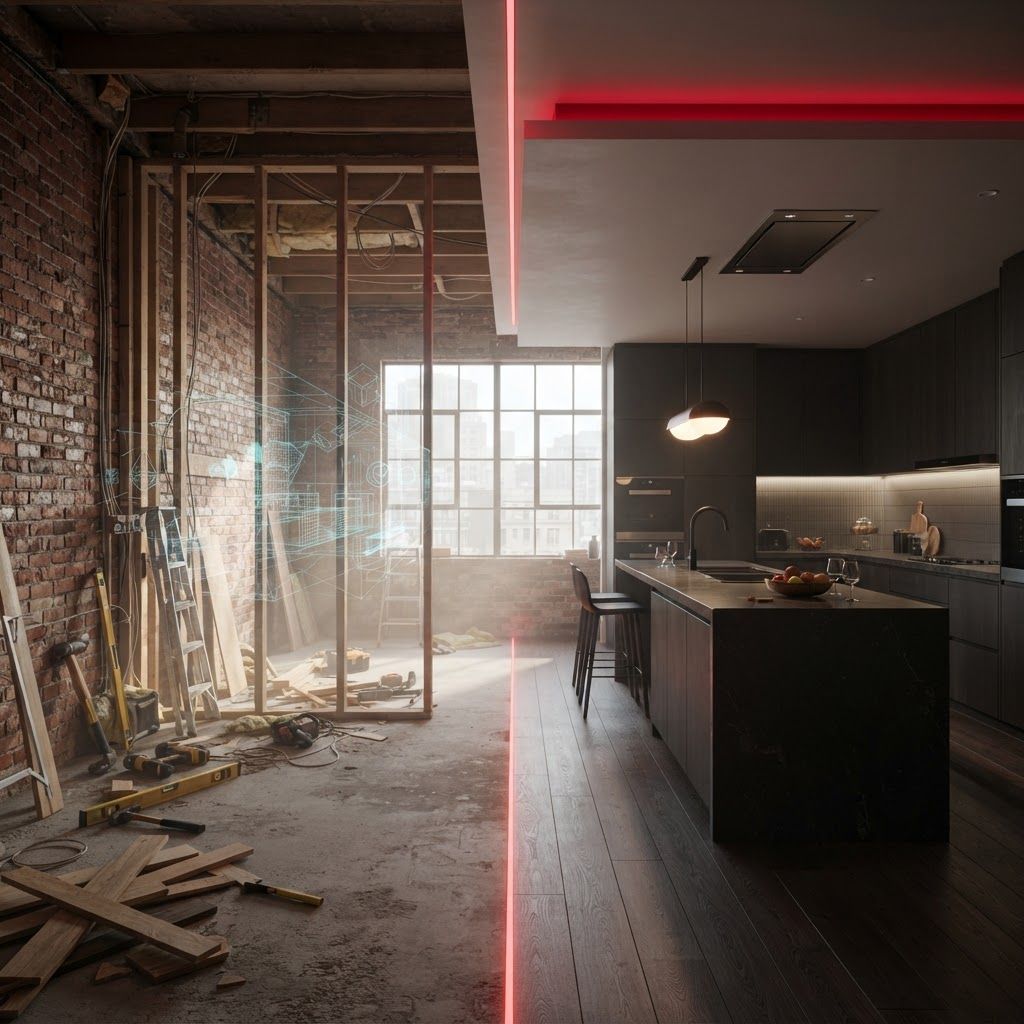
Renovation Is Baltimore's Signature Construction Work
In a city where much of the housing stock predates the automobile, renovation is not a niche within construction; it is the main event. Baltimore's tens of thousands of brick rowhouses, its converted warehouses and its mid-century county homes create sustained demand for contractors who can modernize existing structures rather than build new ones. The work is genuinely harder than new construction. Concealed conditions are the norm, dimensions are rarely square or plumb, and every trade must adapt to what previous generations built.
Common discoveries in Baltimore renovations include knob-and-tube or cloth-insulated wiring, galvanized supply piping restricted by decades of scale, cast iron drain lines nearing the end of their service life, plaster over wood lath, balloon framing without fire blocking, settled or undermined rubble foundations, lead paint and asbestos-containing floor and pipe materials, and party wall moisture intrusion from a neighbor's failing roof. Experienced contractors anticipate these and price accordingly rather than treating each as a crisis.
Categories of Renovation Work
Kitchen and bathroom remodeling remains the most common project type, delivering strong livability improvement and resale value. Whole-house gut renovation strips a building to its structural shell and rebuilds systems, layout and finishes entirely. Additions and expansions add square footage through rear additions, attic conversions or dormer construction. Historic restoration repairs and preserves original materials in accordance with preservation standards. Basement finishing addresses the low ceilings, moisture and egress requirements typical of older Baltimore homes. Accessibility renovation adapts homes for aging in place with zero-step entries, wider doorways and curbless showers.
The Ten Best Renovation Contractors in Baltimore
1. Established rowhouse renovation specialists working across Canton, Fells Point, Federal Hill, Hampden and Bolton Hill are the backbone of the local market. Their expertise includes structural masonry repair, integrating modern mechanical systems into narrow floor plans, rooftop deck construction and coordinating work where no side access exists.
2. Design-build remodeling firms in the Baltimore metro combine in-house design with construction execution, giving homeowners a single contract and a coordinated process. This model reduces the finger-pointing that occurs when a separate designer and builder disagree about intent, and it typically produces more accurate early budgets.
3. Kitchen and bath specialty remodelers in the region focus exclusively on the two highest-value rooms in a house. Their showrooms, established supplier relationships and repetitive experience with cabinetry, plumbing rough-in and tile detailing produce reliable results with fewer surprises.
4. Historic restoration contractors serving Baltimore's designated districts perform brick repointing with lime-based mortars appropriate to soft historic masonry, restore original wood windows rather than replacing them, and repair cornices, marble steps and decorative trim. Using modern portland-heavy mortar on historic brick accelerates deterioration, so this expertise genuinely protects buildings.
5. General remodeling contractors in Baltimore County and surrounding areas handle additions, whole-house updates and finish work on mid-century and later homes. Their projects typically involve fewer structural unknowns than city rowhouses, allowing tighter schedules and more predictable pricing.
6. Basement finishing and waterproofing specialists address a near-universal Baltimore concern. Effective work combines exterior or interior drainage, sump systems, vapor management and, where headroom allows, proper egress windows. Finishing a basement without solving water first is the most expensive mistake a homeowner can make.
7. Aging-in-place and accessibility renovation contractors in the region hold specialized credentials and design modifications ranging from grab bar reinforcement to full first-floor suites. Demand has grown substantially as homeowners choose to remain in familiar neighborhoods rather than relocate.
8. Exterior renovation contractors focused on roofing, siding, masonry and window replacement protect the building envelope that makes everything inside possible. In Baltimore, flat and low-slope rowhouse roofs require particular expertise in membrane systems and proper drainage detailing.
9. Multi-unit and investment property renovation contractors serve landlords and developers converting single-family rowhouses into apartments or rehabilitating rental portfolios. Their strength is efficient repeatable scopes, durable material selection and schedule discipline that minimizes vacancy.
10. Specialty trade contractors operating as prime contractors on focused projects, including electrical service upgrades, whole-house replumbing and HVAC system replacement, handle work that many homeowners tackle independently of a broader remodel. Upgrading an electrical panel and service capacity is often the necessary first step before any other modernization.
Trends in Renovation
Energy retrofits have gained real momentum. Air sealing, attic and wall insulation, heat pump conversion and heat pump water heaters substantially reduce operating costs in older Baltimore homes, and available incentives have improved the economics. Blower-door testing before and after work quantifies the improvement rather than leaving it to guesswork.
Open plan enthusiasm has moderated somewhat, with homeowners now seeking defined spaces for work and quiet alongside connected living areas. Dedicated home office space has become a standard requirement rather than a luxury. Outdoor living investment continues to grow, with rooftop decks and rear patios adding usable space to lots with minimal yard area.
Material and labor cost volatility has changed contracting practice, with more contractors using allowances tied to current pricing and shorter proposal validity periods. Homeowners benefit from selecting finishes early to lock costs and avoid schedule gaps waiting on long-lead items.
Practical Guidance for Homeowners
Permits matter. Structural changes, electrical and plumbing work and additions require permits in Baltimore, and unpermitted work creates problems at resale and with insurance claims. In historic districts, exterior changes may require design review, which affects schedule and should be factored into planning.
Budget a contingency of fifteen to twenty percent on older homes, higher on full gut renovations. Verify Maryland Home Improvement Commission licensing and confirm liability and workers' compensation coverage. Require a detailed written scope with a payment schedule tied to milestones rather than large upfront deposits. Confirm lead-safe certification for work on pre-1978 homes, which is a federal requirement and a genuine health matter in Baltimore's older housing.
Finally, ask how the contractor manages daily site conditions: dust containment, protection of finished areas and communication about access. On an occupied renovation these logistics affect quality of life as much as the finished result affects long-term satisfaction.
Final Thoughts
Renovation is where Baltimore's construction industry demonstrates its greatest skill, because working within old buildings demands adaptability that new construction rarely tests. The city's best contractors combine structural knowledge, respect for historic materials, modern energy performance thinking and honest communication about the unknowns. Choosing a contractor with proven experience in the specific building type, and budgeting realistically for what lies behind the plaster, turns an intimidating project into a lasting improvement.
