
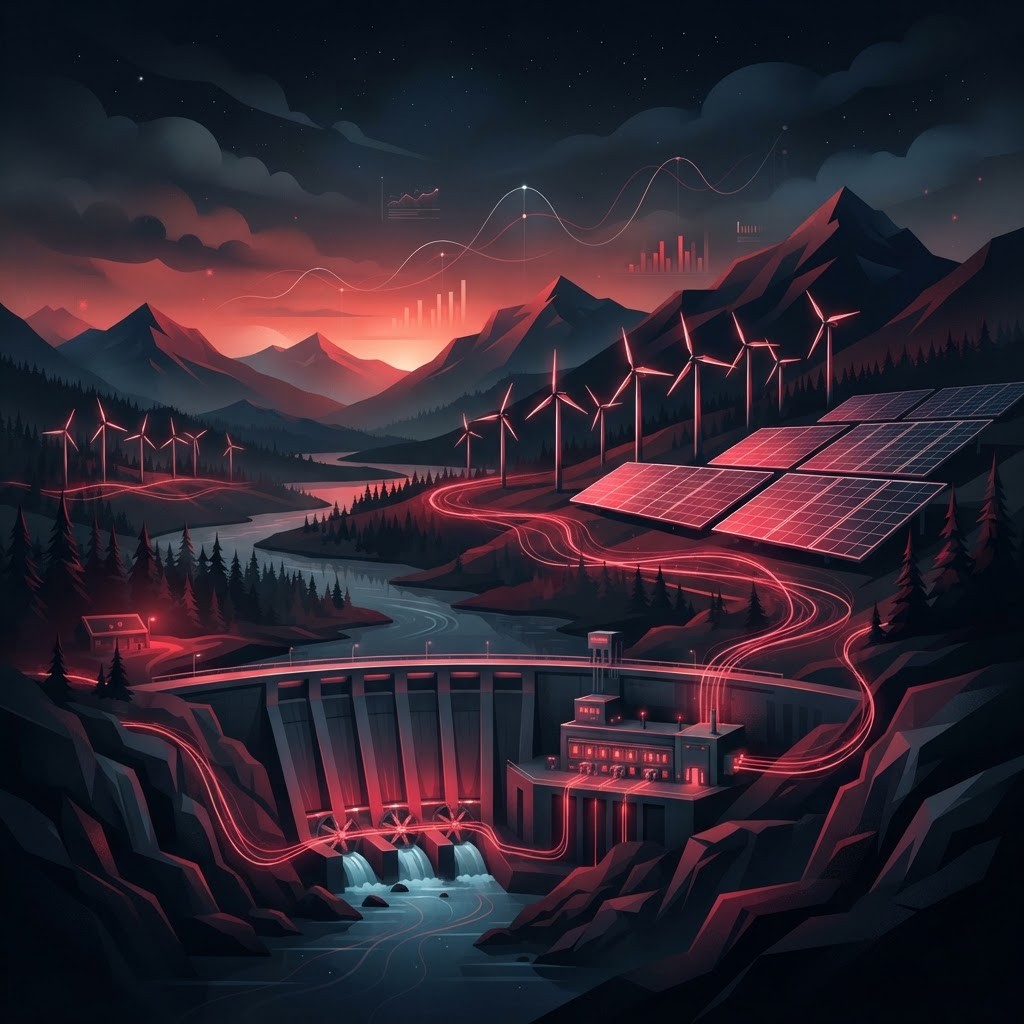
The Cleanest Grid in the Country
Washington occupies a genuinely unusual position in American energy. The Columbia River system, developed across the twentieth century, gave the state an enormous base of low-cost hydroelectric generation that still supplies the majority of its electricity. The practical effect is a grid with among the lowest carbon intensity and lowest retail rates in the United States, which in turn attracted energy-intensive industries — aluminum smelting historically, and data centers today.
That inheritance shapes how renewable development works here. Unlike states building clean energy to displace coal and gas, Washington is building it to serve load growth, to firm an increasingly variable hydro resource, and to comply with a statutory mandate. The Clean Energy Transformation Act requires utilities to eliminate coal-fired generation from retail service and reach a greenhouse gas neutral supply by 2030, with a fully non-emitting and renewable portfolio by 2045. Meeting that standard requires wind, solar, storage, and demand-side resources at meaningful scale.
1. Puget Sound Energy
Serving roughly a million and a half electric and natural gas customers across Western Washington, Puget Sound Energy is the state's largest investor-owned utility and one of its most active renewable developers. The company operates substantial wind capacity in Eastern Washington, has retired its coal interests ahead of statutory deadlines, and runs green power and community solar programs that let customers participate without on-site installation. Its scale makes it central to any assessment of the state's transition.
2. Avista Corporation
Spokane-based Avista supplies electricity and natural gas across Eastern Washington, North Idaho, and parts of Oregon. Its generation portfolio leans heavily on company-owned hydroelectric facilities on the Spokane and Clark Fork rivers, supplemented by wind purchases and biomass. Avista is also notable for grid modernization work, including distribution automation and smart-meter-enabled programs that improve the flexibility utilities need as variable resources grow.
3. Chelan County Public Utility District
Chelan County PUD operates the Rocky Reach and Rock Island hydroelectric projects and consistently ranks among the lowest-cost electricity providers in the nation. As a consumer-owned utility, it returns the benefit of that generation directly to local ratepayers. The district has also become a case study in managing large-scale computing load, having developed structured tariffs for data-intensive customers drawn by inexpensive clean power.
4. Grant County Public Utility District
Grant County PUD owns the Priest Rapids and Wanapum dams on the Columbia River, producing far more energy than the county consumes and selling the surplus into regional markets. The utility has invested heavily in fish passage and habitat restoration alongside generation, illustrating the environmental balancing that defines Northwest hydropower. It has also supported hydrogen production research as a pathway for surplus renewable energy.
5. Seattle City Light
Seattle City Light was among the first large utilities in the country to achieve a carbon-neutral electricity supply, relying primarily on its own hydroelectric projects in the Skagit and Cedar River basins. Beyond generation, the utility runs some of the region's most ambitious efficiency, building electrification, and transportation electrification programs, including public charging infrastructure and fleet conversion support for commercial customers.
6. Snohomish County Public Utility District
Snohomish County PUD combines hydroelectric generation with one of the most diverse renewable portfolios among Washington's public utilities, including biogas, small hydro, and early utility-scale battery storage deployments. It has also been a leader in community solar, allowing residents in shaded or rented housing to buy into shared arrays.
7. Cascade Clean Power Partners
Cascade Clean Power Partners develops and operates utility-scale wind and solar projects in Central and Eastern Washington, typically selling output under long-term contracts to utilities and corporate buyers. The firm specializes in the difficult early phase of development — land assembly, interconnection queue management, and county-level permitting — which has become the primary bottleneck for new renewable capacity statewide.
8. Evergreen Grid Storage
Evergreen Grid Storage focuses exclusively on battery energy storage, developing standalone and co-located systems that shift renewable output into evening peak hours. Storage is increasingly essential in Washington, where a warming climate has altered snowpack timing and made hydro output less predictable across the year. The company works with both utilities and large industrial customers seeking demand charge reduction and backup resilience.
9. Salish Renewables
Salish Renewables partners with tribal nations and rural communities on distributed generation, microgrids, and resilience projects. Its work reflects a significant trend in Washington: tribal governments have become major clean energy developers and owners, pursuing projects that combine revenue, energy sovereignty, and reliability for remote communities.
10. Northwest Biocycle Energy
Northwest Biocycle Energy converts agricultural waste, dairy manure, and wood residuals into renewable natural gas and electricity, primarily serving the Yakima Valley and Whatcom County agricultural economies. Anaerobic digestion offers a dual benefit — waste management and dispatchable renewable energy — and provides farmers with an additional revenue stream from material that was previously a disposal cost.
Trends and Challenges Ahead
Washington's transition faces several real constraints. Transmission capacity is the most pressing: the best wind and solar resources sit east of the Cascades while the largest loads sit west, and moving that power requires infrastructure that takes years to permit and build. Interconnection queues have grown long enough that project timelines are now driven more by administrative process than construction. Siting has become contested as well, with agricultural and habitat considerations complicating large solar proposals in Central Washington.
On the demand side, growth is accelerating. Data centers, electric vehicles, and building electrification are all adding load simultaneously. Meanwhile, climate change is reshaping the hydro base — earlier snowmelt shifts generation away from the summer months when air conditioning demand now peaks. The combined result is that Washington needs substantial new firm and flexible capacity even though its grid is already clean.
Working With a Renewable Energy Provider
For commercial and industrial customers, start by understanding your utility's specific programs, since public utility districts and investor-owned utilities offer very different structures. Evaluate whether a green tariff, a community solar subscription, on-site generation, or a direct power purchase agreement best fits your load profile and time horizon. For developers and landowners, interconnection position and local permitting posture matter more than nameplate economics. And for residential customers, efficiency work almost always delivers better returns per dollar than generation added to an already inefficient building.
Final Thoughts
Washington's renewable sector is not starting from zero — it is managing the harder problem of expanding an already clean system to meet rising demand under a firm legal deadline. The companies above, from century-old hydro operators to storage and biogas specialists, each address a different piece of that puzzle. Together they define what a mature, diversified clean energy economy looks like in practice.
