
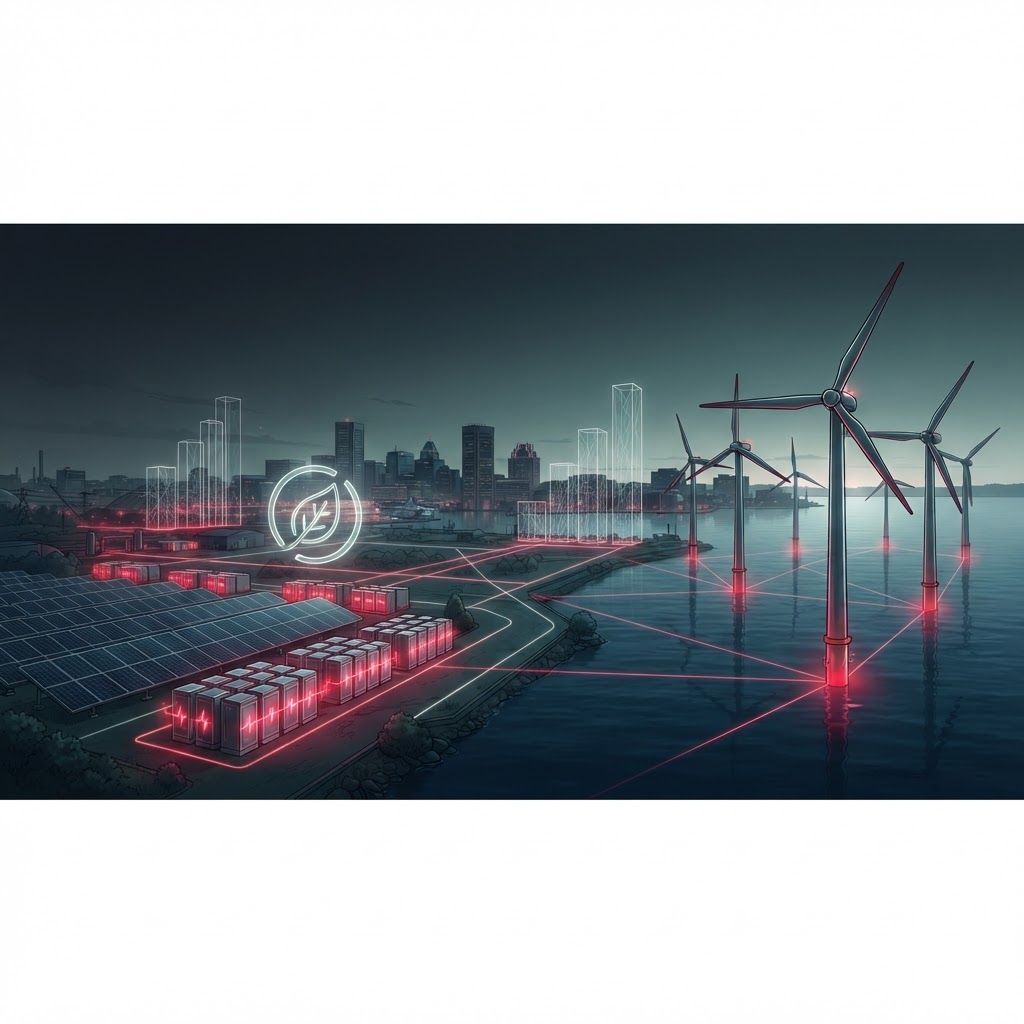
Baltimore's Position in the Clean Energy Transition
Baltimore has emerged as one of the mid-Atlantic's most consequential clean energy locations, and geography explains much of it. The Port of Baltimore offers deepwater berths, heavy-lift capability, and rail and highway connections that make it suitable for staging large components, which matters enormously for offshore wind development along the Atlantic coast. The city also has substantial industrial land available for reuse, a skilled trades workforce with shipbuilding and steel heritage, and proximity to federal research institutions and policymakers.
Maryland policy has reinforced those advantages. The state maintains a renewable portfolio standard with a dedicated offshore wind component, has adopted ambitious statutory greenhouse gas reduction targets, funds efficiency and electrification programs through utility-administered initiatives, and supports community solar that allows renters and households without suitable roofs to subscribe to shared arrays. Building performance standards for large structures are pushing owners toward electrification and deep retrofits, creating steady demand for engineering and installation services.
Ten Renewable Energy Companies and Organizations to Know
US Wind is developing offshore wind capacity off Maryland's coast and has invested in Baltimore industrial waterfront property intended to support turbine component manufacturing and marshaling, a cornerstone of the region's clean energy industrial strategy.
Ørsted, a global offshore wind developer, has pursued Maryland projects and regional supply chain relationships, bringing large-scale project development and operations expertise to the mid-Atlantic market.
Constellation Energy, headquartered in Baltimore, is one of the nation's largest producers of carbon-free electricity, supplying commercial and industrial customers with clean power products and investing in nuclear, wind, and solar generation.
Exelon and its Baltimore Gas and Electric utility operate the delivery infrastructure and efficiency programs that underpin local decarbonization, including grid modernization, electric vehicle charging support, and rebate programs for efficiency upgrades.
Solar Energy World is a regional installer serving residential and commercial customers across Maryland with design, permitting, installation, and storage integration services.
Aurora Energy and similar mid-Atlantic developers focus on commercial rooftop, ground-mount, and community solar projects, handling interconnection and subscriber management.
Sunrise Solar and comparable local installers serve Baltimore's rowhouse and small commercial market, where roof geometry, structural assessment, and historic district review require specialized experience.
Elevate Energy and community-focused efficiency organizations deliver weatherization, energy audits, and low-income retrofit programs that reduce bills and improve housing quality in older neighborhoods.
Civic Works' Baltimore Center for Green Careers trains residents for solar installation, energy auditing, and building trades roles, addressing the workforce bottleneck that constrains project delivery.
Sustainable Energy Solutions providers and engineering consultancies such as regional firms specializing in combined heat and power, geothermal, and building systems optimization round out the market for commercial and institutional clients.
Technologies Driving Local Projects
Offshore wind is the headline story because of its scale and its manufacturing implications, but it is not the only growth area. Distributed solar continues to expand across rooftops, parking canopies, and brownfield sites, increasingly paired with battery storage that provides resilience during outages and reduces demand charges for commercial customers. Building electrification, particularly heat pump conversions and controls upgrades, is becoming central as performance standards tighten for large buildings.
Grid-side investment matters too. Interconnection capacity, transmission upgrades, and demand response programs determine how quickly new generation can connect and how much value it delivers. Emerging areas include hydrogen for hard-to-electrify industrial processes, anaerobic digestion and waste-to-energy at treatment facilities, and thermal networks that share heating and cooling across campuses.
Benefits and Considerations for Customers
For commercial property owners, the case for clean energy has strengthened as equipment costs have fallen and incentives have broadened. Federal investment and production incentives, accelerated depreciation, state renewable energy credits, and utility rebates can substantially shorten payback periods. Power purchase agreements and third-party ownership structures allow organizations to benefit without capital outlay, which appeals to nonprofits and institutions with constrained budgets.
Residential customers should weigh roof condition, shading, and expected tenure carefully. Community solar subscriptions are a practical alternative for renters, households with unsuitable roofs, and those unwilling to finance an installation. Efficiency work often outperforms generation on a dollars-saved basis, so air sealing, insulation, and equipment upgrades deserve consideration first.
Choosing a Renewable Energy Partner
Verify licensing, insurance, and electrical certification, and ask for local references with installations at least several years old so you can assess durability and service responsiveness. Request a detailed production estimate with the assumptions disclosed, and be skeptical of projections that ignore shading, degradation, or realistic utility rate escalation. Understand warranty scope separately for panels, inverters, batteries, and workmanship, and confirm who honors each.
For commercial projects, evaluate the developer's interconnection experience with the local utility, financing sources, and track record on schedule. Clarify who handles permitting, historic review where applicable, structural engineering, and post-installation monitoring. Read contract terms on escalators, assignment, and end-of-term options in any third-party ownership arrangement.
Baltimore's clean energy market is maturing quickly, combining large industrial opportunity at the port with practical building-level improvements across neighborhoods. Customers who pair careful technical diligence with an understanding of available incentives are capturing real savings while contributing to the region's transition.
