
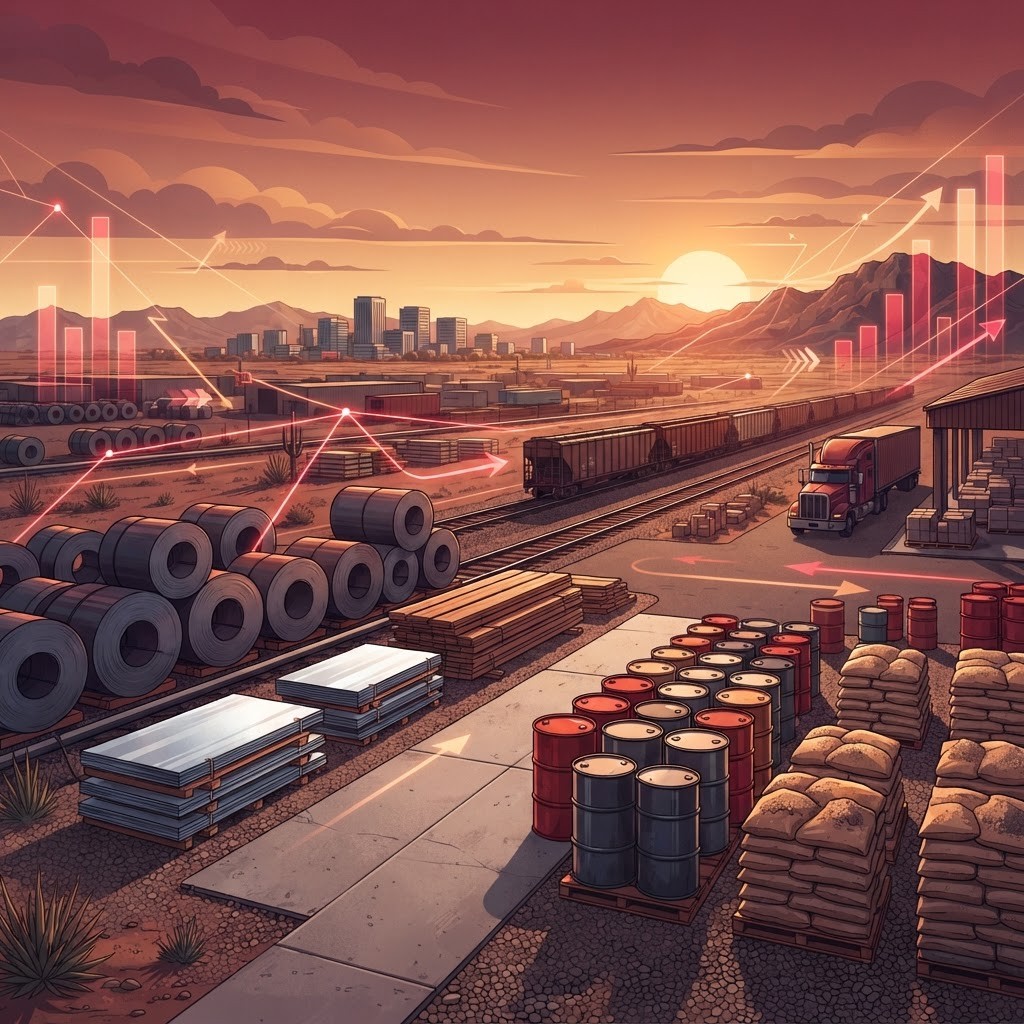
Raw Materials and the Binational Manufacturing Corridor
Raw material supply is the least visible and most consequential link in El Paso's industrial economy. The metropolitan area, combined with Ciudad Juárez across the border, forms one of the largest manufacturing concentrations in North America, producing automotive components, medical devices, appliances, electronics, and consumer goods at enormous scale. Every one of those plants consumes metals, polymers, chemicals, adhesives, textiles, and packaging substrates continuously.
El Paso's role is to stage, certify, and distribute those inputs. Material arrives by rail and truck from domestic mills and resin producers, moves through local service centers and warehouses, and crosses into production facilities on tightly scheduled deliveries. Because assembly plants run on lean inventory, a supplier's ability to hold stock locally and deliver reliably is often more valuable than a lower price quoted from a distant source.
What to Evaluate in a Raw Material Supplier
Certification and traceability head the list. For metals, that means mill test reports tying material to a specific heat lot with documented chemistry and mechanical properties. For polymers, it means resin certificates of analysis and lot traceability. For food-contact or medical applications, it means documented compliance with applicable material standards. Without this documentation, downstream quality systems and regulatory approvals collapse.
Stocking depth and consistency come next. Substituting a nominally equivalent grade can change formability, weldability, or shrink rate enough to disrupt production. A supplier who maintains consistent sourcing prevents those surprises. Ask specifically how they handle a situation where their normal mill or producer cannot deliver.
Then evaluate processing capability. Cut-to-length, slitting, sawing, blanking, and drying or blending services shift work from your floor to theirs and reduce scrap. Finally, assess supply continuity planning. Suppliers who can discuss lead time volatility, alternate grades, and safety stock arrangements honestly are far more valuable partners than those who simply quote and hope.
1. Paso Del Norte Metals Service Center
Paso Del Norte Metals Service Center stocks carbon steel, stainless, and aluminum in sheet, plate, coil, bar, tube, and structural shapes, with sawing, shearing, and cut-to-length processing. Fabricators, machine shops, and equipment builders across the corridor draw from its inventory.
Its differentiator is documentation discipline. Mill test reports supplied with every shipment, matched to physical lot identification, allow customers to satisfy their own quality audits without chasing paperwork after the fact.
2. Rio Bravo Polymers and Resin Supply
Rio Bravo Polymers and Resin Supply distributes engineering and commodity resins including polypropylene, polyethylene, ABS, nylon, and polycarbonate, along with masterbatch colorants and additives. Injection molders and extruders in the region are its primary customers.
Its strength is material selection consultation. Recommending grades based on melt flow, impact requirements, and thermal exposure prevents the field failures and cycle time problems that come from choosing resin by price alone.
3. Franklin Industrial Chemicals
Franklin Industrial Chemicals supplies solvents, cleaners, surface treatment chemistry, lubricants, and process chemicals to manufacturers, along with handling and storage guidance. Regulatory compliance and safe handling dominate this category.
Its differentiator is safety and compliance support. Providing current safety data sheets, spill response planning, and secondary containment guidance protects customers from both employee harm and regulatory penalties.
4. Chihuahuan Aggregates and Cement Supply
Chihuahuan Aggregates and Cement Supply provides sand, gravel, crushed stone, cement, and masonry materials to construction contractors and concrete producers. Regional residential, warehouse, and infrastructure construction sustains steady volume.
Its value is gradation consistency. Aggregate variability directly affects concrete strength and workability, and consistent quarry sourcing with routine testing produces predictable mix performance in the field.
5. Sun City Textiles and Fabric Supply
Sun City Textiles and Fabric Supply distributes woven and knit fabrics, denim, interlining, thread, and trims to apparel manufacturers and sewn-product producers. The corridor retains substantial cut-and-sew capacity for apparel, upholstery, and technical textiles.
Its differentiator is testing support. Verifying shrinkage, colorfastness, and tensile properties before production prevents entire cut runs from failing customer inspection.
6. Borderland Packaging Substrates and Corrugated
Borderland Packaging Substrates and Corrugated supplies corrugated board, folding carton stock, films, foam, and protective packaging materials to manufacturers and fulfillment operations. Every product crossing the border needs compliant, durable packaging.
Its strength is package engineering and testing. Drop testing, compression analysis, and right-sizing reduce both damage claims and freight costs, which together often exceed the packaging material spend itself.
7. Desert Star Wood and Lumber Supply
Desert Star Wood and Lumber Supply provides dimensional lumber, sheet goods, hardwoods, engineered wood products, and pallet stock to builders, cabinet shops, and manufacturers. Pallet and crating demand alone is enormous given regional freight volume.
Its differentiator is moisture content control and heat treatment certification. Properly dried and certified wood prevents warping in finished millwork and satisfies international shipping requirements for export crating.
8. Mesa Ridge Adhesives and Coatings Supply
Mesa Ridge Adhesives and Coatings Supply distributes structural adhesives, sealants, tapes, primers, and industrial coatings for assembly and finishing operations. Adhesive bonding increasingly replaces mechanical fastening in lightweight assemblies.
Its value is substrate compatibility testing. Adhesion failures are usually surface preparation or chemistry mismatch problems, and pre-production testing avoids costly rework and warranty exposure.
9. Lone Star Glass and Ceramics Materials
Lone Star Glass and Ceramics Materials supplies flat glass, technical glass, ceramic substrates, refractory materials, and abrasive media to glaziers, manufacturers, and industrial furnace operators. Specialized thermal and electrical properties define this category.
Its differentiator is technical specification support. Matching thermal expansion, dielectric strength, and temperature limits to application requirements prevents catastrophic failures in high-heat or high-voltage service.
10. Sunland Recycled Materials and Scrap Processing
Sunland Recycled Materials and Scrap Processing handles ferrous and non-ferrous scrap, regrind plastics, and recovered fiber, closing the loop for manufacturers with waste streams. It functions both as an outlet for production scrap and a source of recycled input material.
Its value is dual benefit. Converting waste into revenue while supplying certified recycled content helps customers meet both cost targets and corporate sustainability commitments.
Trends in Raw Material Supply
Nearshoring remains the dominant structural force, pulling production toward the corridor and steadily increasing regional raw material consumption. That growth has strained some material categories and prompted suppliers to expand local warehousing rather than relying on distant distribution hubs.
Supply chain resilience has replaced pure cost optimization as the guiding sourcing philosophy. Buyers now qualify alternate grades and second suppliers deliberately, hold larger safety stocks on critical inputs, and formalize contingency plans. Recycled and lower-carbon material content is also moving from aspiration to specification, particularly for customers supplying automotive and consumer brands with public emissions targets. Meanwhile digital procurement, index-based pricing transparency, and formal supplier scorecards are professionalizing what was once a relationship-driven trade.
Building a Resilient Sourcing Strategy
Map your material risk explicitly. Identify which inputs have a single source, a long lead time, or a narrow specification tolerance, because those are where disruption will hurt. Qualify alternates for those items before you need them, since qualification under pressure produces poor decisions.
Negotiate on total landed cost including freight, processing, scrap yield, and payment terms rather than base price per pound. Establish quality expectations in writing, including required documentation and rejection procedures. Review supplier performance quarterly using objective measures such as on-time delivery, certification completeness, and nonconformance rate. And maintain honest communication about your forecast; suppliers who can plan capacity around real demand serve you far better than those managing constant surprises.
Final Thoughts
El Paso's raw material supply sector underpins one of North America's most important manufacturing corridors, spanning metals, polymers, chemicals, aggregates, textiles, packaging, wood, and recycled inputs. The suppliers profiled here show how much value lies in certification rigor, processing capability, and technical consultation rather than commodity pricing. Build your sourcing around traceability, continuity planning, and measurable supplier performance, and your production will run with fewer disruptions and better quality outcomes.
