
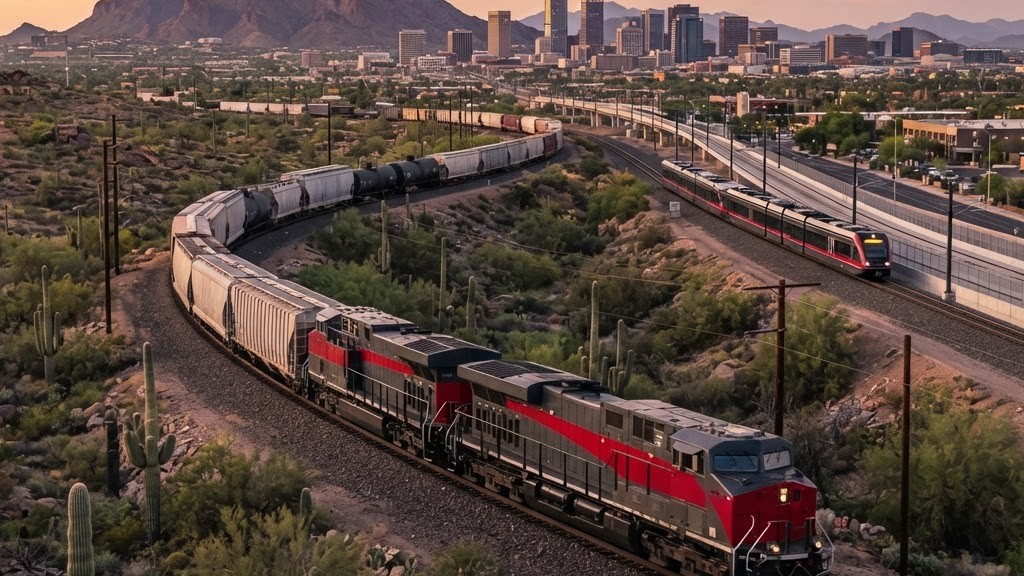
Understanding Rail Service in Phoenix
Phoenix does not have ten conventional passenger railway companies competing within the city. Its rail landscape consists primarily of freight carriers, short-line operators, an urban light-rail system, and heritage or tourist railways elsewhere in Arizona. Intercity Amtrak trains do not currently stop in central Phoenix; passengers generally connect by road to stations outside the city. This list therefore identifies the ten operators and rail organizations most relevant to Phoenix residents, businesses, and visitors, while clearly distinguishing their roles.
1. Union Pacific Railroad
Union Pacific is the principal major freight railroad serving the Phoenix area. Its network connects Arizona industries and distribution activity with ports, border gateways, and national markets. The railroad handles commodities ranging from construction materials and automobiles to consumer and agricultural products. Businesses considering rail service must evaluate siding access, shipment volume, transloading, equipment, and the longer planning cycle associated with rail freight.
2. BNSF Railway
BNSF is a major Western railroad with significant Arizona operations and national reach, though its direct physical role within central Phoenix differs from Union Pacific’s. It remains relevant to regional supply chains through connecting routes, intermodal networks, and transload arrangements. Phoenix shippers should focus on the complete origin-to-destination routing and drayage plan rather than assuming proximity to a rail map equals direct service.
3. Arizona Central Railroad
Arizona Central Railroad is a short-line operator serving the Verde Valley area north of Phoenix. It supports local freight customers and connects with the broader rail network. Short lines are important because they provide localized switching and customer service that large railroads may not offer directly. For Phoenix businesses, its relevance is strongest when suppliers, destinations, or industrial projects lie along its corridor.
4. San Pedro Valley Railroad
San Pedro Valley Railroad operates in southeastern Arizona and supports regional freight activity. Although it does not function as a Phoenix commuter or local freight system, it forms part of the state’s rail ecosystem and can be relevant to statewide industrial flows. Shippers should determine interchange points, commodity capabilities, equipment supply, and total transit expectations before selecting a rail routing.
5. Arizona Eastern Railway
Arizona Eastern Railway serves eastern Arizona industries and connects regional customers to the national network. Its freight role is tied to mining, agriculture, and other industrial activity rather than Phoenix passenger transportation. The operator illustrates how short-line railways sustain specialized rural economies. Valley companies sourcing from eastern Arizona may encounter it within a multimodal supply chain.
6. Copper Basin Railway
Copper Basin Railway is an Arizona short line closely associated with mining and mineral transportation. Its specialized operations are outside metropolitan Phoenix, but the railroad is economically relevant to the state and to industries that depend on Arizona copper. It is not a general passenger service or broad common-carrier choice for typical small businesses, so inquiries must match its actual network and commodities.
7. Valley Metro Rail
Valley Metro Rail is the rail operator most Phoenix residents and visitors encounter directly. The light-rail system connects parts of Phoenix, Tempe, and Mesa, serving downtown districts, universities, cultural attractions, and event venues. Frequent urban service and connections to bus routes make it valuable for car-free travel. Riders should check current service notices, fare rules, and late-night schedules around major events.
8. Amtrak
Amtrak is the national intercity passenger operator relevant to Phoenix, but it does not currently provide direct train service from a central city station. Travelers typically reach trains through connecting arrangements or stations elsewhere in Arizona, depending on the route. This makes total journey planning essential. Passengers should verify the current connection, baggage handling, accessibility, and protection during delays before booking.
9. Grand Canyon Railway
Grand Canyon Railway operates a heritage passenger experience between Williams and the South Rim of Grand Canyon National Park. It is several hours from Phoenix rather than a city transportation provider, yet it is one of the most notable rail experiences accessible from the Valley. Visitors value the historic atmosphere and reduced need to drive into the park. Seasonal schedules and overnight planning matter.
10. Verde Canyon Railroad
Verde Canyon Railroad offers scenic excursions through the Verde Valley from Clarkdale. The journey highlights canyon geology, riparian habitat, bridges, and historic rail infrastructure. It is a leisure operator rather than a mobility service, but it makes an appealing day trip or overnight addition from Phoenix. Classes of service, weather, mobility needs, and the drive back to the Valley should be considered.
Choosing Rail for Freight or Travel
Freight customers should compare rail only after quantifying volume, distance, handling, inventory cost, transload requirements, and first- and final-mile trucking. Rail is often strongest for heavy, repetitive, long-distance flows rather than urgent small shipments. Urban travelers can use Valley Metro Rail most effectively when lodging and destinations sit near stations. Leisure passengers should treat the Grand Canyon and Verde Canyon railways as destination experiences, not transportation substitutes. Phoenix’s railway market is limited in passenger breadth, but its mix of freight, light rail, and heritage operations plays a meaningful role in Arizona’s economy and visitor experience.
