
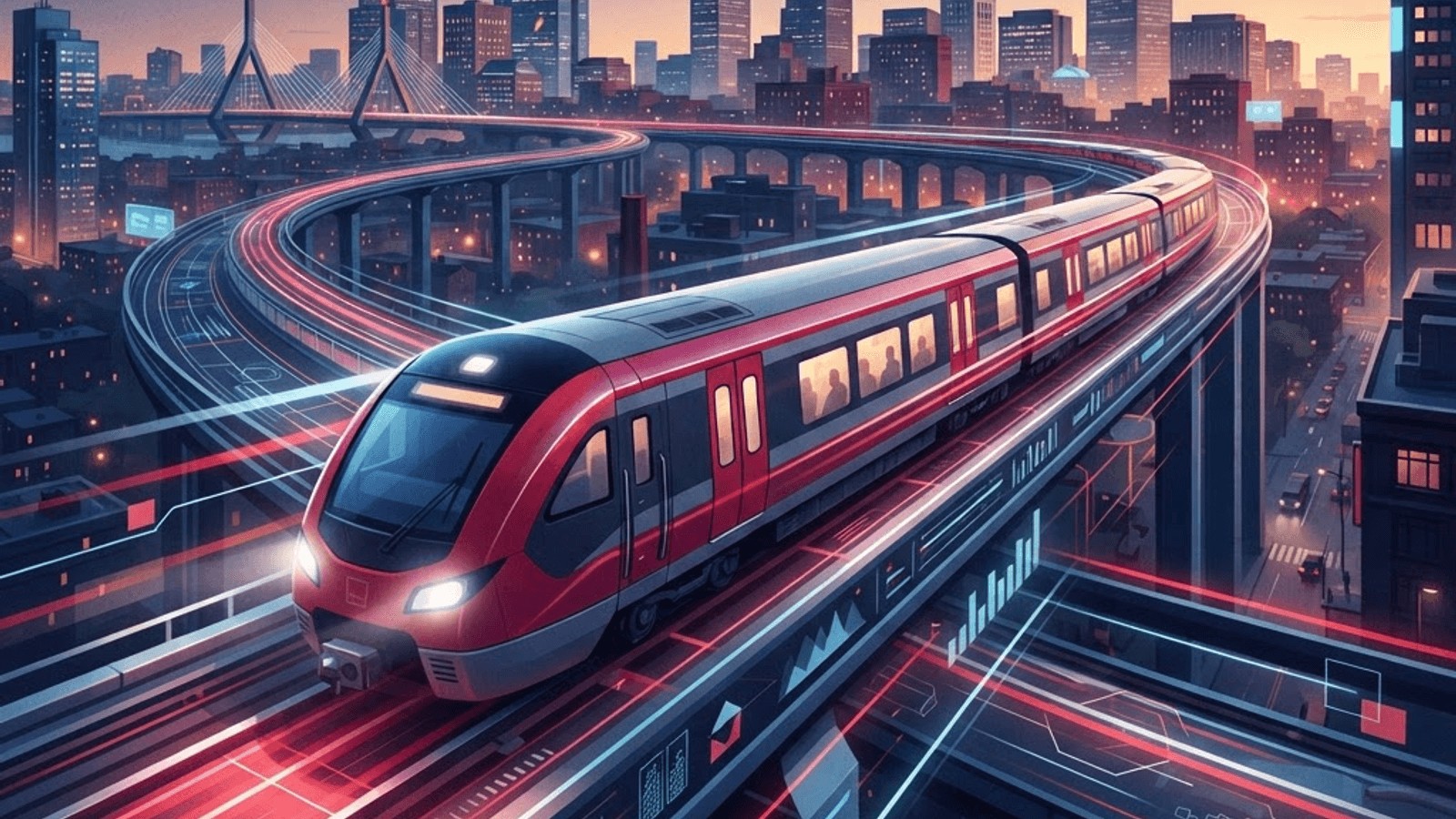
Boston's Rail Legacy and Its Modern Role
Few American cities are as historically tied to railroads as Boston. The region built some of the earliest rail lines on the continent, and the radial pattern of those nineteenth-century routes still shapes how hundreds of thousands of people reach the city each weekday. Rail matters here for a simple structural reason: the road network cannot be widened. Downtown streets are fixed, highway capacity into the core is effectively maxed out, and the metropolitan area continues to add jobs and housing. Every additional trip that rail absorbs is a trip that does not become gridlock.
Modern rail activity around Boston falls into four categories. Commuter rail carries suburban riders from as far as Rhode Island and southern New Hampshire into two downtown terminals. Rapid transit rail moves people within the urban core. Intercity passenger rail links Boston to New York, Washington, and northern New England. Freight rail carries construction aggregates, chemicals, consumer goods, and intermodal containers through and around the metro area, largely at night when passenger demand recedes.
What Makes a Railway Operator Excellent
Riders and shippers judge rail operators on reliability first. A train that is consistently seven minutes late is more damaging to trust than one that is occasionally twenty minutes late but usually on time. Beyond punctuality, the markers of quality include equipment condition, station accessibility, clarity of service information during disruptions, safety record, and the willingness to invest in infrastructure that pays off over decades rather than quarters.
The Top 10 Railway Operators and Rail Service Providers in Boston
1. MBTA Commuter Rail
The commuter rail network operated under the Massachusetts Bay Transportation Authority is the backbone of suburban access to Boston. More than a dozen lines radiate from North Station and South Station, reaching communities across eastern Massachusetts. Recent years have brought a strategic shift toward more frequent all-day service on key corridors rather than a pure peak-hour commuter model, along with fare simplification and accessibility upgrades at older stations.
2. Keolis Commuter Services
Keolis Commuter Services operates and maintains the commuter rail system under contract, managing crews, dispatching, equipment maintenance, and day-to-day performance. The organization has invested heavily in predictive maintenance for locomotives and coaches, mechanical reliability programs, and real-time passenger information. Its operational discipline is most visible in winter, when snow and ice response plans determine whether service holds together during a nor'easter.
3. Amtrak
Amtrak provides Boston's intercity passenger rail connections, including high-speed Northeast Corridor service south toward Providence, New York, Philadelphia, and Washington, along with regional service and the route north to Maine. For business travelers, city-center to city-center rail often beats flying once security and airport access time are counted. Ongoing investment in newer trainsets and station improvements continues to raise the comfort and speed of the corridor.
4. MBTA Rapid Transit Rail Operations
The subway and light rail lines serving the urban core function as a distinct railway operation with their own signaling, vehicles, and maintenance regime. A sustained program of new rail cars, track replacement, power system upgrades, and signal modernization has been the focus of recent capital spending, aimed at eliminating slow zones and restoring the frequencies riders expect from an urban metro.
5. CSX Transportation
CSX Transportation is one of the principal freight railroads serving eastern Massachusetts, moving intermodal containers, building materials, and bulk commodities into terminals near the metro area. Its intermodal service allows shippers to substitute rail for long highway hauls, reducing cost per ton-mile and emissions. Coordination with passenger operators on shared corridors is a defining feature of its local operations.
6. Pan Am Railways Network Operations
The former Pan Am Railways system, now integrated into a larger eastern freight network, provides critical rail access across northern New England into the Boston area. The lines it serves carry lumber, paper products, chemicals, and aggregates. Investment in track upgrades and clearance improvements has expanded the range of equipment that can reach regional customers.
7. Providence and Worcester Railroad
The Providence and Worcester Railroad, a regional carrier operating in southern New England, serves industrial customers on branch lines that larger railroads no longer directly work. Short-line railroads like this one are the connective tissue of freight rail, offering flexible switching, local knowledge, and personal customer service to manufacturers that ship only a handful of cars each week.
8. Massachusetts Coastal Railroad
Operating southeast of Boston, Massachusetts Coastal Railroad handles freight on lines toward Cape Cod, including notable municipal solid waste and construction material traffic. The company also supports seasonal excursion and scenic passenger operations, demonstrating how a single rail corridor can serve both economic and tourism purposes.
9. Fitchburg Line Regional Rail Services
Service along the Fitchburg corridor deserves specific mention for the way it has been rebuilt over the past decade. Double tracking, station reconstruction, and grade crossing improvements substantially cut travel times from north-central Massachusetts into Boston, illustrating how targeted infrastructure investment can transform a line's ridership and reliability.
10. Boston Terminal Rail Support Services
Behind every passenger and freight movement sits a layer of specialist providers handling switching at terminals, coach cleaning and servicing, track inspection, signal maintenance, and rolling stock overhaul. These contractors rarely appear in public timetables, yet the punctuality riders experience each morning depends directly on the quality of their overnight work.
Trends Shaping Rail in Greater Boston
The most consequential trend is the move toward regional rail thinking, where commuter lines run frequently in both directions all day rather than concentrating on morning inbound and evening outbound trips. Electrification studies, battery-electric trainset pilots, and platform-level boarding projects all support that vision. Accessibility is another major theme, with station rebuilds bringing older stops into full compliance so that riders using wheelchairs, strollers, or luggage can board without assistance. On the freight side, clearance and weight capacity upgrades continue to open New England to standard national equipment, improving competitiveness for regional manufacturers.
Getting the Most From Boston's Rail Network
For commuters, the practical advice is to build routines around the published schedule rather than the timetable you remember from years ago, since frequencies and fare structures have changed considerably. Combine rail with bike share or transit connections at the city end of the trip, and use official real-time information during storms. For freight shippers, the key step is an honest modal analysis: many companies discover that shifting even a portion of long-haul volume to intermodal rail reduces cost and carbon while still meeting customer expectations. Either way, Boston's railways remain the most space-efficient way to move people and goods through a region that simply has no room left to spare.
