
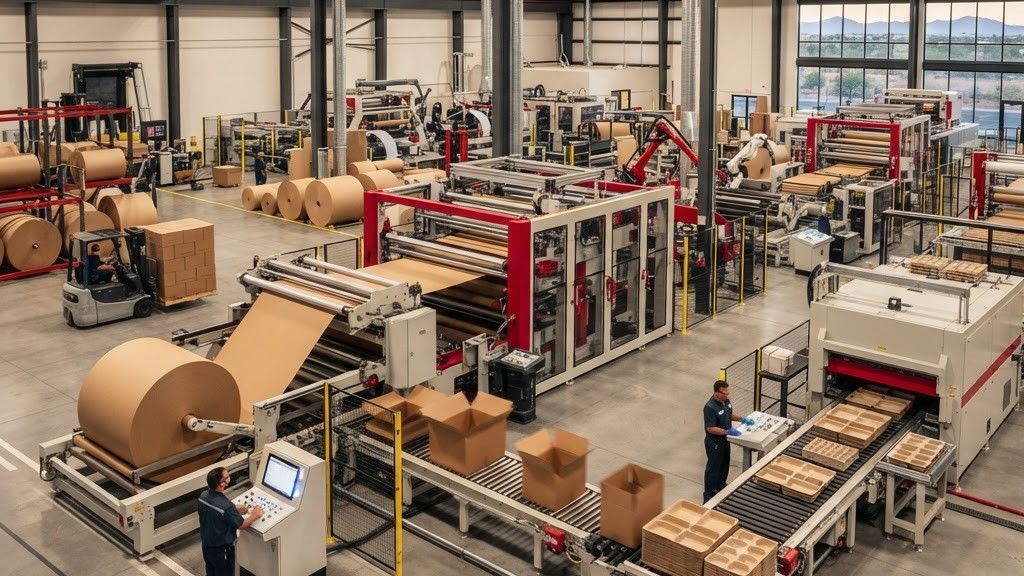
Paper Goods and Packaging in Phoenix
Phoenix's population growth and expanding distribution economy create strong demand for corrugated boxes, retail cartons, paper food packaging, labels, tissue, and protective shipping materials. The region's location along major Southwest freight routes makes packaging availability especially important to manufacturers and e-commerce operations. Local converting reduces transportation of bulky empty boxes and allows faster response to design changes. The best supplier depends on volume, print requirements, food-contact needs, strength, automation compatibility, and sustainability goals.
1. International Paper
International Paper is one of the largest fiber-based packaging producers serving Arizona. Its corrugated capabilities support industrial shipping, agriculture, consumer products, and distribution. Large-scale producers can offer consistent board grades, testing resources, design expertise, and supply continuity. Buyers should provide product weight, pallet pattern, stacking conditions, humidity exposure, and distribution hazards so packaging can be engineered rather than overbuilt.
2. WestRock
WestRock, now part of Smurfit Westrock, supplies corrugated packaging, consumer cartons, displays, and paper-based solutions. Its broad capabilities are useful for brands that need structural protection and strong shelf presentation. Retail-ready packaging can reduce store labor while improving merchandising. Customers should assess print quality, die-cut accuracy, assembly efficiency, and whether a proposed design runs reliably on packing equipment.
3. Packaging Corporation of America
Packaging Corporation of America serves the market with containerboard and corrugated packaging. Its integrated model provides access to paper production and box converting expertise. For Phoenix customers, consistent compression strength is crucial because packages may be stacked in hot warehouses and transported long distances. Right-sizing can lower fiber use and freight expense while reducing product movement inside the box.
4. Pratt Industries
Pratt Industries is recognized for corrugated packaging made with recycled paper. Its circular model and modern converting capabilities appeal to customers pursuing recycled content and efficient package design. Recycled fiber can perform well when board grade is matched to actual distribution conditions. Buyers should test compression, moisture sensitivity, print results, and closure methods rather than relying only on nominal dimensions.
5. Georgia-Pacific
Georgia-Pacific supplies tissue, towels, dispensers, food-service paper, and packaging products used by Phoenix businesses. Its portfolio serves offices, healthcare, hospitality, manufacturing, and restaurants. Managed dispensing systems can reduce consumption and maintenance compared with evaluating rolls or cases solely by unit price. Facility managers should consider usage, refill labor, storage, hygiene, and compatibility across locations.
6. Veritiv
Veritiv distributes packaging, print, and facility products while also providing design and supply-chain expertise. Distributors can consolidate purchases across boxes, cushioning, tape, labels, and equipment. That breadth is valuable for growing Phoenix operations that need vendor-managed inventory or packaging-line support. Customers should compare local stock, emergency availability, minimums, equipment service, and opportunities to standardize sizes.
7. Ernest Packaging Solutions
Ernest Packaging Solutions serves Arizona customers with custom packaging design, materials, equipment, and testing-oriented problem solving. Its consultative model can help companies address product damage, packing labor, or excessive material use. A strong packaging partner studies the complete distribution process rather than simply replacing an existing box. Prototypes and transit tests are useful before broad rollout.
8. Orora Packaging Solutions
Orora provides corrugated packaging, displays, flexible materials, labels, and packaging equipment to western businesses. Multi-material capability can simplify projects involving primary, secondary, and transport packaging. For Phoenix manufacturers, coordinated design and machinery support can improve line efficiency. Buyers should define expected production speed, changeover frequency, operator skill, and maintenance coverage when automation is involved.
9. Imperial Dade
Imperial Dade supplies food-service disposables, janitorial paper, and facility products across the region. Restaurants, schools, healthcare sites, and hospitality operators value dependable inventory and broad selection. The best food-service paper product must balance heat resistance, grease performance, customer experience, storage space, and local disposal options. Standardizing products across sites can simplify training and purchasing.
10. Phoenix-Based Custom Box and Display Converters
Local independent converters produce short-run boxes, point-of-purchase displays, partitions, pads, and specialty die cuts. They can be ideal for startups, seasonal promotions, prototypes, and customers needing faster communication. A local plant visit allows teams to review board samples, print proofs, and assembly methods. Buyers should confirm setup charges, tooling ownership, order minimums, spoilage allowances, and repeat-order consistency.
Packaging Trends in the Valley
E-commerce is increasing demand for right-sized packaging that survives parcel networks and presents well when opened. Brands are reducing unnecessary plastic and exploring curbside-recyclable fiber alternatives. Digital printing makes shorter customized runs more practical. Automated case forming and sealing help warehouses manage labor constraints. Meanwhile, customers are asking for evidence behind recycled-content and recyclability claims.
Designing for Arizona Conditions
Although Phoenix is dry, packaging may encounter temperature extremes in trailers, loading docks, or outdoor storage. Adhesives and tapes need appropriate heat performance. Dust can interfere with seals, and long shipping distances increase vibration exposure. Food and pharmaceutical products may require barriers or temperature-controlled systems. Packaging engineers should test realistic conditions rather than assuming a standard box will perform everywhere.
Selecting the Best Supplier
Collect data on product damage, shipping modes, order frequency, packing labor, and material inventory before seeking quotes. Compare board specifications, recycled content, print capability, quality controls, lead times, and design support. Large integrated manufacturers offer scale, distributors provide breadth, and local converters deliver flexibility. The strongest supplier will reduce total delivered cost while protecting the product, supporting efficient operations, and meeting credible environmental objectives.
