
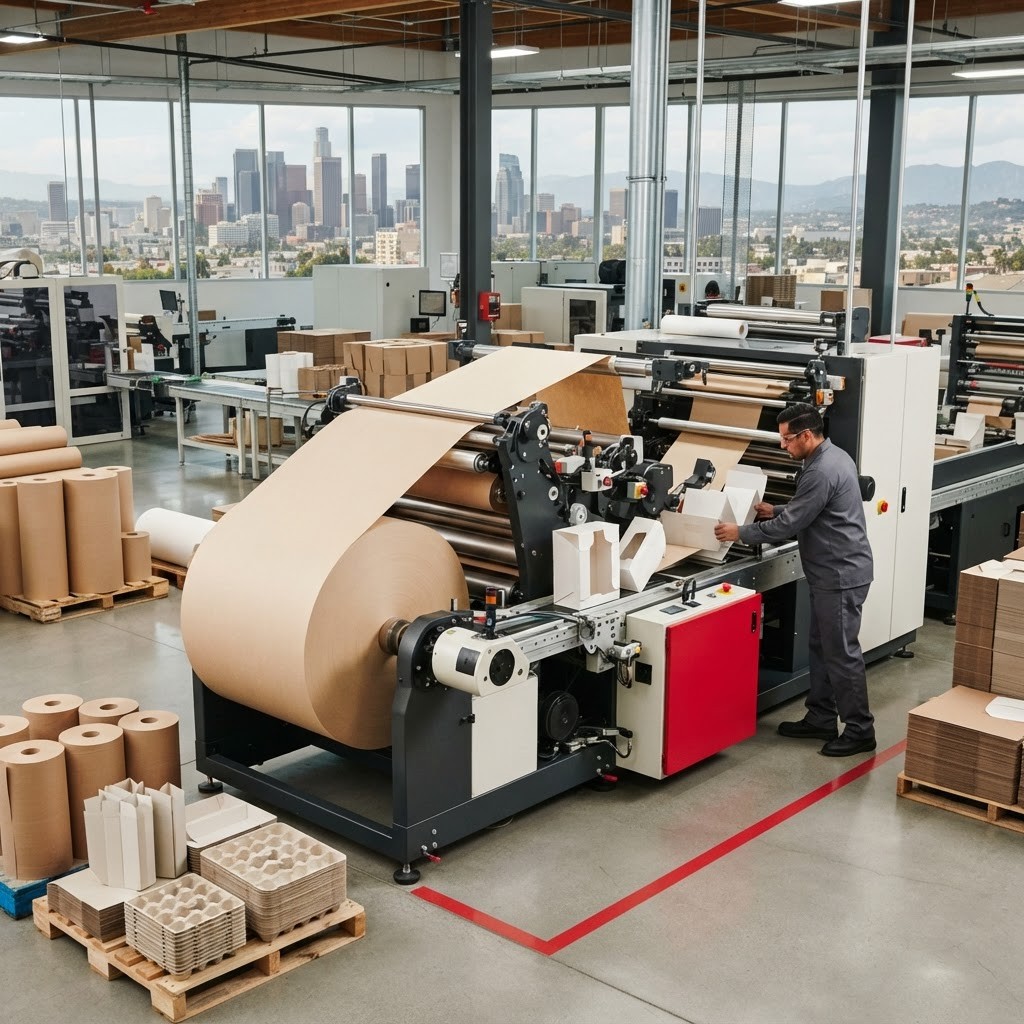
Why Los Angeles Is a Strong Paper-Goods Market
Los Angeles combines a huge consumer economy with active food, fashion, beauty, entertainment, and direct-to-consumer sectors. That mix creates steady demand for cartons, bags, food-service products, labels, tissue, corrugated shipping materials, and premium presentation packaging. Local and regional manufacturing can make sampling faster and enable closer oversight of color, structure, and finishing.
The following companies represent different portions of the paper-converting and packaging market. Buyers should verify current production locations and capabilities because some suppliers combine local service with broader regional or national manufacturing networks.
1. International Paper
International Paper has a significant presence in corrugated packaging and fiber-based solutions. For Los Angeles businesses shipping appliances, food, consumer products, or e-commerce orders, the company’s scale and technical resources can be valuable. Its teams can help evaluate board grades, compression strength, pallet efficiency, and opportunities to reduce excess material.
2. WestRock
WestRock, now part of Smurfit Westrock, is recognized for corrugated, folding-carton, and consumer-packaging expertise. Its broad capabilities are relevant to brands that need structural design, printing, automation compatibility, and reliable production across multiple markets. Large suppliers can be especially useful when packaging must remain consistent across a national rollout.
3. Orora Packaging Solutions
Orora Packaging Solutions serves Southern California with corrugated packaging, displays, protective materials, and supply-chain support. The business is a useful option for companies seeking to consolidate packaging purchasing. Its value can extend beyond the box itself to inventory planning, equipment, and pack-line efficiency.
4. Ernest Packaging Solutions
Ernest Packaging Solutions is a Los Angeles-rooted packaging business known for custom problem-solving and an energetic approach to design. It works with corrugated structures, retail displays, protective packaging, and packaging systems. Brands with unusual products or presentation goals may benefit from its engineering-led perspective.
5. Golden West Packaging Group
Golden West Packaging Group provides folding cartons, corrugated packaging, and display solutions across California. The company’s mix of structural and graphic capabilities is relevant to retail products that must protect merchandise while also communicating quality on the shelf. Buyers can explore coatings and finishes while keeping distribution performance in view.
6. Berkley International
Berkley International is known for custom packaging and retail presentation solutions, including paper-based structures and specialty formats. It serves brands that care about the unboxing experience as well as practical protection. Early collaboration can help avoid elaborate concepts that are difficult to assemble or ship efficiently.
7. Packaging Corporation of America
Packaging Corporation of America is a major producer of containerboard and corrugated packaging with service capabilities for Southern California customers. Its scale suits businesses with recurring shipping-case demand and defined performance standards. Testing can help right-size materials instead of simply adding more board.
8. Pratt Industries
Pratt Industries is widely associated with recycled-paper corrugated packaging and closed-loop thinking. For Los Angeles brands working toward fiber and recycled-content goals, its model can be attractive. Environmental claims should still be evaluated alongside print quality, supply consistency, moisture exposure, and product protection.
9. Southern California Packaging Group
Southern California Packaging Group supports custom corrugated, protective packaging, and shipping needs in the regional market. A locally responsive converter can be helpful for short-run launches, changing assortments, and businesses that need hands-on packaging guidance. Buyers should ask about design samples and production minimums.
10. Republic Bag
Republic Bag produces paper shopping bags and related retail packaging for brands and merchants. Paper bags are an important customer touchpoint in Los Angeles retail districts, but handle strength, paper weight, printing, and local bag regulations all affect the correct specification. A well-made bag supports both function and brand presentation.
Sustainability and Buying Advice
Fiber packaging is benefiting from efforts to reduce unnecessary plastic, yet sustainability is more nuanced than changing one material. Efficient dimensions, recycled content, certified fiber, lower ink coverage, water-based coatings, and recyclability can all contribute. Overpackaging wastes material and increases freight, while under-engineered packaging can cause product damage with an even larger environmental cost.
Give suppliers product weight, dimensions, fragility, distribution method, expected volume, print files, and packing-line constraints. Request physical prototypes and conduct transit tests before a major launch. Food and cosmetic brands should verify barrier, migration, and cleanliness requirements. Finally, assess responsiveness and inventory planning: Los Angeles promotions, premieres, seasonal launches, and retail openings often leave little room for missed packaging dates.
Planning a Successful Supplier Relationship
Before opening an account, create a written purchasing brief that defines required products, expected order frequency, acceptable lead times, quality standards, budget limits, and delivery constraints. Share realistic forecasts without presenting them as guaranteed orders. Ask each supplier how quotations are updated, how backorders are communicated, who handles quality concerns, and what documentation accompanies a shipment. A trial order can reveal far more about picking accuracy, packaging, communication, and product consistency than a polished sales presentation.
It is also wise to avoid dependence on a single source for every critical item. Maintain approved alternatives while giving strong primary suppliers enough predictable business to invest in the relationship. Review performance quarterly using measurable factors such as on-time delivery, defect rate, response speed, invoice accuracy, and resolution of claims. In Los Angeles, delivery plans should account for traffic, loading zones, limited warehouse space, seasonal demand, and the distance between coastal, central, and inland locations. Clear receiving procedures help teams photograph damage, check quantities, preserve lot information, and report discrepancies promptly.
Finally, treat the list above as a starting point rather than a substitute for due diligence. Visit showrooms or facilities when practical, request samples, verify business credentials and insurance where relevant, and speak with comparable customers. The best long-term partner is transparent about both strengths and limitations. Consistent communication, documented expectations, and fair payment practices create a more resilient supply chain for buyer and supplier alike.
