
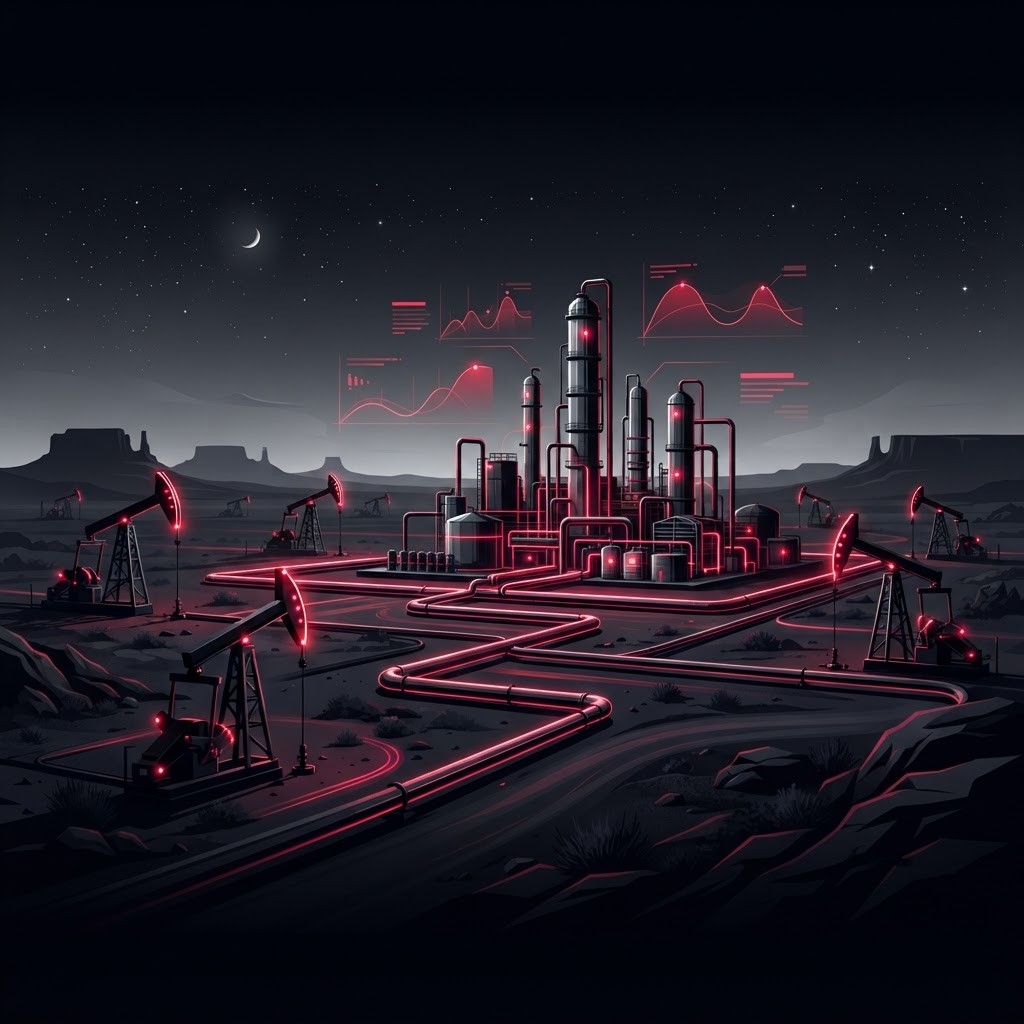
El Paso's Role in the Energy Value Chain
El Paso is not a drilling town, yet it occupies a strategically important position in the oil and gas industry. The city sits west of the Permian Basin, the most productive oil field in the United States, and serves as a refining center, pipeline junction, distribution point, and logistics gateway toward Arizona, California, New Mexico, and northern Mexico. Product that leaves El Paso fuels a wide swath of the Southwest.
That role makes the local industry midstream and downstream in character. Refining, natural gas transmission, fuel terminals, trucking and rail logistics, pipeline services, and industrial supply dominate, along with corporate and regional offices supporting operations spread across West Texas and southern New Mexico.
Refining and Downstream Operations
The El Paso refinery is the anchor of local downstream activity. Operated by Marathon Petroleum Corporation following its acquisition of Andeavor, formerly Western Refining, the facility processes crude into gasoline, diesel, jet fuel, and other products serving West Texas, New Mexico, and Arizona markets. Its associated terminals and distribution network give the region reliable fuel supply and support a substantial base of skilled operations, maintenance, and engineering employment.
Around the refinery sits a network of fuel distributors, jobbers, and terminal operators handling wholesale supply, branded fuel distribution, and commercial fueling for the region's enormous trucking sector. Because El Paso is one of the busiest commercial land ports in North America, diesel logistics is itself a major business.
Midstream and Natural Gas Transmission
Natural gas infrastructure is where the El Paso name carries national recognition. El Paso Natural Gas, now part of Kinder Morgan, operates one of the most important interstate pipeline systems in the western United States, moving Permian and San Juan Basin gas toward Arizona, Nevada, California, and Mexican border delivery points. Kinder Morgan's broader Texas footprint includes additional gas and products pipelines and storage.
Other significant midstream operators with regional relevance include Plains All American Pipeline, Energy Transfer, Targa Resources, ONEOK, and Enterprise Products Partners, all of which move Permian crude, natural gas, and natural gas liquids through West Texas systems that connect toward El Paso, Mexico, and Gulf Coast markets. Cross-border gas exports to Mexico, serving power generation and industry in Chihuahua and beyond, have grown into one of the most consequential flows in the entire North American gas market.
Upstream Operators in the Broader Region
While production occurs east of the city, the operators driving Permian output shape El Paso's economy through supply chains, employment, and freight. ExxonMobil, Chevron, ConocoPhillips, Occidental Petroleum, Diamondback Energy, Devon Energy, Coterra Energy, Permian Resources, and Franklin Mountain Energy are among the companies with significant Permian and Delaware Basin positions. Franklin Mountain Energy, named for the range that defines El Paso's skyline, illustrates the connection between regional identity and basin activity.
These operators consume enormous quantities of equipment, water, sand, chemicals, and labor, much of which moves through regional logistics networks. Their capital spending decisions ripple quickly into demand for trucking, warehousing, and industrial services across West Texas.
Oilfield Services and Industrial Supply
Service companies form the operational backbone of the industry. Halliburton, Baker Hughes, SLB, NOV, and Weatherford International maintain West Texas and New Mexico operations supporting drilling, completion, artificial lift, and production optimization. Alongside them, regional firms provide pipeline construction and integrity services, tank and vessel fabrication, valve and instrumentation supply, electrical and instrumentation contracting, environmental remediation, water hauling and treatment, and specialized transportation.
El Paso's industrial base, manufacturing capacity, and border logistics infrastructure make it a practical location for distribution, fabrication, and equipment staging serving Delaware Basin activity to the east and Mexican operations to the south.
Workforce, Safety, and Regulation
Oil and gas remains one of the higher-paying industrial employment sectors in the region, supporting process operators, welders, pipefitters, electricians, instrumentation technicians, commercial drivers, engineers, and environmental specialists. Regional community colleges and technical programs supply much of this pipeline, and the University of Texas at El Paso contributes engineering graduates to the sector.
Regulation is layered. The Railroad Commission of Texas oversees oil and gas operations in the state, the Texas Commission on Environmental Quality and the Environmental Protection Agency address air and water compliance, the Pipeline and Hazardous Materials Safety Administration governs pipeline safety, and cross-border facilities involve federal permitting and coordination with Mexican authorities. Air quality management is particularly sensitive in the El Paso and Juárez airshed, which shares meteorology across an international boundary.
Trends Reshaping the Industry Locally
Four developments matter most. Methane emission reduction has become a compliance and reputational priority, driving investment in leak detection, vapor recovery, and electrified equipment. Natural gas exports to Mexico continue to expand as Mexican power generation shifts toward gas. Water management, including produced water recycling, has become central in an arid basin where freshwater is contested. And diversification is real: several traditional energy companies are investing in solar, storage, hydrogen, and carbon capture, blurring the line between the oil and gas sector and the renewable industry that is growing alongside it in the same region.
How to Evaluate Companies and Partners
For businesses seeking suppliers or customers in this sector, evaluate safety performance metrics, regulatory compliance history, financial stability, and operational track record in the specific basin or corridor involved. For job seekers, examine certification support, safety culture, shift structure, and whether the employer offers training pathways. For landowners and communities, ask about surface use agreements, water sourcing, road impact, emission controls, and reclamation commitments.
Final Thoughts
El Paso's oil and gas sector is built on refining, pipelines, logistics, and services rather than drilling, and that position gives it durable relevance as energy flows shift across the Southwest and into Mexico. As emissions standards tighten and diversification accelerates, the companies that combine operational reliability with environmental performance are the ones defining the industry's next phase in the region.
