
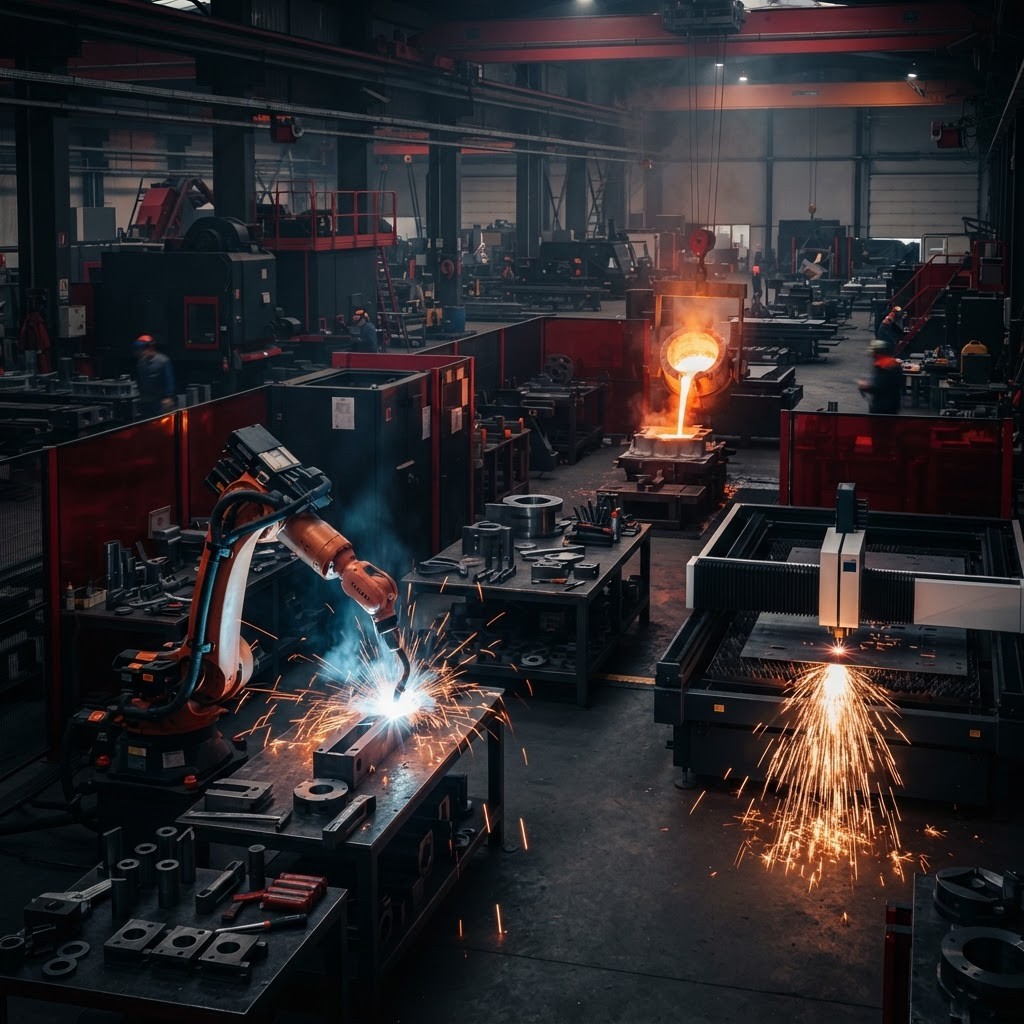
The Backbone of Portuguese Industry
Metalworking, or the metalomecânica sector as it is known locally, is one of the most important and export-driven parts of Portuguese industry. It encompasses precision machining, sheet-metal fabrication, foundry work, structural steel and complex assemblies serving automotive, aerospace, energy, railway and machinery clients. Concentrated in the industrial regions of the north and centre, particularly around Porto, Aveiro and Leiria, the sector combines skilled labour, modern equipment and a culture of engineering rigour that has earned the trust of demanding international customers.
The strength of Portuguese metalworks lies in its versatility. Companies range from large groups producing safety-critical automotive components to specialist workshops delivering bespoke fabrications. This breadth allows the sector to support entire supply chains, from raw casting and machining to finished, ready-to-install assemblies.
What Sets Top Metalworks Companies Apart
Leading firms are distinguished by precision, certification and process control. Many hold quality accreditations required for automotive and aerospace work, along with capabilities in CNC machining, robotic welding, laser cutting and surface treatment. Traceability of materials, dimensional accuracy and consistent repeatability are essential. Increasingly, digital manufacturing, automation and additive technologies separate the leaders from the rest.
The Top 10 Metalworks Companies
1. Sakthi Portugal. A major foundry and machining operation, Sakthi produces safety-critical cast and machined components for the automotive industry, exemplifying high-volume precision metalwork.
2. CATIM-associated precision engineers. Precision-engineering firms aligned with the sector's technical institutes deliver machined components to tight tolerances for industrial and automotive clients.
3. Adira. A historic metal-forming manufacturer, Adira not only builds press brakes and laser systems but represents deep expertise in sheet-metal working technology that supports the wider sector.
4. Motofil. Specialising in robotic welding and automated fabrication lines, Motofil brings advanced automation to metalworking, boosting productivity and consistency for its clients.
5. Famova / structural steel fabricators. Structural steel specialists fabricate frames and heavy assemblies for construction, infrastructure and industrial facilities, combining engineering with large-scale capacity.
6. Metalogalva. A leading producer of galvanised metal structures, Metalogalva manufactures poles, towers and structural components for energy, telecoms and infrastructure markets worldwide.
7. Ramada Aços. A key supplier of special steels and steel solutions, Ramada supports the metalworking chain with high-quality materials and value-added processing.
8. Palbit. Producing cemented carbide tools and cutting solutions, Palbit underpins the machining capabilities of the entire sector with high-performance tooling.
9. Sodecia. A global automotive components group with Portuguese roots, Sodecia delivers metal-formed and welded structural parts to major vehicle manufacturers around the world.
10. Erofio / precision tooling and machining specialists. Precision toolmakers and machining specialists round out the sector, producing high-accuracy components and moulds that serve advanced manufacturing programmes.
Serving High-Demand Industries
The automotive industry is the sector's largest customer, requiring components that meet stringent safety and quality standards at high volumes. Aerospace work, though smaller, demands even greater precision and certification, and Portugal's growing aerospace cluster relies on capable metalworkers. Energy, particularly renewables such as wind, has become a significant market, with demand for towers, structures and precision components. Railway, machinery and construction complete a diverse customer base.
This diversification is a strength. By serving multiple industries, metalworks companies can absorb fluctuations in any single market and continuously apply lessons from the most demanding clients across their operations.
Technology and Digital Transformation
Industry 4.0 is transforming Portuguese metalworking. Modern shops run networks of CNC machines and robotic cells connected to production-management systems that track efficiency and quality in real time. Laser cutting and additive manufacturing enable complex geometries and rapid prototyping. Automated inspection ensures parts meet exact specifications. These investments improve competitiveness against lower-cost regions by delivering superior quality and reliability.
Sustainability in Metalworking
Sustainability is rising on the agenda. Companies are improving energy efficiency, recycling metal scrap and adopting cleaner surface-treatment processes. The sector also plays a direct role in the green transition by manufacturing components for wind turbines, electric-vehicle platforms and energy infrastructure, positioning metalworkers as enablers of decarbonisation across the economy.
Choosing a Metalworks Partner
When selecting a metalworking supplier, buyers should evaluate relevant certifications, machining and fabrication capabilities, and quality-control systems. Material traceability is critical for regulated industries, as is the supplier's capacity to scale and meet delivery schedules. Engineering support and the ability to co-develop solutions add significant long-term value.
Conclusion
Portugal's metalworks companies combine skilled craftsmanship, advanced automation and rigorous quality to serve some of the world's most demanding industries. From high-volume automotive foundries to precision toolmakers and structural steel specialists, the companies featured here embody the engineering excellence that makes Portuguese metalworking a trusted partner in global supply chains.
