
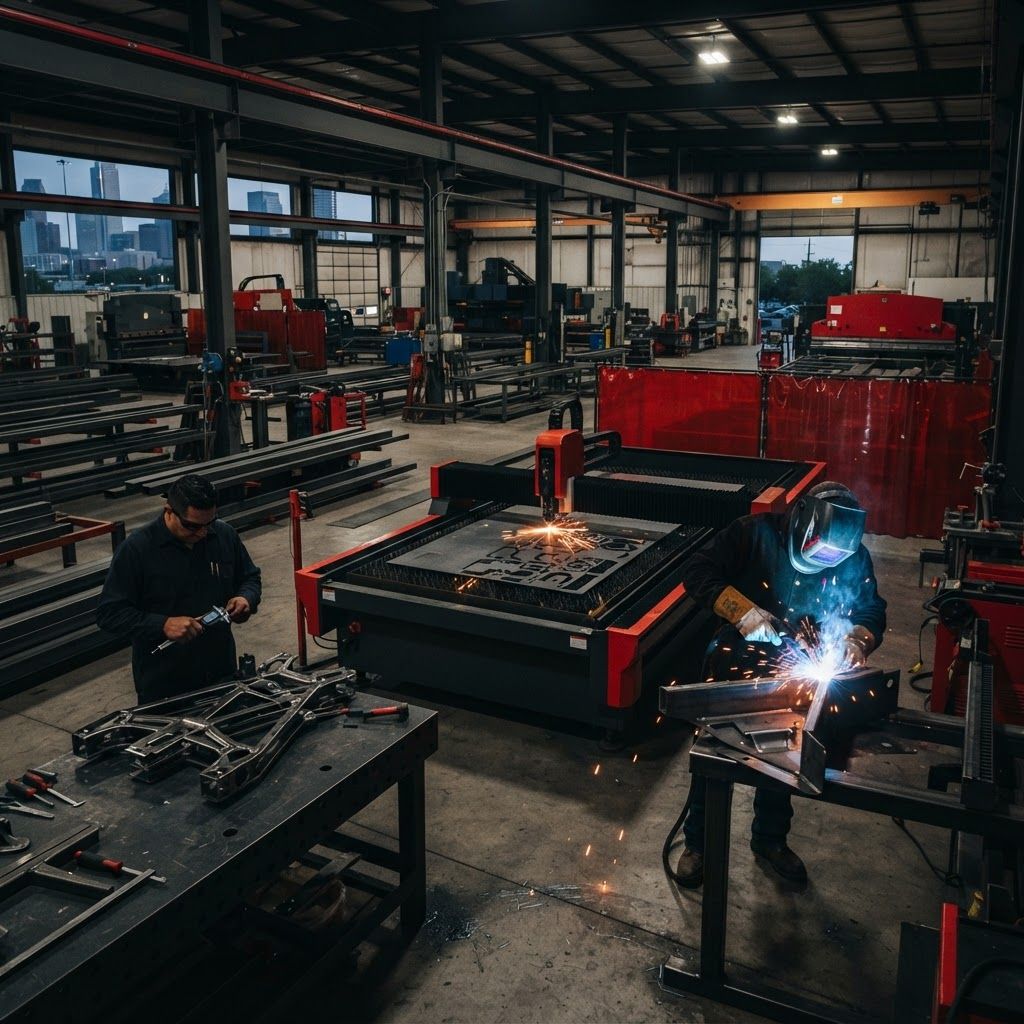
Dallas Metalworking Capabilities
North Texas metalworking supports construction, aerospace, defense, transportation, energy, food equipment, data centers, and general manufacturing. The regional base includes structural fabricators, machine shops, sheet-metal specialists, ornamental workshops, and industrial finishers. Customers benefit from proximity during design reviews, first-article inspection, and urgent production changes.
This list presents companies representing several metalworking disciplines. Not every provider is suitable for every job: a structural steel fabricator and a precision aerospace machine shop operate under very different standards. Buyers should match material, tolerance, size, certification, volume, and finishing needs to demonstrated shop capability.
1. CMC
Commercial Metals Company, headquartered in Irving, is a central name in the North Texas metals economy. Its activities include steel production, recycling, reinforcing products, fabrication, and construction solutions. CMC is especially relevant to large building and infrastructure programs that value an integrated path from recovered metal to finished reinforcing products.
2. Trinity Industries
Dallas-based Trinity Industries is associated with heavy metal fabrication for rail transportation. Production at this scale requires forming, automated and manual welding, fixtures, coatings, inspection, and rigorous process control. The company’s long industrial history contributes to the region’s workforce and supplier expertise in large welded assemblies.
3. Maysteel Industries
Maysteel provides custom sheet-metal fabrication, enclosures, and complex assemblies for industrial customers. Typical capabilities include laser cutting, punching, bending, welding, powder coating, hardware insertion, and assembly. This integrated approach helps original equipment manufacturers reduce handoffs while maintaining control over cosmetic and dimensional requirements.
4. All Metals Fabricating
All Metals Fabricating is a North Texas custom manufacturer known for precision sheet metal and contract production. Its services encompass cutting, forming, welding, machining, finishing, and assembly. The company is attractive to customers seeking a single local partner for prototypes through production, particularly when responsiveness and design-for-manufacturability feedback matter.
5. Bassett Industries
Bassett Industries offers metal fabrication, tube bending, laser cutting, welding, and related manufacturing services. Tube and pipe work requires specialized tooling and process knowledge to control flattening, springback, weld orientation, and repeatability. Its range of processes supports equipment, transportation, and architectural applications.
6. Kofahl Sheet Metal
Kofahl Sheet Metal represents the Dallas area’s strength in custom sheet-metal work for commercial and industrial projects. Such companies produce ductwork, hoods, equipment components, flashing, and purpose-built assemblies. Field coordination, accurate drawings, material selection, and practical installation knowledge differentiate strong regional fabricators.
7. Metal Supermarkets Dallas
Metal Supermarkets serves small manufacturers, maintenance teams, contractors, and individuals needing metal in practical quantities. Access to cut-to-size steel, aluminum, stainless, brass, and other materials can shorten prototyping and repair cycles. The company fills an important gap between mill-scale purchases and retail selections.
8. Ryerson
Ryerson supplies and processes metals for manufacturers throughout North Texas. Its product range includes sheet, plate, bar, tube, and structural shapes, supported by cutting and value-added processing. Large distributors help customers consolidate grades and forms while improving material availability, but specification and traceability requirements should be communicated clearly.
9. O’Neal Steel
O’Neal Steel serves the Dallas industrial market with carbon and alloy steel products and processing services. Customers can reduce internal handling by purchasing blanks or near-net shapes rather than full stock sizes. Supplier performance should be judged on material certification, cut quality, dimensional consistency, packaging, and delivery reliability.
10. Texas Nameplate
Texas Nameplate specializes in metal identification products such as nameplates, labels, and marked components used on equipment and durable goods. Though smaller than structural fabrication, this work demands precision, legibility, adhesion, corrosion resistance, and process compatibility. It illustrates the depth of niche metalworking available in Dallas.
Material, Finish, and Design Choices
Successful fabrication begins with understanding how the selected alloy behaves. Carbon steel is economical and strong but needs suitable corrosion protection. Stainless steel offers durability yet requires disciplined handling to preserve its surface. Aluminum reduces weight and forms well in many applications, though welding and finish expectations must be defined. A good Dallas fabricator can recommend available gauges, bend radii, tolerances, and finishes before details become expensive to change.
Powder coating, wet paint, plating, galvanizing, passivation, brushing, and polishing each have different appearance, durability, masking, and dimensional effects. Establish approved samples and inspection lighting for cosmetic work. For exterior installations, include drainage and avoid crevices that trap water. Designing around standard stock and efficient nesting can reduce both price and scrap.
Capacity and Schedule Questions
A shop may have impressive equipment but insufficient capacity during the required window. Ask which operations are performed internally, where outside processing occurs, and how subcontracted quality is controlled. Review material lead times and identify the production constraint. For assemblies, shipping fixtures and protective packaging should be engineered alongside the part rather than improvised at dispatch.
Evaluating a Metal Fabricator
Send controlled drawings and clearly identify critical dimensions, weld standards, grain direction, finish class, inspection requirements, and approved substitutions. Review equipment capacity, quality certifications, welder qualifications, calibration, nonconformance handling, and first-article methods. For recurring work, ask how fixtures and revision-controlled programs are stored.
Automation is expanding through fiber lasers, robotic welding, connected inspection, and production scheduling software, but skilled people remain essential for setup and problem solving. Dallas shops are also helping customers reduce assemblies through smarter bends, optimize material yield, and choose lower-impact finishes. The best partner will communicate risks early, quote transparently, and repeatedly deliver parts that fit without field rework.
