
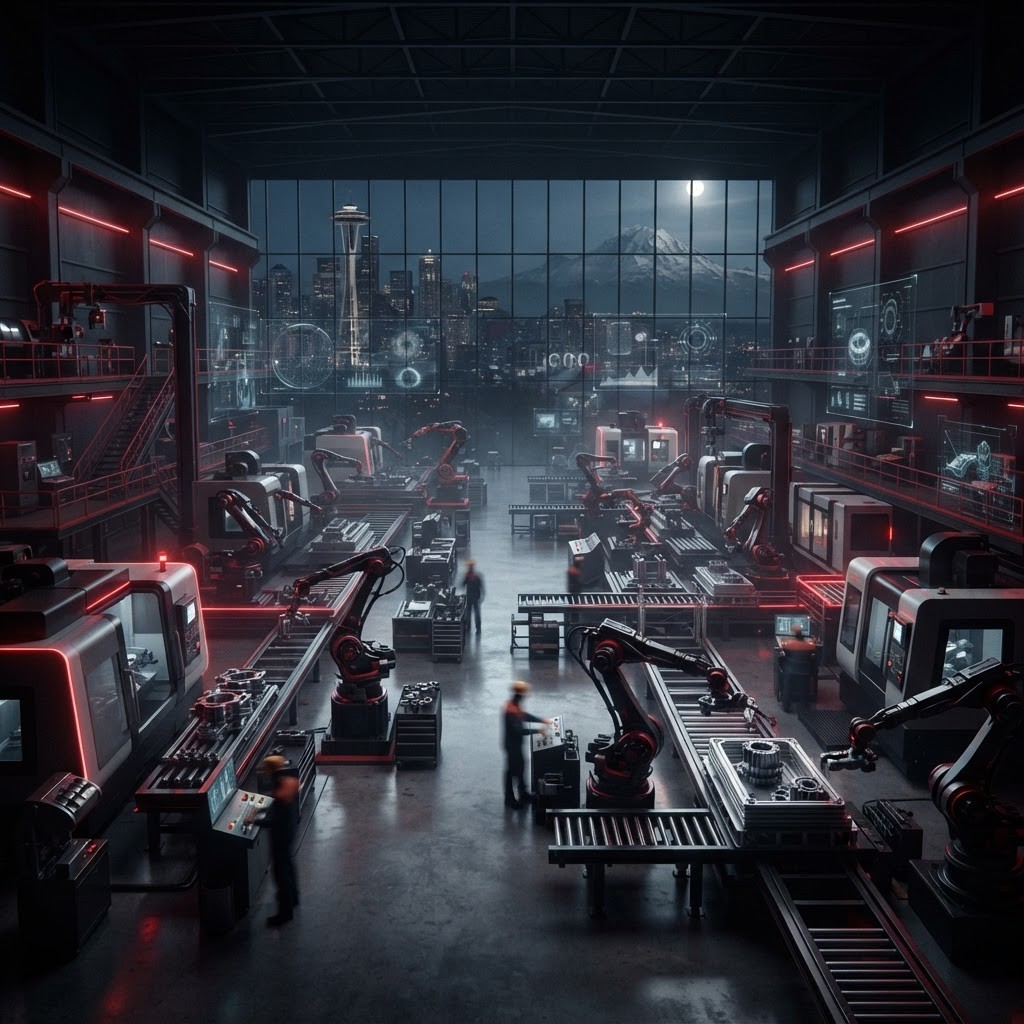
Why Washington Is a Powerhouse for Machinery Manufacturing
Washington State occupies an unusual position in American industry. It is home to one of the world's largest aerospace clusters, a deep-water port network that moves goods across the Pacific, an agricultural economy that produces a significant share of the nation's apples, hops, and potatoes, and a technology sector that pushes automation into every corner of the supply chain. Machinery manufacturers in the state have grown up serving all four of those markets at once, which forces a level of engineering discipline that is not always required elsewhere.
The practical result is a supplier base that is unusually versatile. A machine shop in Kent may build tooling for a jetliner subassembly in the morning and a stainless conveyor for a seafood processor in the afternoon. Companies in Spokane and the Yakima Valley have specialized in food and agricultural equipment that must survive wash-down cycles, freezing winters, and harvest seasons that allow almost no downtime. Along the Puget Sound, marine and shipyard machinery builders work to standards where a failure is a safety event, not an inconvenience.
How the Best Machinery Manufacturers Are Evaluated
Buyers who purchase capital equipment rarely choose on price alone. The criteria that matter most include documented quality systems such as AS9100 or ISO 9001 registration, in-house engineering capacity, the breadth of machining and fabrication equipment under one roof, welding certifications, controls and automation expertise, and the ability to provide spare parts and field service for a decade or more. Lead time reliability has become just as important as capability, because a machine delivered three months late can cost a processor an entire season.
Top 10 Best Machinery Manufacturers in Washington
1. Boeing Fabrication — As the manufacturing backbone of the state's aerospace industry, Boeing's fabrication divisions build and maintain some of the most complex tooling and automated assembly machinery in the world. Their internal machinery programs, including automated fastening and panel assembly systems, have effectively trained generations of Washington machinists and set the precision benchmark that regional suppliers work to meet.
2. Kadant Carmanah Design — Operating in the wood products corridor, Kadant Carmanah is recognized for sawmill and veneer machinery, including trimmers, sorters, and lathe systems. Their strength is designing equipment that handles high-volume Pacific Northwest timber with tight dimensional tolerance and minimal fiber loss, which directly improves a mill's yield economics.
3. Pacific Bearing and Machine Works — A long-standing name in industrial repair and custom machinery, this category of Puget Sound machine works serves marine, pulp, and heavy industrial clients. Their differentiator is around-the-clock rebuild capability: large-capacity lathes, boring mills, and welding bays that can return a critical shaft or gearbox to service in days rather than weeks.
4. Key Technology — Headquartered in Walla Walla, Key Technology is one of the most respected names in food processing machinery worldwide. Its optical sorters, vibratory conveyors, and inspection systems are used by potato, nut, and frozen vegetable processors globally. The company's proximity to Washington's agricultural belt means machines are tested against real crops in real conditions before release.
5. Vanmark Equipment — Known throughout the potato and root vegetable sector, Vanmark builds peelers, scrubbers, destoners, and dewatering systems. Processors value the company's hygienic design philosophy and its focus on abrasion resistance, since these machines run continuously through some of the most punishing product streams in food manufacturing.
6. Electroimpact — Based in Mukilteo, Electroimpact is a genuine global leader in automated aerospace assembly machinery, including riveting machines, automated fiber placement systems, and wing assembly cells. Its reputation rests on engineering depth: the company designs mechanics, controls, and software in-house, allowing highly customized machines that integrate cleanly into existing factories.
7. Genie, a Terex brand — Redmond-based Genie manufactures aerial work platforms, telehandlers, and material lifts recognized on job sites worldwide. Beyond product design, Genie is respected for dealer support networks and operator training resources, which reduce total cost of ownership for construction and rental fleets.
8. Skagit Industrial Machinery Builders — The Skagit and Whatcom county corridor hosts a cluster of builders serving berry growers, dairies, and specialty food producers. Their advantage is agility: small engineering teams that will design a single-purpose machine for a grower's unique process, then support it locally for years.
9. Sound Machine and Automation — Representing the region's growing automation integrators, these firms combine robotics, vision systems, and custom mechanical design to retrofit older plants. They matter because most Washington manufacturers are not building greenfield factories; they are upgrading existing lines, and that requires integration talent more than raw fabrication.
10. Spokane Industries — With steel foundry operations and a fabrication division, Spokane Industries produces castings and machinery components for mining, agriculture, and heavy equipment. Their vertical integration, from molten metal to finished machined part, gives customers unusual control over quality and schedule.
Industry Trends Shaping Washington Machinery Builders
Three trends dominate current conversations. The first is automation driven by labor scarcity: food processors and mills across Eastern Washington are investing in machinery that reduces manual handling because seasonal labor is harder to secure each year. The second is data. Buyers increasingly expect machines to arrive with sensors, condition monitoring, and open communication protocols so performance can be tracked from a plant dashboard. The third is sustainability, particularly energy efficiency, water reduction in wash-down processes, and machinery designed for repair rather than replacement.
Choosing the Right Partner for Your Operation
The best approach is to define the problem before shopping for a machine. Document throughput targets, product variability, sanitation requirements, footprint limits, and the skill level of the operators who will run the equipment. Then ask each manufacturer for references in a comparable application and, where possible, visit a running installation. Pay close attention to the quality of documentation, the availability of spare parts, and how the company handles a warranty claim, because those factors determine your experience long after commissioning day.
Washington's machinery sector rewards buyers who engage early and share detail. These are engineering-led companies, and the strongest outcomes almost always come from a collaborative specification process rather than a transactional purchase order.
