
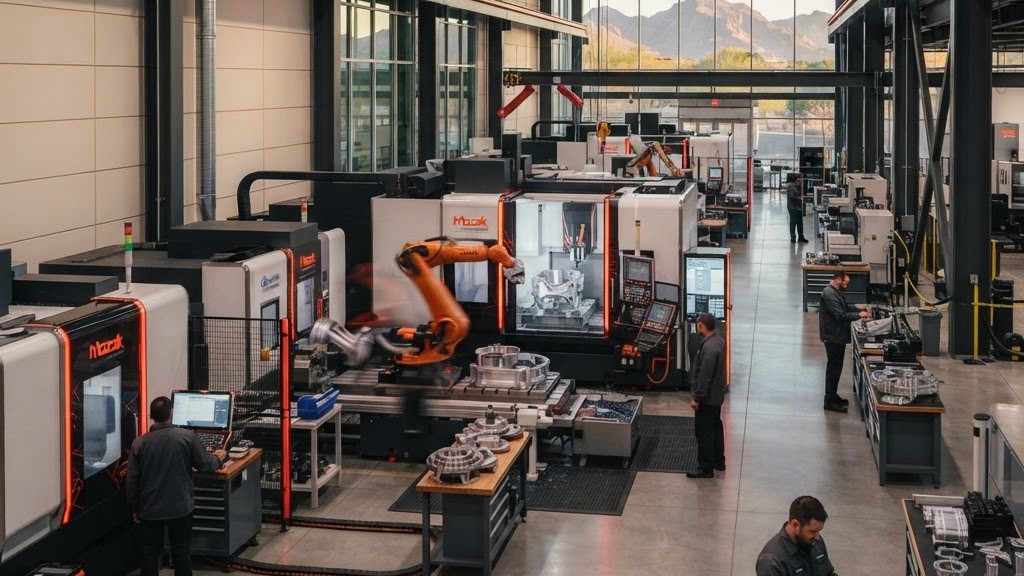
Industrial Machinery in the Valley
Phoenix's machinery sector reflects the industries surrounding it. Semiconductor plants need ultra-precise automation and process equipment; mines require rugged material-handling systems; aerospace companies demand tightly controlled machining; distribution centers invest in conveyors and robotics; and food producers need sanitary equipment that performs in a hot climate. The Valley's rapid industrial expansion has created opportunities for global equipment companies and specialized local fabricators alike. The following organizations illustrate the depth of the market.
1. ASM America
ASM has a substantial Phoenix presence supporting semiconductor wafer-processing equipment. Its systems contribute to advanced deposition and other critical fabrication steps where control at extremely small scales determines chip performance. Semiconductor equipment suppliers differentiate themselves through process expertise, uptime, precision, and rapid field support. Proximity to Arizona fabs enables close engineering collaboration and creates a specialized base of technicians.
2. Applied Materials
Applied Materials supports semiconductor manufacturers with production equipment, services, and materials engineering. As Greater Phoenix adds fabrication capacity, equipment availability and maintenance response become increasingly important. Tools in this category are major capital assets, and buyers focus on yield, throughput, contamination control, process repeatability, and lifecycle service. Applied Materials' global scale and broad process portfolio make it a significant participant in Arizona's equipment ecosystem.
3. Lam Research
Lam Research supplies wafer fabrication equipment used in etch, deposition, and cleaning processes. Its Phoenix-area activities connect the region to highly technical manufacturing support. New chip architectures require increasingly complex processes, making collaboration between equipment suppliers and fabs essential. The company's role highlights how machinery innovation enables advances often attributed only to chip designers.
4. KLA
KLA develops process-control, inspection, and metrology systems that help semiconductor producers detect defects and improve yield. These machines combine precision optics, sensors, data analysis, and automation. In a fabrication plant, finding a process problem early can prevent substantial loss. KLA's technologies are therefore central to efficient production and illustrate the growing overlap between machinery, electronics, and software.
5. Axon
Scottsdale-based Axon develops connected public-safety devices and related hardware production capabilities. Although best known as a technology company, its work involves precision manufacturing, testing systems, fixtures, automation, and durable electromechanical products. Public-safety equipment demands reliability, traceability, and rigorous quality controls. Axon's growth contributes to the Valley's broader base of advanced product manufacturing.
6. FLSmidth
FLSmidth has a strong presence serving mining and mineral-processing customers in Arizona and worldwide. Its portfolio includes crushers, mills, pumps, flotation systems, conveying solutions, and process technologies. Arizona's copper industry creates local demand for machinery that can handle abrasive material, heavy loads, dust, and continuous operation. Energy efficiency, water stewardship, maintainability, and wear life are important differentiators in this sector.
7. Komatsu Mining
Komatsu supports Arizona mining operations with large equipment, technology, parts, and service. Modern mining machinery increasingly integrates autonomous functions, fleet data, remote monitoring, and electrification. Buyers must look beyond purchase price to parts logistics, technician availability, fuel or energy consumption, rebuild options, and uptime. A strong regional service network can be as valuable as the machine itself.
8. Honeywell Aerospace
Honeywell's Phoenix operations include production and engineering related to aircraft engines, auxiliary power units, controls, and aerospace systems. These products combine complex machinery with advanced electronics and must meet strict aviation requirements. The company's local footprint supports precision machining, special processes, assembly, testing, and supplier development. Its presence has helped build a workforce familiar with high-reliability manufacturing.
9. Daifuku
Daifuku provides material-handling and automation solutions used in warehouses, factories, clean rooms, and distribution centers. Phoenix's status as a Southwest logistics hub makes conveyors, sortation, storage, and automated movement increasingly relevant. A well-designed system can improve throughput and reduce repetitive handling, but it must be matched to order profiles and peak volumes. Integration software and service response should be evaluated alongside mechanical equipment.
10. Modern Industries
Tempe-based Modern Industries provides precision machining, engineering, laboratory, and manufacturing services. Its capabilities serve industries that require close tolerances, material knowledge, and validated quality. Local companies like Modern Industries are valuable when customers need prototypes, difficult parts, or a responsive domestic supplier. Their combination of machining and technical services can shorten problem-solving cycles.
How to Compare Machinery Providers
Start with the operating requirement rather than a brand name. Define throughput, material characteristics, tolerances, environmental conditions, utilities, safety needs, and available floor space. Ask suppliers for references involving comparable applications. Total cost should include installation, training, consumables, preventive maintenance, spare parts, software subscriptions, energy use, and expected downtime. For custom systems, insist on clear acceptance testing and responsibility boundaries between vendors.
Regional Industry Trends
Automation is expanding because Phoenix manufacturers face both growth and competition for skilled labor. Predictive maintenance uses sensor data to identify developing problems before equipment fails. Semiconductor investment is raising demand for clean manufacturing, precision gas delivery, and contamination control. Mining companies are pursuing water and energy reductions, while warehouses are adopting robotics. Cybersecurity also matters because connected machinery can create operational risk if remote access and software updates are poorly managed.
Choosing the Right Phoenix Partner
Global suppliers offer broad resources and proven platforms, while local specialists can provide flexibility and fast support. Many successful projects combine both: a major original equipment manufacturer supplies the core machine, and a regional integrator handles guarding, utilities, controls, or material flow. Buyers should verify safety standards, quality credentials, technician coverage, and parts strategy. A disciplined specification and factory acceptance process will do more to ensure success than selecting equipment on initial price alone.
