
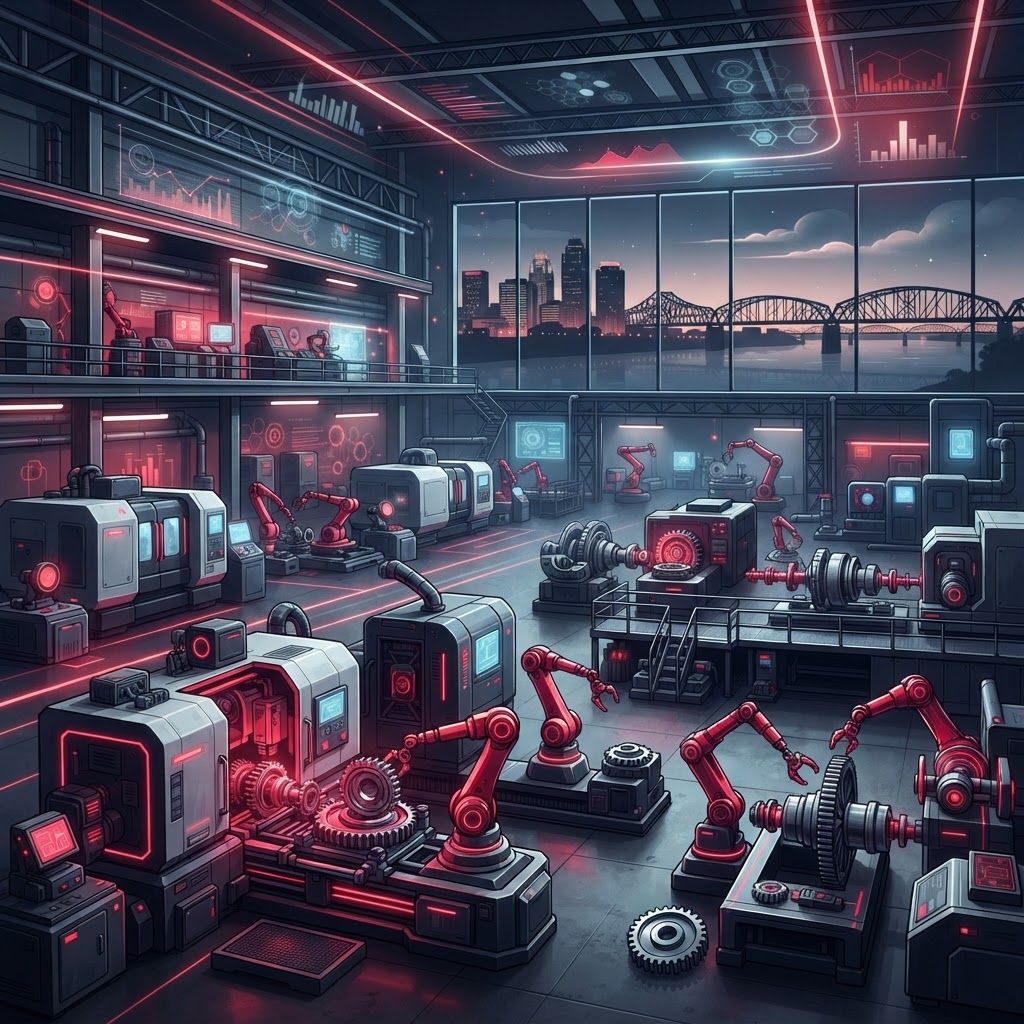
Why Louisville Is a Machinery Manufacturing Powerhouse
Louisville sits at the crossroads of the American industrial map. With the Ohio River on one side, a major rail network running through the metro, and the UPS Worldport air hub operating around the clock, the city can move heavy equipment and precision components faster than most manufacturing centers of its size. That logistics advantage has attracted machinery builders for well over a century, and it continues to reward companies that need same-day parts delivery or rapid emergency repairs.
Just as important is the local talent pool. Between technical colleges, apprenticeship programs, and generations of families who have worked in the trades, Louisville produces machinists, millwrights, tool and die makers, and controls engineers in real numbers. Machinery manufacturing is a knowledge business as much as a metal business, and that accumulated know-how is difficult for other regions to replicate quickly.
What Machinery Manufacturers in Louisville Actually Do
The category is broader than most buyers expect. Some firms design and build complete production lines, conveyors, and custom automation cells. Others specialize in rebuilding industrial gearboxes, pumps, compressors, and hydraulic systems. A third group focuses on precision machining, producing shafts, housings, rollers, and dies to tight tolerances for customers in automotive, food processing, bourbon, packaging, and aerospace. Many of the best shops in the city do all three, which is why they remain resilient through economic cycles.
The Top 10 Best Machinery Manufacturers in Louisville
1. Atlas Machine and Supply
A family-owned institution founded in Louisville and now spanning multiple states, Atlas Machine and Supply is best known for large-capacity machining, industrial compressor sales and service, and 24-hour emergency repair. Its combination of in-house heavy machining, fabrication, and field service makes it a first call when a mill, press, or gearbox goes down unexpectedly. The company is widely respected for turnaround speed on jobs other shops decline.
2. Henry Vogt Machine Company
One of the oldest names in Louisville industry, the Vogt organization built its reputation on heavy machinery, valves, and ice-making equipment. Today the legacy continues through precision valve manufacturing and engineered components for power generation and process industries. Buyers value the company for documentation quality, materials traceability, and long service life on critical-duty parts.
3. Louisville Forge and Gear Works
This specialist manufacturer produces custom gearing, sprockets, couplings, and forged components for mining, steel, marine, and heavy processing customers. Its ability to reverse-engineer obsolete gears from worn samples or damaged assemblies is a genuine differentiator for plants running legacy equipment. Heat treatment and metallurgical support are handled with unusual rigor.
4. Derby Fabricating Solutions
Derby Fabricating Solutions has grown from a regional supplier into a sophisticated manufacturer serving automotive and appliance OEMs. While much of its output is components and assemblies, its tooling, die, and automation engineering groups build the machinery that produces them. The company is known for disciplined quality systems and strong program management on high-volume launches.
5. Bluegrass Industrial Machine Works
A mid-sized machine shop serving the bourbon, food, and beverage sectors, this manufacturer designs sanitary conveyors, filling supports, agitators, and stainless steel process equipment. Distillery expansion across Kentucky has made sanitary machinery a booming niche, and shops with stainless welding credentials command real trust here. Customers frequently cite responsiveness and clean weld quality.
6. Falls City Machine and Automation
Focused on custom automation cells, robotic integration, and vision-guided inspection systems, this builder serves manufacturers looking to reduce labor dependence without replacing entire lines. Its engineers typically start with a time study rather than a hardware pitch, which tends to produce better payback math. Controls documentation and operator training are strong points.
7. Ohio Valley Precision Machining
This shop concentrates on close-tolerance CNC turning and milling for hydraulic, aerospace, and medical device customers. Investments in multi-axis machining centers and in-process metrology allow it to hold demanding tolerances repeatably across production runs. Small-batch prototyping alongside production capacity makes it useful across a product lifecycle.
8. River City Pump and Equipment
Specializing in pumps, blowers, mixers, and rotating equipment, this manufacturer both assembles new packages and rebuilds worn units to original specification. Vibration analysis, laser alignment, and predictive maintenance services extend the relationship well beyond the initial sale. Municipal water, chemical, and food plants form the core customer base.
9. Kentuckiana Conveyor and Material Handling
Warehouse and distribution growth around Louisville has created steady demand for conveyors, sortation systems, palletizers, and mezzanine structures. This manufacturer designs, fabricates, and installs complete material handling systems, then supports them with spare parts programs. Its practical approach to retrofitting existing buildings is a notable strength.
10. Portland Tool and Die Works
Named for one of Louisville's historic riverfront neighborhoods, this tool and die manufacturer builds stamping dies, progressive tooling, fixtures, and gauges. Die repair and maintenance contracts keep customer presses running, and the company's simulation work reduces costly trial iterations. It is a favored partner for metal formers who need tooling that survives high cycle counts.
Industry Trends Shaping Louisville Machinery Builders
Three trends dominate current conversations. First, automation demand has shifted from large-scale line replacement toward targeted cells that solve one labor-intensive bottleneck at a time. Second, reshoring and supply chain caution have pushed buyers toward domestic machinery sources with visible spare parts inventories. Third, data is now expected as standard: customers want machines that report cycle counts, downtime causes, and energy usage rather than operating as isolated islands on the floor.
Sustainability has also become a purchasing criterion rather than a talking point. Variable frequency drives, energy-efficient motors, compressed air optimization, and rebuild-over-replace strategies all reduce operating cost while lowering emissions. Louisville manufacturers with strong remanufacturing capability are especially well positioned for this shift.
How to Choose the Right Machinery Manufacturer
Start with capability verification rather than marketing claims. Ask for machine lists, maximum part envelopes, weight capacities, and tolerance capability studies. Request references from customers with similar duty cycles, and if possible visit the shop floor to observe housekeeping, work-in-process organization, and how measurement equipment is stored and calibrated.
Next, examine service depth. A machine purchase is a decade-long relationship, so parts availability, field technician headcount, and emergency response times matter more than the lowest quoted price. Clarify lead times in writing, understand how change orders are priced, and confirm who owns design documentation once the project is complete. Finally, evaluate cultural fit; the best supplier relationships in this industry look more like engineering partnerships than transactions.
Final Thoughts
Louisville's machinery manufacturers offer a rare combination of traditional craftsmanship and modern engineering discipline. Whether you need a rebuilt gearbox by Monday, a stainless process skid for a new distillery, or a fully integrated robotic cell, the city has a builder with genuine depth in that niche. Take the time to match your specific requirements to a supplier's real strengths, and you will find a partner capable of supporting your operation for many years.
