
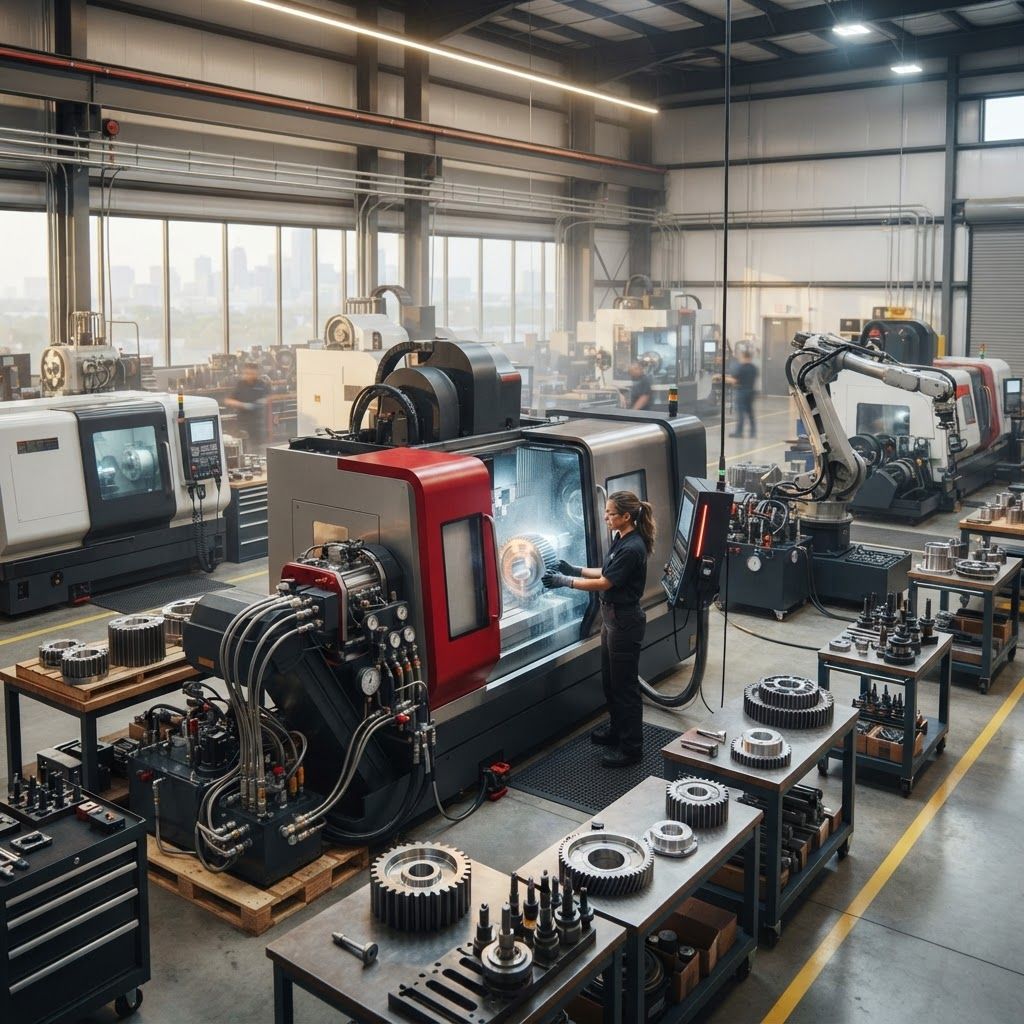
Why Fort Worth Is a Machinery Center
Fort Worth's industrial base creates demand for both massive production equipment and highly precise engineered systems. Aerospace plants require tooling and automation; construction firms need earthmoving equipment; energy companies depend on pumps and controls; and food, agriculture, and logistics operations use conveyors, packaging machines, and material-handling systems. The city's central geography and transportation access also make it a practical location for parts distribution and field service.
The companies below represent different machinery categories. Some manufacture in Fort Worth or nearby communities, while others maintain major regional operations that serve local facilities. Buyers should verify the exact scope of each location and seek suppliers with proven experience in the intended duty cycle.
1. Caterpillar
Caterpillar is a global leader in construction and mining machinery, engines, and power systems, with a strong dealer and service presence in North Texas. Fort Worth contractors rely on its broad equipment ecosystem for earthmoving, grading, loading, and power generation. Product depth, parts availability, telematics, and resale recognition are key differentiators. Buyers should compare utilization and service costs when deciding between ownership, rental, and leasing.
2. Holt CAT
Holt CAT supports Caterpillar equipment users across Texas through sales, rentals, parts, rebuilds, and field service. Although it is primarily a dealer and service organization rather than an original manufacturer, its regional infrastructure is central to machinery uptime in Fort Worth. The ability to access trained technicians and replacement components can materially affect project schedules and lifecycle cost.
3. Bell Textron
Bell manufactures highly complex rotorcraft in the Fort Worth region. Aircraft production involves precision machinery, composite fabrication, assembly tooling, drive systems, and rigorous test equipment. Bell's inclusion reflects the advanced mechanical engineering concentrated locally. Its programs demonstrate the value of configuration control, repeatable processes, and long-term support in machinery built for safety-critical applications.
4. Lockheed Martin
Lockheed Martin's Fort Worth facility integrates advanced manufacturing machinery at exceptional scale. Automated drilling, precision fixtures, robotics, metrology, and material-handling systems support aircraft production. While the company primarily manufactures aerospace products, its operation is a regional model for digital manufacturing. Local suppliers can learn from its emphasis on traceability, process capability, and tightly controlled tooling.
5. FLSmidth
FLSmidth provides equipment and services for mining and materials processing, including crushing, conveying, separation, and related systems. Its capabilities are relevant to Texas aggregate, cement, and minerals operations. The company differentiates through process knowledge and engineered systems rather than isolated machines. Buyers should evaluate throughput guarantees, wear-part strategy, energy demand, and commissioning support.
6. Flowserve
Irving-based Flowserve is a major manufacturer of pumps, valves, seals, and flow-control equipment serving energy, chemical, water, and industrial markets throughout Fort Worth. Its products operate in demanding environments where reliability and materials compatibility matter. Engineering depth, global service, and a broad installed base distinguish the company. Correct sizing and maintenance planning are critical to avoiding inefficiency and downtime.
7. Lennox
Richardson-based Lennox manufactures heating, ventilation, and air-conditioning equipment and has a substantial North Texas presence. Its systems are essential machinery for Fort Worth homes, factories, offices, and institutions facing long, hot summers. Energy efficiency, controls, serviceability, and climate performance are key considerations. Commercial buyers should evaluate part-load operation and maintenance access, not merely nominal capacity.
8. Trinity Industries
Dallas-based Trinity Industries is closely associated with rail transportation equipment and services. Railcars are large engineered assets that combine structural fabrication, braking, running gear, coatings, and regulatory requirements. The company's regional presence supports the freight economy serving Fort Worth. Industrial shippers should assess fleet availability, commodity compatibility, maintenance, and network strategy when considering rail equipment.
9. Cummins
Cummins manufactures engines, generators, power systems, and related components supported through North Texas distribution and service channels. Its equipment serves construction sites, hospitals, data centers, fleets, and industrial facilities. A broad power portfolio and mature service network are major strengths. Buyers should define load profiles, emissions requirements, fuel availability, redundancy, and testing plans before choosing a system.
10. Local Automation and Machine Shops
Independent Fort Worth machine builders, integrators, and precision shops create fixtures, conveyors, robotic cells, control panels, replacement parts, and one-off production equipment. They can respond quickly and collaborate closely during commissioning. Their flexibility is particularly useful for retrofits and high-mix manufacturing. Customers should review similar projects, engineering documentation, safety practices, software ownership, and support commitments.
Qualifying a Machinery Supplier
A disciplined procurement process begins with measurable requirements: capacity, accuracy, cycle time, utilities, environment, safety, and expected availability. Request references for comparable applications and discuss installation, operator training, spare parts, preventive maintenance, and emergency response. Fort Worth's industrial growth is accelerating adoption of sensors, predictive maintenance, automation, and energy-efficient drives. Even so, maintainability and sound mechanical design remain fundamental. The strongest supplier will offer transparent engineering, realistic performance assumptions, and dependable support over the machine's full life. Buyers should document acceptance criteria before placing an order and retain maintenance records after commissioning, creating a practical baseline for reliability improvements.
