
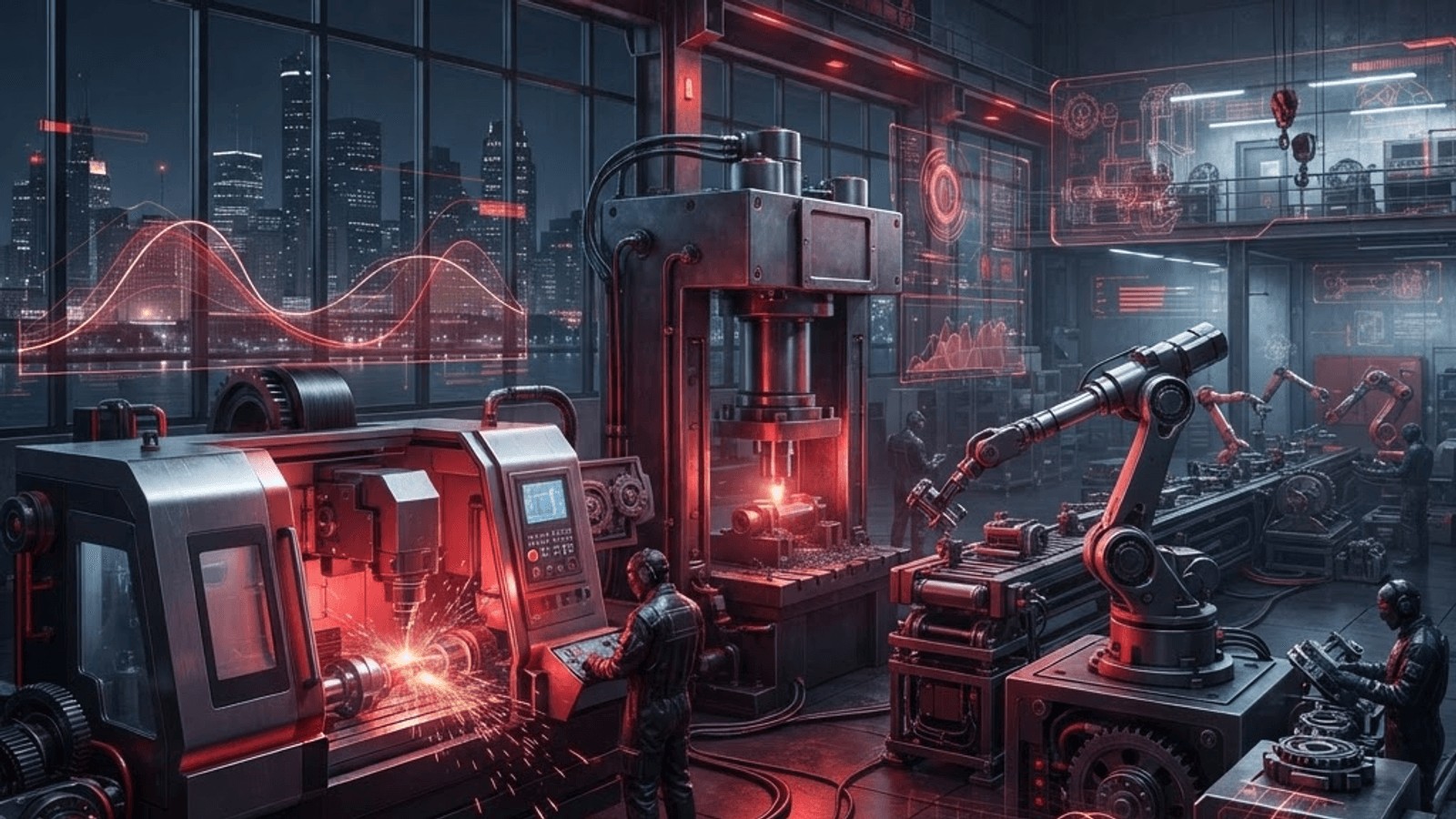
The Machines Behind Detroit Manufacturing
Detroit is famous for what it builds, but the region's deeper competitive advantage may be its ability to build the machines that build things. Machine tools, robotic work cells, transfer lines, presses, test stands, conveyors, and specialized fixtures are all designed and manufactured in southeast Michigan. This capital equipment sector supports the automotive industry that gave rise to it, and it exports expertise to aerospace, appliance, medical device, food processing, and energy customers across the world.
The work sits at the intersection of mechanical design, controls engineering, and skilled fabrication. A single automated assembly cell may combine servo motion, vision inspection, pneumatics, safety interlocks, robotics, and custom tooling, all integrated to a cycle time measured in seconds. Few regions have as many people who have done this successfully as many times.
What Makes a Machinery Builder Reliable
Capital equipment purchases carry real risk. A late or underperforming machine can delay an entire production program. The best Detroit machinery manufacturers reduce that risk through disciplined engineering practices: thorough requirement definition, design reviews before fabrication, simulation of cycle time and reach, standardized controls architecture, comprehensive factory acceptance testing, and clear documentation. Equally important is service capability, because equipment expected to run for fifteen or twenty years will need spare parts, controls upgrades, and technical support long after installation.
1. Automation Integrators and Robotic Cell Builders
System integrators are the backbone of Detroit's machinery sector. They design and build robotic welding, dispensing, assembly, and material handling cells, integrating robots, end effectors, vision, and safety systems into turnkey production equipment. Their strength lies in project management and controls engineering as much as mechanical design.
2. Machine Tool Builders and Rebuilders
Detroit-area companies build and rebuild CNC machining centers, grinders, honing machines, and specialty metal-cutting equipment. Rebuilding is a particularly valuable service, restoring geometric accuracy and modernizing controls on machines whose castings remain sound, at a fraction of new equipment cost.
3. Special Machine and Custom Equipment Manufacturers
When no catalog machine exists, special machine builders design equipment from scratch. Detroit firms in this category produce leak test stands, press-fit and assembly stations, laser welding systems, and end-of-line functional test equipment tailored to a single part family.
4. Press, Stamping, and Metal Forming Equipment Makers
Metal forming equipment manufacturers supply mechanical and servo presses, coil handling and feeding lines, transfer systems, and die change equipment. Their customers include stamping plants across North America where uptime and part-to-part consistency determine profitability.
5. Conveyor and Material Handling Systems Manufacturers
Material handling builders design and fabricate power and free conveyors, automated storage systems, autonomous mobile robot integrations, and plant-wide part flow solutions. Their work directly governs how efficiently a factory moves work in process, which is often the hidden constraint in production throughput.
6. Tooling, Fixture, and Gauge Manufacturers
Precision tooling and fixture shops produce workholding, welding fixtures, assembly nests, and inspection gauges. Because a machine is only as accurate as the fixture holding the part, these suppliers carry outsized influence over quality outcomes, and Detroit's concentration of skilled toolmakers is a genuine regional asset.
7. Hydraulic and Pneumatic Systems Manufacturers
Fluid power manufacturers build hydraulic power units, cylinders, manifolds, and pneumatic assemblies for industrial machinery. Their engineering support on circuit design, filtration, and thermal management prevents the reliability problems that plague poorly specified fluid power systems.
8. Industrial Furnace and Heat Treating Equipment Builders
Heat treatment is essential to metal component performance, and Detroit-area builders manufacture furnaces, quench systems, induction hardening equipment, and atmosphere control systems. Energy efficiency and process repeatability are the dominant competitive factors in this segment.
9. Machine Vision and Inspection Equipment Providers
Automated inspection has become standard rather than optional. Providers in the region build vision systems, coordinate measuring machine integrations, laser scanning stations, and in-line dimensional gauging equipment, often paired with data collection systems that support statistical process control.
10. Machinery Service, Retrofit, and Controls Upgrade Firms
Many Detroit plants operate mechanically sound equipment with obsolete controls. Retrofit specialists replace legacy programmable logic controllers, drives, and human-machine interfaces, add remote monitoring, and bring safety systems up to current standards, extending asset life substantially at modest cost.
Trends in Industrial Machinery
Several developments are changing how machinery is built and bought. Collaborative robots have expanded automation into low-volume and mixed-model applications where fenced cells were never justifiable. Digital twins allow builders to simulate and debug equipment before steel is cut, reducing commissioning time. Condition monitoring and predictive maintenance sensors are being designed into new machines as standard, turning service into a data-driven activity. Modular, reconfigurable equipment is gaining favor as manufacturers face shorter product cycles and uncertain volumes. Finally, energy efficiency has become a purchasing criterion, with servo-driven systems replacing continuously running hydraulics in many applications.
How to Evaluate a Machinery Manufacturer
Write a detailed specification covering cycle time, capability requirements, part variants, controls platform, safety standard, and acceptance criteria before requesting quotes. Ask to see similar equipment running, ideally at a customer site rather than only in the build bay. Clarify who owns the design and documentation, what spare parts are recommended, and how long support will be available. Evaluate the builder's controls standards, since a nonstandard architecture creates long-term maintenance burden for your team. Structure payment milestones around design review, factory acceptance, and site acceptance rather than calendar dates.
Final Thoughts
Detroit's machinery manufacturers combine deep engineering experience with hands-on fabrication skill, producing equipment that runs reliably for decades in demanding environments. Whether you need a robotic cell, a rebuilt machining center, a custom test stand, or a controls retrofit, the metro area offers a supplier base that understands production realities because it has lived them.
