
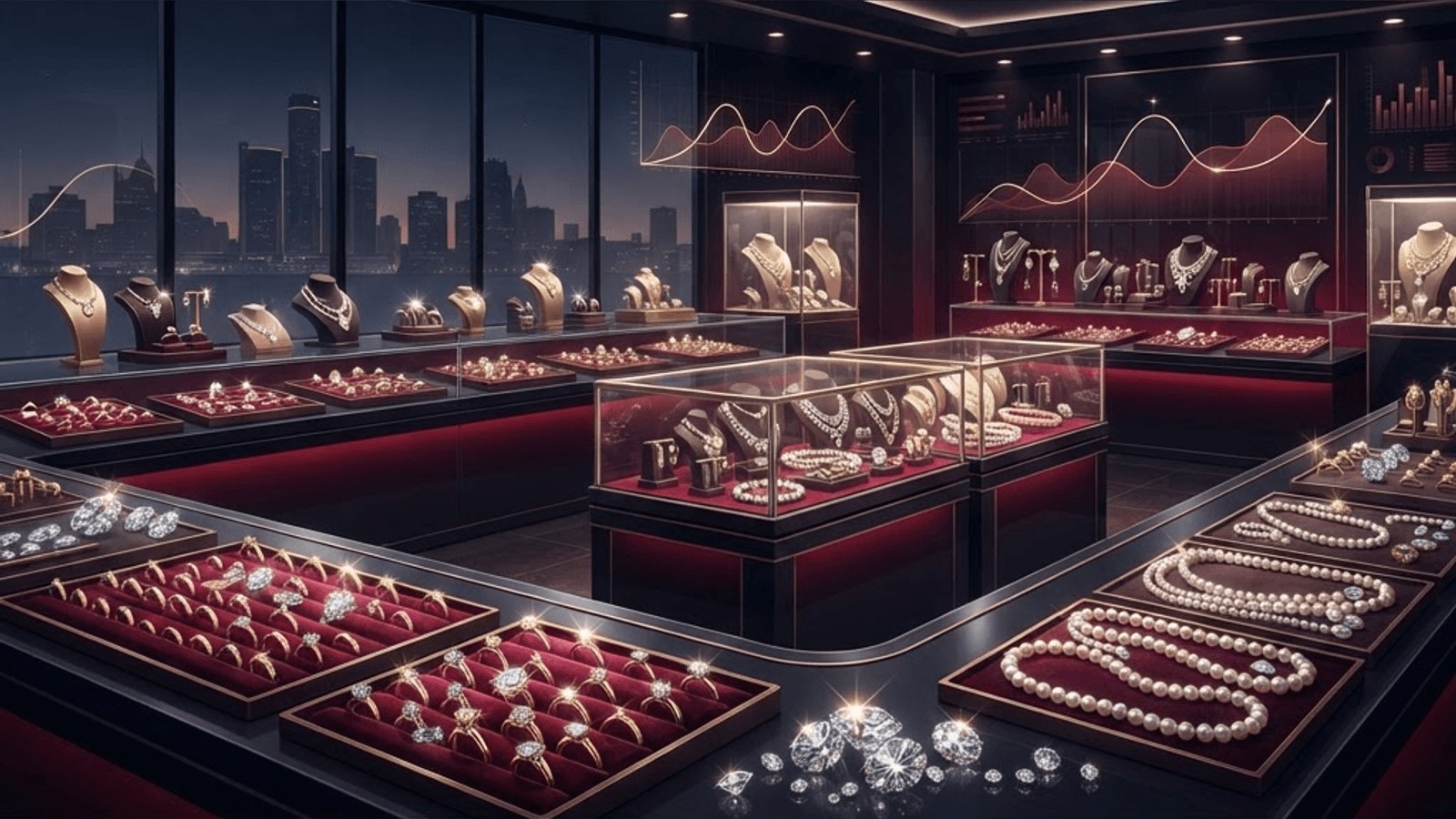
Detroit's Jewelry Trade: Heritage Meets New Energy
Detroit has long supported a serious jewelry community. Generations of family-owned jewelers built reputations on bridal collections, custom design and expert repair, while the region's manufacturing culture produced a surprising depth of bench talent, casting expertise and metalworking knowledge. Today that heritage coexists with a wave of independent designers, studio jewelers and boutique retailers drawn to the city's creative resurgence.
Supporting all of them is a wholesale layer that most consumers never see. Jewelry wholesalers supply finished pieces, loose diamonds and colored gemstones, findings, mountings, precious metal in casting and sheet form, tools, packaging and display fixtures. Some operate as traditional showrooms serving retail accounts; others function as trade-only suppliers to bench jewelers and designers. Understanding who does what is the first step toward building a sound sourcing strategy.
Segments of the Jewelry Wholesale Market
Finished goods wholesalers supply ready-to-sell collections across bridal, fashion, gold, silver and branded categories, typically with programs for stock balancing, memo consignment and seasonal replenishment. Diamond and gemstone dealers supply loose stones, increasingly with grading documentation from recognized laboratories, and often serve both retailers and custom designers.
Findings and mounting suppliers provide the components of jewelry manufacturing: settings, clasps, chains, earring backs and semi-mounts awaiting a center stone. Precious metal suppliers deliver casting grain, sheet, wire and solder, and many also operate refining services that let jewelers recover value from scrap. Finally, equipment and packaging suppliers furnish the tools, torches, polishing systems, cases and boxes that make a retail or studio operation function.
Ten Jewelry Wholesalers and Suppliers Serving Detroit
Stuller is one of the most widely used trade suppliers in North America. Detroit bench jewelers and designers rely on it for an enormous catalog of mountings, findings, diamonds, gemstones, tools and metals, combined with fast fulfillment that supports custom work on tight timelines.
Rio Grande serves the studio and artisan segment particularly well, supplying metals, gemstones, tools and consumables alongside educational resources that help independent makers refine technique and finishing quality.
Quality Gold distributes a broad assortment of gold, silver and fashion jewelry to independent retailers, with strong programs for everyday inventory categories such as chains, earrings, religious pieces and gift items that drive steady turn.
Hoover & Strong has built its reputation on responsible sourcing, offering recycled precious metals, ethically sourced stones and refining services, which resonates strongly with retailers whose customers ask about provenance.
United Precious Metal Refining supports the manufacturing side with casting alloys, plating solutions and refining, valuable for Detroit studios producing their own pieces rather than reselling finished goods.
Rand Diamond and comparable diamond dealers serve the loose stone market, supplying certified natural and laboratory-grown diamonds across a range of budgets, with memo arrangements that let retailers present options without carrying full inventory risk.
Gabriel & Co. supplies designer bridal and fashion collections to independent jewelers, offering recognizable design identity and marketing support that helps smaller stores compete with national chains.
Midwest Jewelers Supply and similar regional trade houses provide the practical backbone of the local market: tools, findings, repair components and quick-turn supplies for shops that cannot wait on national shipping.
Gemworld and colored stone specialists serve growing demand for sapphires, emeralds, rubies and unusual gemstones as consumers seek alternatives to traditional diamond engagement rings.
Detroit-area estate and antique jewelry dealers operate a distinctive wholesale niche, supplying vintage and pre-owned pieces to retailers building curated collections, a category that has expanded significantly alongside interest in sustainability and unique design.
Trends Shaping Jewelry Wholesale
Laboratory-grown diamonds represent the most consequential shift in decades. Their rapid price decline and improving quality have reshaped bridal assortments, compressed margins on natural stones in some ranges and forced retailers to develop clear positioning and disclosure practices. Wholesalers now typically supply both categories, and the strongest ones help retailers explain the difference honestly.
Traceability and ethical sourcing have moved from marketing language to genuine expectation. Recycled gold, documented conflict-free supply chains and transparency about gemstone origin increasingly influence purchasing, particularly among younger buyers. Suppliers with credible chain-of-custody documentation hold a real advantage.
Customization is the third major trend. Consumers want pieces that feel personal, which favors wholesalers supplying semi-mounts, loose stones and rapid manufacturing support rather than only finished inventory. Advances in computer-aided design and precision casting have made bespoke work commercially viable for small studios, a development that suits Detroit's maker culture especially well.
How Retailers and Designers Should Choose Suppliers
Inventory strategy should drive supplier selection. A retailer focused on bridal needs strong mounting selection, reliable stone sourcing and memo flexibility. A gift-oriented store needs fast-turning silver and gold basics at predictable margins. A design studio needs metals, findings and casting support more than finished goods.
Verify documentation rigorously. Grading reports from respected laboratories, metal purity certification and clear disclosure of treatments or laboratory-grown origin protect both margin and reputation. A single undisclosed treatment discovered by a customer can damage trust built over years.
Assess practical terms carefully: minimum order requirements, return and stock-balancing policies, repair part availability, turnaround on special orders and how quickly the supplier resolves quality issues. In a category where a delayed engagement ring is a genuine crisis, responsiveness carries enormous weight.
The Outlook for Detroit
Detroit's jewelry market benefits from a rare combination: established multigenerational retailers, a growing independent design community and a manufacturing culture that respects craftsmanship. Wholesalers serving this market are responding with broader laboratory-grown offerings, stronger sustainability credentials and faster support for custom work. For retailers and designers, the opportunity lies in pairing dependable core inventory suppliers with trade partners who make original, personal pieces possible.
