
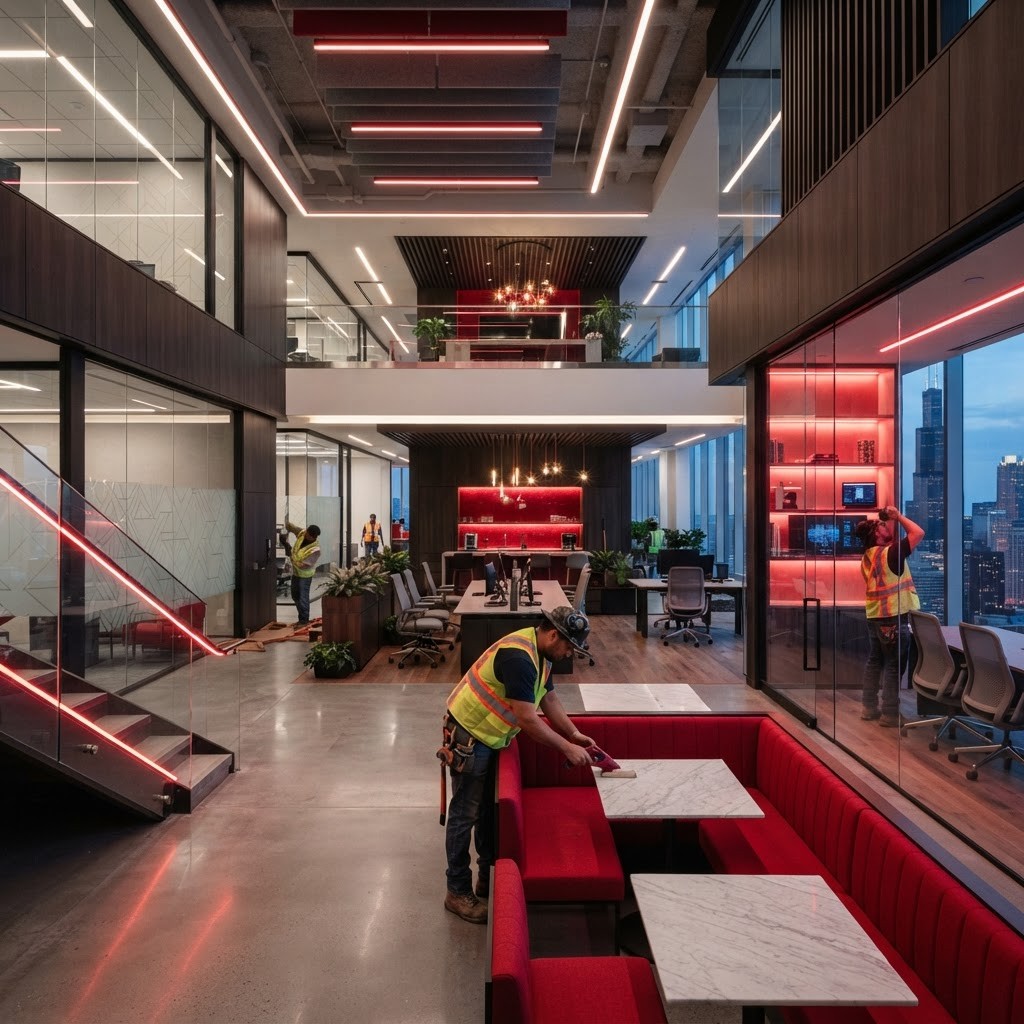
The Value of a Specialized Fitout Contractor
Interior fitouts are fast, coordination-heavy projects. Mechanical distribution, lighting, technology, millwork, furniture, acoustics, and brand elements must come together within a fixed move date. In Chicago, teams also manage high-rise loading restrictions, occupied neighbors, union requirements, and building-specific approvals. These ten firms have meaningful experience delivering commercial interiors in the region.
1. Skender
Skender has a particularly strong reputation in Chicago commercial interiors. The company uses lean planning, technology, and close trade coordination to manage sophisticated workplaces and other interior environments. Its teams understand the importance of early procurement, mockups, and clear decision schedules on compressed projects.
2. Clune Construction
Clune Construction was founded in Chicago and is widely recognized for corporate interiors and mission-critical work. The firm has experience delivering polished spaces for prominent clients while navigating occupied buildings and complex technical requirements. Its national reach also helps organizations seeking consistency across multiple locations.
3. Leopardo Companies
Leopardo provides interior construction for workplace, retail, healthcare, and hospitality clients. Its local resources and broad construction platform support projects ranging from modest renovations to multi-floor buildouts. The company’s preconstruction capabilities help teams align design ambition with available budget and schedule.
4. Executive Construction
Executive Construction specializes in interiors and has built a deep portfolio across corporate, technology, professional services, and specialty spaces. The firm’s focus encourages detailed knowledge of finish sequencing, building operations, and client move requirements. It is frequently considered for high-quality workplace projects in central Chicago.
5. J.C. Anderson
J.C. Anderson is a Chicago-area general contractor with decades of interiors experience. The firm works across office, healthcare, education, retail, and building repositioning. Its repeat-client culture and familiarity with local properties can be valuable when construction must be phased around ongoing business operations.
6. GMA Construction Group
GMA Construction Group delivers commercial, institutional, and community-focused construction, including interior buildouts. The firm combines technical execution with a strong commitment to inclusive participation and neighborhood impact. It is relevant to clients who view project delivery and community value as connected priorities.
7. Bulley & Andrews
Bulley & Andrews performs interior construction alongside ground-up, restoration, and institutional work. Its craftsmanship and experience in notable buildings support renovations where new interiors interact with existing architecture. The company is well positioned for projects involving premium materials or sensitive historic conditions.
8. Pepper Construction
Pepper Construction brings technical depth and high-performance expertise to commercial interiors. Its teams can address complex building systems, sustainability goals, and construction within occupied environments. The firm’s quality-control approach is useful when details and operational reliability carry equal importance.
9. Power Construction
Power Construction’s interiors capabilities benefit from the resources of a major Chicago builder. It can support tenant buildouts, repositioning, hospitality spaces, and interior components of larger developments. Strong local subcontractor relationships help with pricing, procurement, and schedule planning.
10. Skyline Construction
Skyline Construction delivers commercial interior projects with an emphasis on collaborative service and predictable execution. Its experience across modern workplaces and technology-driven clients supports agile scheduling and detailed coordination. Organizations with evolving workplace standards may value a contractor accustomed to fast decision cycles.
Interior Fitout Trends
Chicago workplaces are becoming more flexible, hospitality-oriented, and technology-rich. Clients are investing in acoustic comfort, varied collaboration settings, wellness rooms, adaptable furniture, and improved indoor air quality. Reuse is also gaining importance: teams increasingly retain ceilings, partitions, furniture, or materials to reduce waste and embodied carbon. Reality capture and model-based coordination help contractors verify dense overhead systems before installation.
How to Compare Fitout Teams
Look beyond the corporate portfolio and meet the proposed superintendent, estimator, and project manager. Ask about occupied-space protocols, long-lead items, building relationships, after-hours work, and commissioning. Review how bids are leveled and how scope gaps are identified. A fitout company should also provide a detailed milestone schedule covering design release, permits, procurement, construction, furniture, technology, inspections, and move-in. The best partner protects the opening date without sacrificing safety or finish quality.
Planning for a Successful Chicago Project
Before work starts, owners should document existing conditions and define who is responsible for design, permits, material selections, access, protection, inspections, and final cleanup. Chicago schedules should account for building management rules, neighborhood constraints, seasonal weather, and products with long manufacturing lead times. It is wise to keep a reasonable contingency for concealed conditions, especially in older properties. Written meeting notes, current drawings, approved samples, and a shared decision log reduce misunderstandings as work progresses.
References are most useful when they come from recent projects with a similar building type and scope. Ask those clients whether the team maintained the site, communicated upcoming decisions, handled changes fairly, and returned promptly for closeout items. Review the contract carefully and avoid relying on verbal assumptions. Payment milestones should correspond to verifiable progress, while warranties should identify both covered work and the process for requesting service. Finally, remember that a ranked list is a starting point rather than a substitute for due diligence. Availability, staffing, and company focus can change. Interview multiple qualified providers, compare equivalent scopes, verify current credentials, and choose the team that demonstrates technical competence, transparent communication, and a realistic understanding of the project.
