
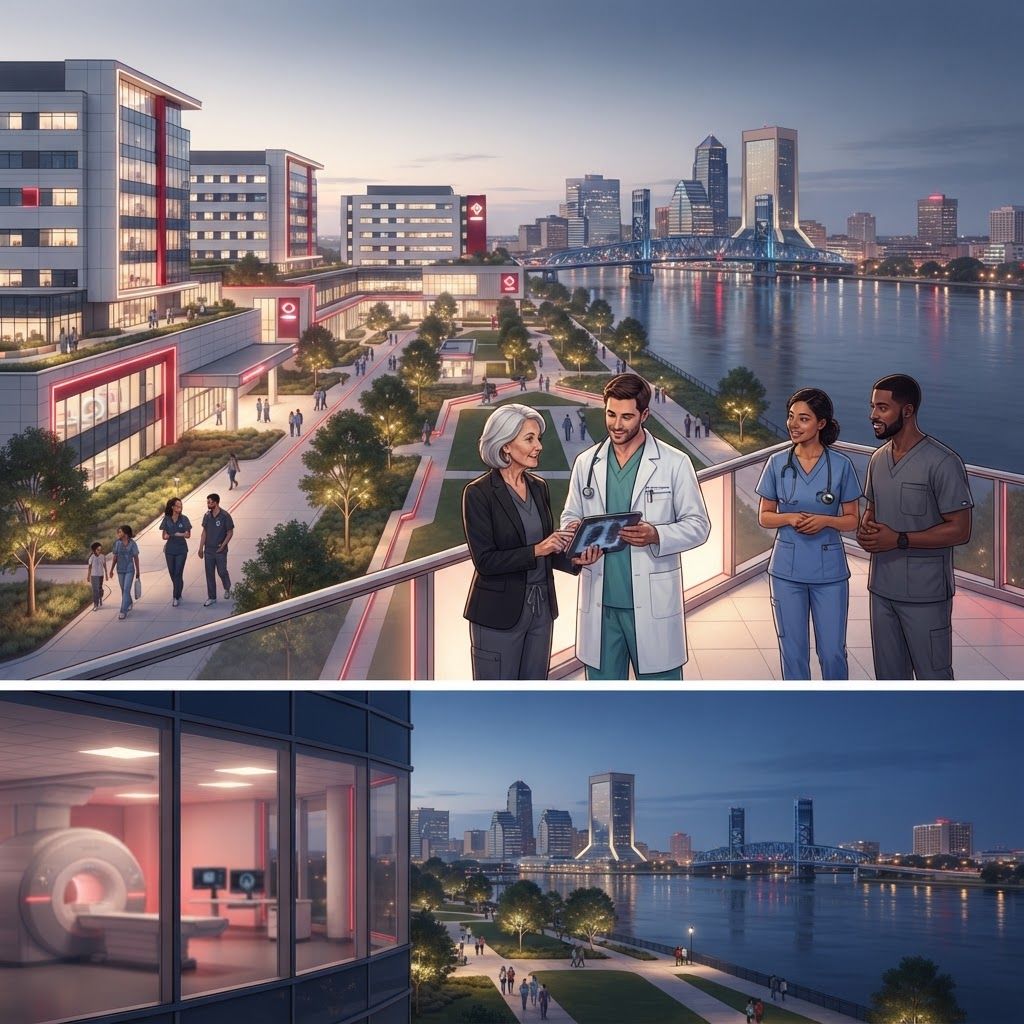
Jacksonville's Hospital Landscape
Jacksonville serves patients from across Northeast Florida, Southeast Georgia, and beyond. Its hospital network ranges from internationally known specialty medicine to academic trauma care, children's services, community campuses, rehabilitation, and military medicine. The best hospital is not simply the largest or most famous; it is the facility with the right specialists, insurance participation, urgency level, and continuity for a particular patient.
The following list focuses on major hospitals and campuses with notable roles in the region. Hospital capabilities, affiliations, and services evolve, so patients should verify current details through their physician and insurer. For a life-threatening emergency, seek immediate emergency assistance rather than comparing facilities.
1. Mayo Clinic Hospital in Florida
Mayo Clinic's Jacksonville campus is a destination for complex and multidisciplinary care. Its integrated model brings specialists, diagnostics, research, and hospital treatment together, which can benefit patients with uncommon conditions or cases requiring several departments. The campus is especially recognized for advanced specialty programs and a coordinated approach to difficult diagnoses.
2. UF Health Jacksonville
UF Health Jacksonville is an academic health center with a central role in trauma, emergency care, teaching, research, and care for diverse communities. Its connection to the University of Florida supports specialist access and clinical education. Patients with severe injuries or complicated urban emergency needs may encounter resources not available at smaller community facilities.
3. Baptist Medical Center Jacksonville
Baptist Medical Center Jacksonville is a major downtown hospital within the region's broad Baptist Health network. It provides comprehensive medical and surgical services and connects with specialty institutes across the system. Its central location and network relationships can support continuity among primary, specialty, inpatient, and follow-up care.
4. Wolfson Children's Hospital
Wolfson Children's Hospital is Northeast Florida's dedicated children's hospital and a crucial referral center for pediatric specialty care. Child-focused physicians, nurses, equipment, and support services distinguish it from adult hospitals that treat some younger patients. Families benefit from an environment designed around developmental needs and caregiver involvement.
5. Ascension St. Vincent's Riverside
Ascension St. Vincent's Riverside has a longstanding presence in Jacksonville and serves the urban core with a broad range of hospital services. Its history, specialty care, and connections within the Ascension network make it a familiar choice for many local families. Location can be especially convenient for Riverside, Avondale, and nearby communities.
6. HCA Florida Memorial Hospital
HCA Florida Memorial Hospital is a full-service acute-care hospital serving central and eastern Jacksonville. It offers emergency, surgical, cardiovascular, and other inpatient and outpatient services. As part of a large statewide network, it can draw on standardized systems and regional resources while maintaining a substantial local clinical presence.
7. Baptist Medical Center South
Baptist South supports fast-growing communities along Jacksonville's southern corridor. The campus offers hospital and emergency services closer to neighborhoods that might otherwise face a long trip downtown. Its location, modern facilities, and connection to the Baptist network make it practical for both planned and urgent care in southern Duval County.
8. Ascension St. Vincent's Southside
Ascension St. Vincent's Southside serves a densely populated area near major residential and business corridors. It provides emergency, surgical, and medical services within the broader Ascension system. For many patients, proximity and established physician relationships are major advantages, especially when follow-up visits or family support require repeated travel.
9. Naval Hospital Jacksonville
Naval Hospital Jacksonville serves eligible active-duty service members, retirees, and military families. Its mission, access rules, and care pathways differ from civilian hospitals, but it is an important part of the region's healthcare infrastructure. Familiarity with military life and coordinated beneficiary services can be particularly valuable to Jacksonville's large defense community.
10. Brooks Rehabilitation Hospital
Brooks Rehabilitation Hospital focuses on intensive inpatient rehabilitation rather than general acute care. It supports people recovering from stroke, spinal cord injury, brain injury, complex orthopedic conditions, and other disabling illnesses. Specialized therapy teams, rehabilitation physicians, and adaptive resources make it a leading choice when recovery and functional independence are the primary goals.
Specialization Matters More Than a Simple Ranking
A hospital known for complex specialty medicine may not be the most efficient place for routine care, while a nearby community hospital may be ideal for common procedures and easier family access. Trauma designation, pediatric capability, transplant services, rehabilitation intensity, and high-risk maternity resources are examples of distinctions that matter for specific situations.
Patients should ask referring physicians where they have privileges, which hospital team handles the relevant condition most often, and how records will move between systems. Experience with a specific procedure can be more informative than overall size. Public quality measures offer useful context but should be interpreted alongside case complexity and patient needs.
Insurance, Access, and Practical Planning
Confirm that both the facility and individual clinicians participate in the insurance plan whenever care is scheduled. An in-network hospital does not automatically guarantee that every professional involved is in network. Ask about authorization, estimated patient responsibility, facility charges, and financial assistance. Emergency protections may apply differently, so retain all documentation.
Jacksonville travel time varies considerably by neighborhood, bridge traffic, and weather. For planned treatment, consider parking, lodging, caregiver access, pharmacy needs, and follow-up frequency. Patient portals and centralized records are helpful, but bringing an updated medication list, allergy information, and concise medical history remains good practice.
Building a Safer Care Experience
Patients and caregivers should understand the care plan, expected tests, medication changes, discharge warning signs, and whom to call with questions. Request an interpreter when needed and use patient advocates or case managers for complex transitions. Before leaving, reconcile medications and confirm follow-up appointments.
Jacksonville's hospital ecosystem is a regional asset because its institutions serve different missions. Matching those strengths to the patient's condition, coverage, and practical circumstances leads to a more useful decision than any universal ranking could provide.
