
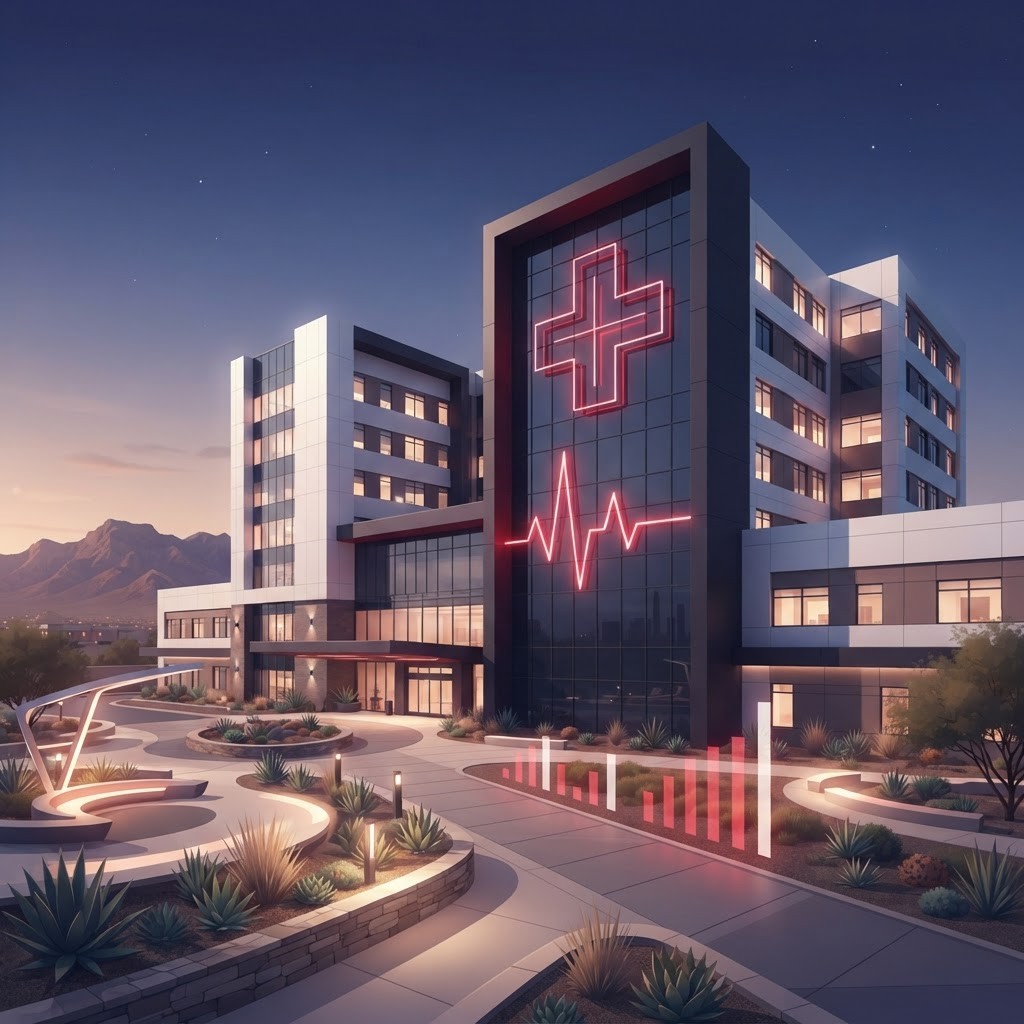
El Paso occupies an unusual position in American healthcare. As the largest city on the United States and Mexico border in Texas, it serves not only its own population of roughly 700,000 but also surrounding communities in Southern New Mexico, West Texas, and Ciudad Juárez. That responsibility has produced a hospital system that combines academic medicine, trauma care, military healthcare, and specialized pediatric services within a relatively compact geography.
Understanding El Paso's Hospital Landscape
The region's care is delivered largely through several hospital networks operating multiple campuses, supplemented by a public teaching hospital, a dedicated children's hospital, military facilities serving Fort Bliss, and veteran healthcare services. This structure matters for patients because facility capability varies significantly. Not every emergency department offers the same level of trauma readiness, and not every campus performs advanced cardiac, neurological, or oncological procedures. Knowing where specialty capacity actually sits can meaningfully affect outcomes.
Evaluation Approach
Hospitals below were assessed on emergency and trauma capability, breadth of specialty services, accreditation and quality certifications, availability of advanced diagnostic and surgical technology, academic and research involvement, nursing and staffing strength, and community reputation. Geographic accessibility across El Paso's spread-out neighborhoods was also considered.
The Top 10 Hospitals in El Paso
1. University Medical Center of El Paso
As the region's public teaching hospital and home to the area's highest-level trauma program, UMC is the backbone of critical care in West Texas and Southern New Mexico. Its affiliation with a medical school supports academic medicine, resident training, and access to complex care that community hospitals refer out. Strengths include trauma surgery, burn care, stroke response, and comprehensive outpatient clinics serving underinsured populations.
2. The Hospitals of Providence Memorial Campus
One of the oldest hospitals in the city, the Memorial Campus offers broad acute care with notable programs in cardiology, orthopedics, women's services, and neurosciences. Its central location makes it highly accessible, and its long tenure has produced deep community trust across generations of El Paso families.
3. Del Sol Medical Center
Serving the East side, Del Sol combines a busy emergency department with strong cardiovascular, stroke, and rehabilitation services. It is frequently recognized for cardiac intervention capability and for maintaining substantial critical care capacity in one of the city's fastest-growing residential corridors.
4. Las Palmas Medical Center
Centrally located, Las Palmas is known for surgical services, women's and maternity care, and a well-developed cardiovascular program. Its size and specialty depth make it a common destination for planned procedures as well as acute admissions.
5. El Paso Children's Hospital
The region's only dedicated pediatric hospital provides specialized care that general facilities cannot match, including pediatric intensive care, pediatric surgery, hematology and oncology, and neonatal services. For families across the borderland, it eliminates the need to travel hundreds of miles for advanced children's care.
6. The Hospitals of Providence Transmountain Campus
A newer facility positioned to serve the Northwest and Northeast, the Transmountain Campus features modern infrastructure, an academic teaching component, and comprehensive emergency, surgical, and imaging services. Its contemporary design supports efficient patient flow and updated technology.
7. The Hospitals of Providence Sierra Campus
Located near the medical corridor on the Westside, Sierra Campus provides acute care with recognized programs in orthopedics, spine, bariatrics, and women's health. Patients often note shorter wait times relative to larger central facilities for scheduled care.
8. The Hospitals of Providence East Campus
Built to meet demand from El Paso's expanding East side, this campus delivers emergency services, maternity care, surgery, and imaging close to residential growth areas. Proximity is a genuine clinical advantage in time-sensitive situations such as chest pain or stroke symptoms.
9. William Beaumont Army Medical Center
Serving active-duty service members, military families, and retirees connected to Fort Bliss, this facility provides comprehensive inpatient and outpatient military medicine. Its modern campus supports surgical services, behavioral health, and specialty clinics tailored to the military community's needs.
10. El Paso VA Health Care System
Rounding out the list, the VA system delivers primary care, mental health services, specialty clinics, and coordinated community care for regional veterans. Its integrated approach to chronic disease management, prosthetics, and post-service rehabilitation fills a distinct and essential role.
Healthcare Trends Affecting El Paso Patients
Several developments are reshaping local care. Academic expansion tied to medical education has increased physician retention, easing longstanding specialist shortages. Telehealth adoption has grown significantly, improving access for patients in outlying communities and reducing travel for follow-up visits. Freestanding emergency centers and ambulatory surgery centers have shifted lower-acuity volume away from hospital campuses, shortening some wait times. Binational health dynamics also remain distinctive, with cross-border patient flow influencing capacity planning and public health strategy.
How to Choose the Right Hospital
For life-threatening emergencies, do not attempt to select a preferred hospital; call emergency services and let responders route you to the appropriate trauma or stroke-capable center. For planned care, verify that the facility performs your specific procedure in meaningful volume, confirm that both the hospital and the individual physician are in your insurance network, and ask about anesthesia and pathology billing separately. For pediatric needs, prioritize facilities with dedicated pediatric intensive care. Requesting your care team's experience with your particular condition is reasonable and often clarifying.
Final Thoughts
El Paso's hospital ecosystem is stronger and more specialized than many outsiders assume, spanning trauma, academic medicine, pediatrics, military healthcare, and veteran services. The practical takeaway is to know your options before you need them: identify the nearest emergency department, understand which campus handles your chronic condition best, and keep your insurance network details current. Preparation, more than proximity alone, determines how smoothly care unfolds.
