
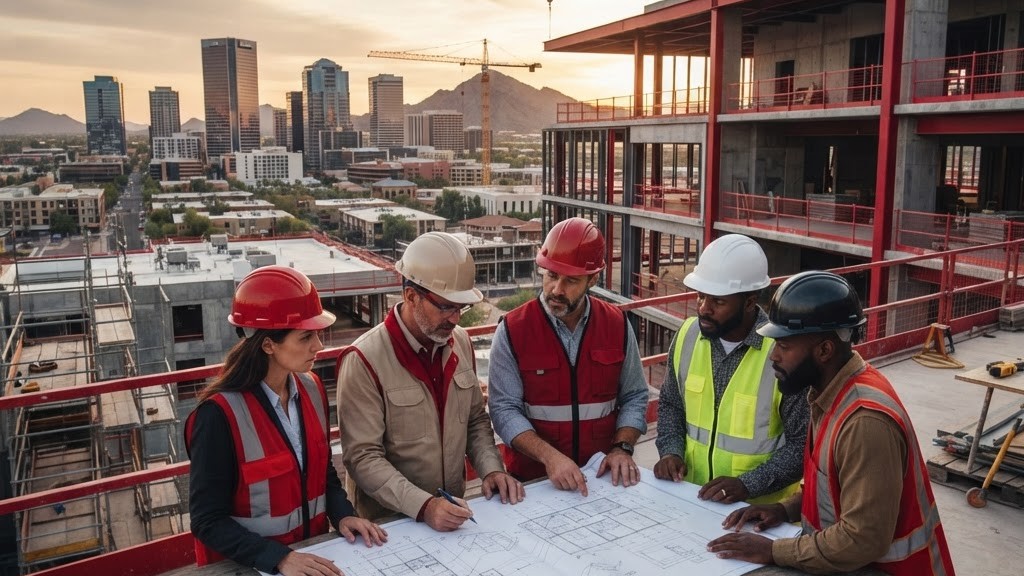
Building in a Fast-Growing Desert Market
Phoenix construction demands more than scheduling trades. Contractors must coordinate labor and materials in extreme heat, navigate municipal reviews across multiple jurisdictions, manage water and energy considerations, and respond to rapid development in advanced manufacturing, healthcare, logistics, hospitality, housing, and education. The strongest firms pair local knowledge with disciplined safety, preconstruction, procurement, and quality systems. This list includes major regional builders and respected Arizona-based companies suited to different project scales.
1. DPR Construction
DPR Construction has a significant Phoenix presence and deep experience in technically complex markets, including healthcare, life sciences, advanced technology, and commercial work. The firm is recognized for collaborative planning and digital construction practices. Owners with demanding systems, clean environments, or phased operations may value that technical focus.
2. Sundt Construction
Sundt Construction has Arizona roots and broad capabilities spanning building, transportation, industrial, and infrastructure projects. Its self-perform experience and large-project resources support complex delivery. The company's long regional history also provides familiarity with desert conditions, local labor, and public-sector requirements.
3. McCarthy Building Companies
McCarthy Building Companies is active across healthcare, education, renewable energy, water, and commercial sectors. Strong preconstruction and construction-management capabilities make it relevant for owners who need early cost and constructability guidance. Its portfolio reflects experience with occupied campuses and technically demanding facilities.
4. Willmeng Construction
Willmeng Construction is an Arizona-based general contractor with work in municipal, aviation, office, industrial, education, and tenant-improvement markets. A strong local identity and varied portfolio help the company serve both public and private clients. Its experience includes projects where stakeholder coordination and operational continuity are essential.
5. CHASSE Building Team
CHASSE Building Team is known in Arizona for education, municipal, nonprofit, multifamily, and commercial construction. The firm emphasizes team culture and community involvement alongside project delivery. Schools and public organizations may appreciate experience coordinating around active users, calendars, and community expectations.
6. Layton Construction
Layton Construction delivers large commercial, healthcare, hospitality, manufacturing, and distribution projects in the region. National resources combined with local teams can benefit developments that require substantial procurement and management capacity. The company is suited to projects with complex schedules and multiple specialized trade packages.
7. Okland Construction
Okland Construction has operated in the Southwest for decades and works across healthcare, higher education, commercial, and civic markets. Its preconstruction approach supports cost modeling and design coordination before field work begins. That early involvement can reveal opportunities to simplify assemblies and protect long-lead procurement.
8. JE Dunn Construction
JE Dunn Construction brings national scale to Phoenix projects in healthcare, commercial, mission-critical, education, and other sectors. Technology-supported planning and established project controls are useful on large programs. Owners should assess the proposed local team, because day-to-day leadership remains central even when a contractor has extensive corporate resources.
9. Adolfson & Peterson Construction
Adolfson & Peterson Construction maintains an Arizona operation and serves education, municipal, healthcare, commercial, and multifamily clients. The firm's collaborative delivery experience fits projects using construction manager at risk and similar methods. Early contractor participation can improve bid packaging and phasing decisions.
10. Haydon Building Corp
Haydon Building Corp is an Arizona contractor with building and heavy civil capabilities. This blend is valuable on developments where vertical construction intersects with substantial site work, utilities, drainage, or public improvements. Local self-perform resources can also strengthen control over critical early activities.
How Owners Should Compare Contractors
Relevant experience matters more than raw company size. Ask for projects matching the proposed type, budget, delivery method, systems complexity, and jurisdiction. Review the actual superintendent, project manager, preconstruction lead, and safety leadership—not only corporate credentials. Strong proposals explain assumptions, allowances, exclusions, escalation, long-lead risks, and schedule logic in plain language.
Phoenix owners should ask how bidders will manage summer work hours, worker heat safety, dust, monsoon exposure, equipment productivity, and material storage. They should also examine subcontractor relationships, quality-control processes, change management, and closeout support. Modern differentiators include building-information modeling, reality capture, prefabrication, lean planning, and detailed energy or water coordination. The right general contractor creates cost certainty early, communicates difficult news promptly, and remains accountable through commissioning and warranty—not simply through the ribbon cutting.
Contract Terms and Project Governance
A well-matched contractor still needs a clear agreement. Define the basis of compensation, contingency ownership, insurance, bonds, schedule milestones, payment review, change authorization, and dispute procedures. Establish a meeting rhythm and a single source for current drawings, requests for information, submittals, and decisions. Owners should assign empowered representatives and respond promptly when choices affect procurement. Monthly reports should connect cost, schedule, safety, quality, and risk rather than treating them as separate subjects. At turnover, require training, test reports, warranties, record documents, attic stock, and a tracked completion list. Good governance allows the project team to solve problems quickly while maintaining a reliable record of why decisions were made. This discipline supports lasting trust.
