
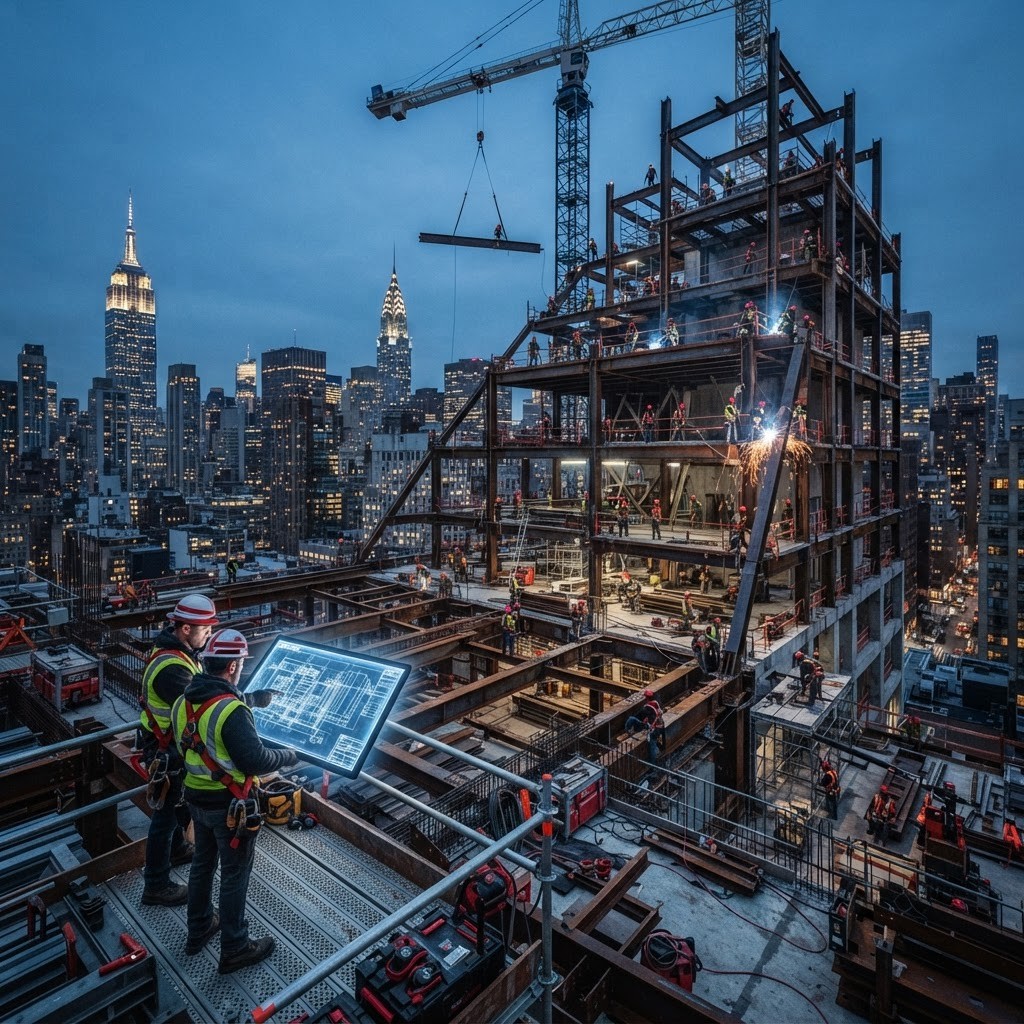
Building Successfully in New York
A general contractor in New York must manage far more than labor and materials. Projects may involve occupied buildings, restricted delivery windows, union coordination, landmark requirements, environmental controls, vertical logistics, and multiple city approvals. The strongest firms combine field leadership with preconstruction planning, safety systems, cost control, and transparent communication. This list highlights major contractors with substantial New York experience. The best choice depends on project type, scale, procurement method, and team chemistry rather than reputation alone.
1. Turner Construction Company
Turner is one of the most prominent builders in New York and across the country. Its portfolio spans commercial, healthcare, education, sports, aviation, and civic work. The firm is particularly relevant to large, logistically complex assignments requiring formal reporting and extensive trade coordination. Owners often value its preconstruction resources, safety programs, and ability to manage major schedules. Smaller clients should confirm that project scale aligns with the firm’s operating model.
2. Tishman Construction
Tishman Construction, part of AECOM, has played a significant role in New York’s skyline and complex urban development. The organization brings construction management capabilities to high-rise, hospitality, commercial, and major public projects. Its experience with sophisticated stakeholders can be useful where design, phasing, and regulatory interfaces are extensive. Clients should examine the proposed project team, since day-to-day leadership matters as much as the corporate portfolio.
3. Structure Tone
Structure Tone is deeply associated with corporate interiors, renovations, repositioning, and construction management. The company’s New York work often requires fast schedules and careful operations in occupied commercial properties. Expertise in interior construction is distinct from ground-up building: it demands close coordination of mechanical systems, technology, finishes, furniture, and tenant activities. Owners should ask how shutdowns, noise, dust, and after-hours work will be managed.
4. Lendlease
Lendlease has delivered major residential, commercial, and mixed-use construction in New York. Its international perspective and development knowledge support projects where constructability and long-term asset considerations intersect. Large urban projects benefit from early analysis of logistics, facade systems, procurement risk, and building performance. Clients should define decision-making authority clearly so complex governance does not slow field progress.
5. Gilbane Building Company
Gilbane is known for work in education, healthcare, commercial, public, and cultural sectors. The firm offers preconstruction and building services supported by established safety and quality processes. Institutional clients may appreciate experience with occupied campuses and mission-critical operations. During selection, owners should request examples of comparable projects and ask how lessons learned will influence staffing, contingency planning, and commissioning.
6. Skanska USA Building
Skanska brings extensive resources to infrastructure-adjacent, commercial, healthcare, education, and civic construction. Sustainability, safety, and large-project controls are prominent aspects of its market identity. New York owners pursuing lower-carbon or high-performance buildings should explore how sustainability commitments translate into procurement, material tracking, envelope testing, and building systems. Measurable execution is more meaningful than broad environmental statements.
7. Hunter Roberts Construction Group
Hunter Roberts has a strong New York presence and experience in residential, healthcare, education, cultural, and commercial work. Its portfolio reflects the need to operate within constrained urban sites and demanding schedules. A regional firm with major-project capability can offer a balance of local knowledge and formal systems. Clients should review staff availability, superintendent experience, and how the company handles trade-market capacity.
8. Plaza Construction
Plaza Construction is recognized for luxury residential, hospitality, commercial, retail, and mixed-use projects. High-end work requires close attention to mockups, finish standards, tolerances, and long-lead materials. Owners should ask how the firm manages samples, architect approvals, room or unit prototypes, and punch-list closure. Quality is best protected when expectations are established early rather than inspected only at completion.
9. Consigli Construction
Consigli has expanded its New York presence with expertise in complex renovation, academic, life-science, cultural, and commercial projects. Renovation work benefits from strong investigation and problem-solving because existing conditions rarely match records perfectly. Clients should explore the contractor’s approach to scanning, exploratory openings, hazardous materials, temporary protection, and allowances for concealed conditions.
10. Shawmut Design and Construction
Shawmut is well known for retail, hospitality, luxury residential, cultural, academic, and commercial interiors. The firm’s work often involves brand-sensitive finishes and compressed opening schedules. For restaurants and retail, coordination among kitchen vendors, millwork, lighting, technology, and operational teams is critical. Owners should establish turnover sequencing and training needs well before the opening date.
Selecting a General Contractor
Begin with a clear request for qualifications based on comparable project type, size, location, and delivery method. Evaluate the proposed personnel, not only the company résumé. Review safety performance, insurance, bonding, litigation disclosures, subcontractor relationships, financial capacity, and references. During preconstruction, compare assumptions behind estimates. A low number built on exclusions and unrealistic allowances is less useful than a transparent, reconciled budget.
Contracts should define scope, schedule, payment, retainage, changes, allowances, insurance, dispute procedures, and closeout obligations. New York owners should also understand who is responsible for permits, controlled inspections, site safety, building management coordination, and agency signoffs. Digital tools for models, schedules, field observations, and cost reporting can improve visibility, but they do not replace decisive leadership. The best general contractor creates trust through accurate information, early warnings, safe operations, and consistent follow-through from preconstruction to final turnover.
