
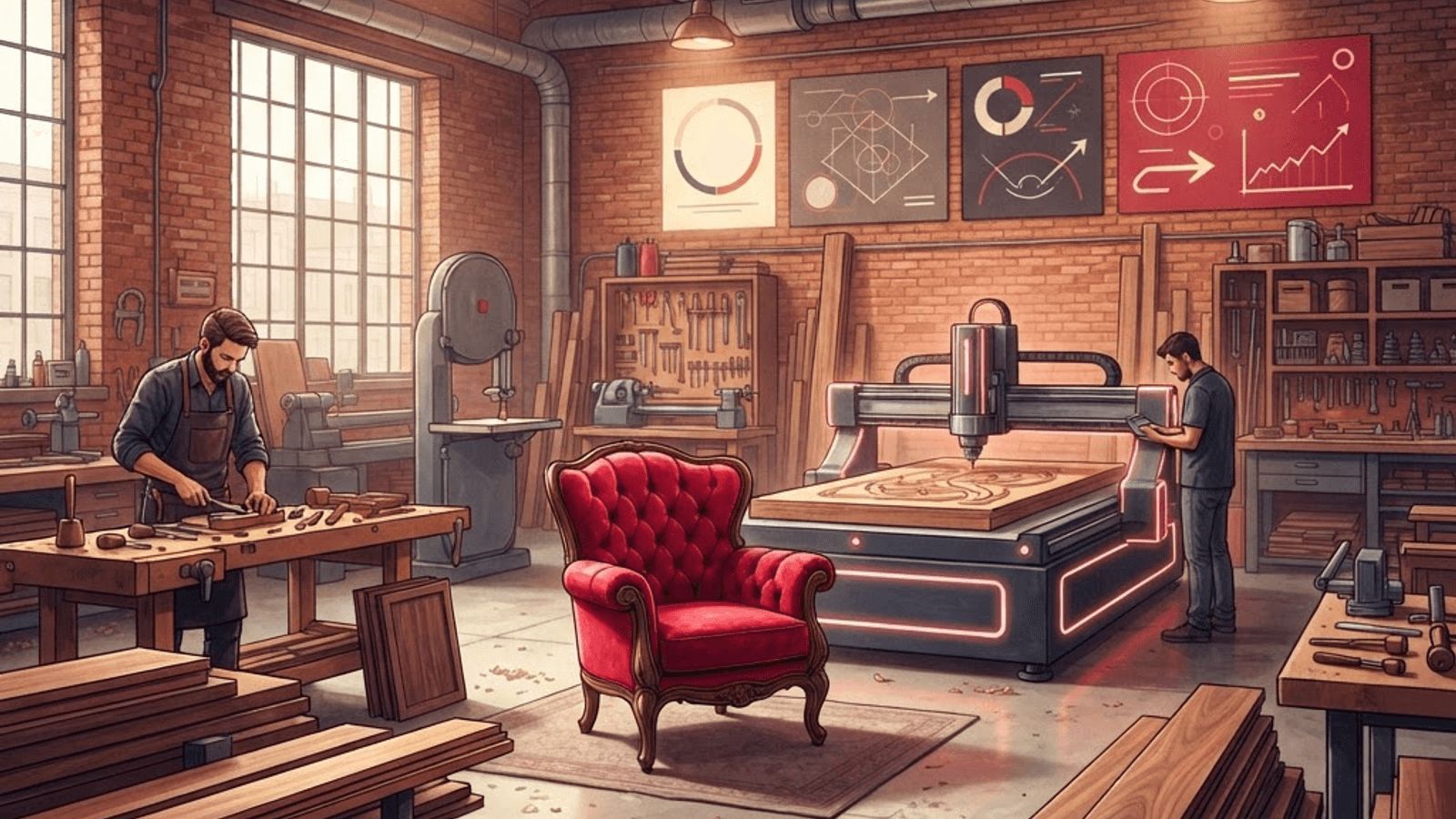
A City Built for Furniture Making
Baltimore has an unusually strong environment for furniture manufacturing, and the reasons are structural. Large, affordable industrial buildings from the city's manufacturing era provide the square footage that woodworking requires. A regional hardwood supply from Maryland, Pennsylvania, and West Virginia forests puts quality material within a short drive. A dense architecture and interior design community generates continuous demand for custom work. And a strong maker culture, reinforced by art and design schools, supplies talent that industrial regions often lack.
The result is a furniture sector that spans genuine production shops building hundreds of hospitality pieces, mid-sized commercial millwork operations, and individual studio makers producing signature pieces. For buyers, this range means the city can serve a restaurant fit-out, a corporate office refresh, or a single dining table with equal competence, provided the right shop is matched to the job.
Understanding the Types of Furniture Manufacturers
Not every business calling itself a furniture manufacturer builds furniture. Some import components and assemble. Others resell with customization. True manufacturers cut, join, finish, and upholster in house. Within genuine manufacturing, the meaningful distinctions are these: casegoods shops build cabinets, desks, and storage; seating and upholstery shops build frames and apply foam and fabric; millwork shops build architectural built-ins and fixtures; and studio makers produce artisan pieces in very small quantities.
Capacity is the other axis. A studio maker producing a dozen pieces monthly cannot deliver a hotel order, and a production shop tooled for repeatable runs may find a one-off sculptural commission uneconomical. Clarifying quantity, timeline, and repeatability at first contact saves everyone time.
The Top Furniture Manufacturers Serving Baltimore
Sandtown Millworks is among the city's best-known furniture producers, combining reclaimed material sourcing with production capability for commercial and residential clients. Its differentiators are material story, workforce development commitment, and the ability to scale a design into repeatable production.
Bmore Woodworks serves commercial clients with casegoods, conference tables, and built-in millwork, supported by CNC machining for consistency across multi-unit orders. Designers value its shop drawing quality, which reduces revision cycles.
Locust Point Upholstery Company builds seating from frame construction through finished upholstery, serving hospitality, healthcare, and residential interiors. Its strengths are hardwood frame durability, correct foam specification, and compliance with commercial flammability requirements.
Hampden Furniture Studio produces artisan residential pieces in hardwood, emphasizing traditional joinery and hand-applied finishes. Clients commissioning heirloom-quality dining tables, beds, and casework choose this category for craftsmanship rather than speed.
Patapsco Contract Furniture focuses on the contract segment, manufacturing furniture packages for offices, dormitories, and multifamily developments. Its differentiators are volume delivery scheduling, standardized finish programs, and durability testing appropriate for heavy institutional use.
Federal Hill Metal and Wood combines steel fabrication with woodworking to produce mixed-material tables, shelving, and industrial-style furnishings. Having both capabilities under one roof avoids the coordination problems that mixed-material designs usually create.
Chesapeake Cabinet Works manufactures kitchen and bath cabinetry along with custom storage systems, offering full custom sizing rather than modular constraints. Renovation clients in Baltimore's historic housing stock, where nothing is square or standard, particularly benefit.
Harbor Hospitality Furnishings supplies restaurants, bars, and hotels with booths, banquettes, bar tops, and dining furniture engineered for commercial abuse. Its differentiator is understanding service-industry wear patterns and cleaning regimens.
Remade Furniture Collective operates in the circular segment, refinishing, reupholstering, and remanufacturing existing furniture for organizations pursuing waste reduction. Refurbishing quality institutional furniture is frequently cheaper and greener than replacement.
Charm City Office Interiors Manufacturing produces workstations, height-adjustable desks, and collaborative furniture for regional employers. Ergonomic performance, cable management, and reconfigurability define value in this category.
Trends Shaping Local Furniture Manufacturing
Digital fabrication has changed the economics of custom work. CNC routers and computer-aided design allow a shop to produce a bespoke piece with production-level consistency, narrowing the historical gap between custom and manufactured. Buyers now get customization without the price penalty that once accompanied it.
Sustainability has moved from marketing to specification. Clients ask about wood certification, low-emission finishes, formaldehyde-free panel products, and end-of-life repairability. Shops using solid hardwood and mechanical joinery are advantaged because their products can be repaired rather than discarded.
Domestic sourcing and lead-time reliability are the third force. Import lead times and freight volatility pushed designers toward regional makers who can commit to dates and absorb late-stage changes, a flexibility overseas suppliers structurally cannot offer.
How to Commission Furniture Successfully
Provide dimensions, intended use, expected traffic, and finish preferences, along with reference images. Expect the manufacturer to produce shop drawings for approval; skipping this step is the most common cause of disappointment. Request material samples and finish samples, and view them in the actual installation lighting, because finishes shift dramatically between fluorescent showrooms and daylit rooms.
Ask about construction specifics. For casegoods, inquire about panel material, edge treatment, drawer slide quality, and joinery method. For seating, ask about frame material, joinery, foam density, and fabric abrasion rating. These details determine whether furniture lasts five years or thirty.
Clarify lead time, deposit structure, delivery, and installation responsibility in writing. For commercial projects, confirm the shop can meet fire-code requirements and provide documentation for inspection.
Final Thoughts
Baltimore's furniture manufacturers offer a rare combination of craftsmanship, production capability, and proximity. Whether the need is a hospitality package, institutional casegoods, custom cabinetry for a historic rowhouse, or a single heirloom table, the city's shops can deliver work that outlasts imported alternatives. Choosing the right shop for the scale of the job is the key to a satisfying result.
