
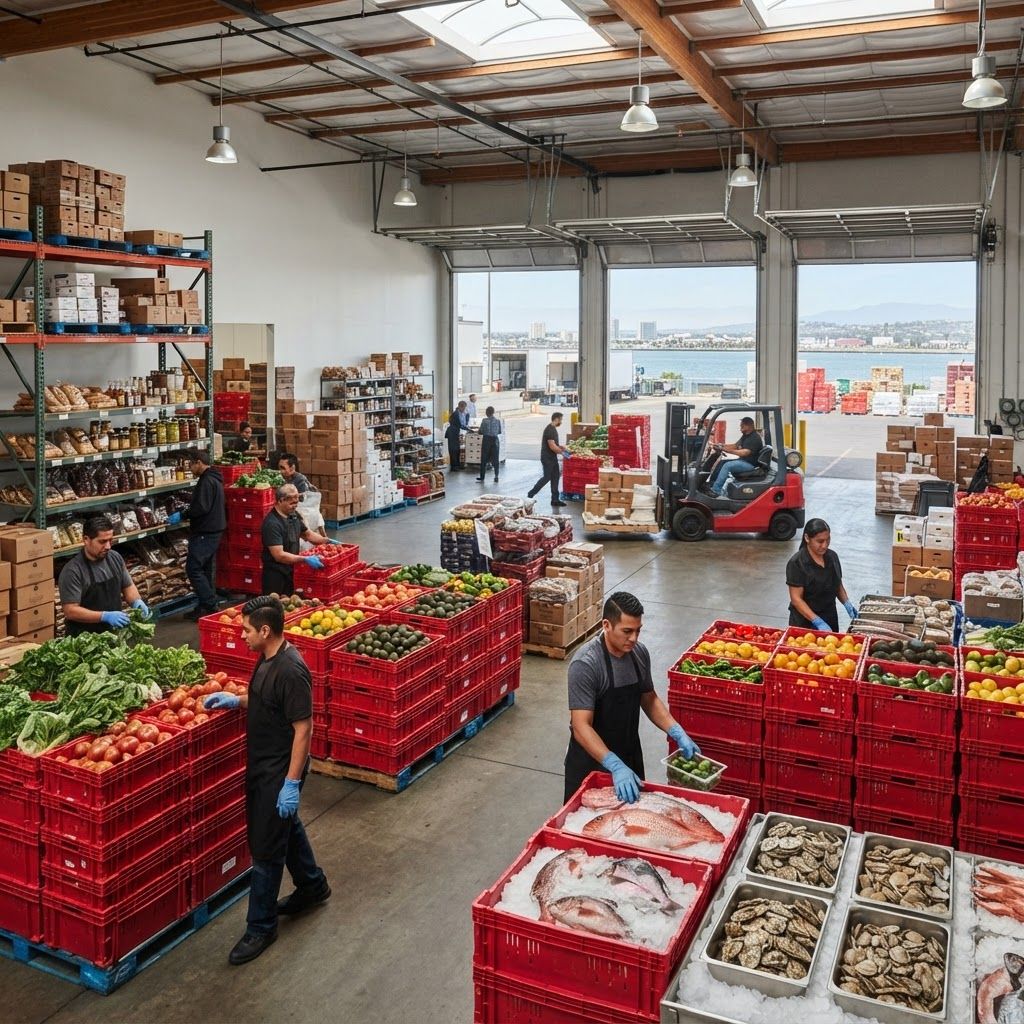
Supplying San Diego’s Food Economy
San Diego’s food scene draws from Pacific seafood, nearby farms, Mexican culinary traditions, craft producers, and year-round tourism. Wholesalers keep this ecosystem moving through cold storage, quality control, route planning, and purchasing relationships. The best supplier is not always the largest; product expertise, responsiveness, consistency, and fit with a kitchen’s volume are equally important. Buyers should also evaluate food-safety practices, delivery windows, substitutions, and traceability.
1. Specialty Produce
Specialty Produce is one of San Diego’s best-known produce distributors. It supplies restaurants and food businesses with conventional staples, specialty fruits and vegetables, microgreens, herbs, and products from regional farms. The company stands out for assortment and close ties to the culinary community. Chefs value access to unusual seasonal ingredients as well as dependable everyday produce.
2. Catalina Offshore Products
Catalina Offshore Products specializes in seafood and has deep connections to San Diego’s fishing heritage. Its selection includes local and imported species for restaurants, retailers, and consumers. Seafood purchasing depends on freshness, handling, seasonality, and source knowledge. Catalina’s category expertise helps buyers understand alternatives and make use of species that reflect responsible availability rather than relying on a narrow list year-round.
3. Sysco San Diego
Sysco serves San Diego food-service operators with broadline distribution across fresh, frozen, dry, beverage, disposables, and kitchen-supply categories. Its scale benefits restaurants and institutions that want consolidated ordering and scheduled routes. The company can support menu planning and operational needs in addition to product delivery. Buyers should work closely with representatives to define acceptable substitutions and monitor category-specific quality.
4. US Foods
US Foods is another major broadline distributor serving independent restaurants, hospitality groups, and institutional kitchens. Its portfolio includes national brands, private-label products, fresh foods, and operational resources. Broadline efficiency can reduce receiving complexity, but kitchens should still compare key ingredients through tastings and yield tests. A lower case price may not be economical if trimming loss or portion inconsistency is high.
5. Shamrock Foods
Shamrock Foods supplies food-service customers with dairy, meat, produce, grocery, frozen items, and disposables. The company combines a large catalog with regional distribution capability. San Diego operators can use such a supplier to simplify purchasing while retaining access to specialized categories. Delivery reliability is especially important for hotels, caterers, and high-volume venues with limited storage.
6. Chefs’ Warehouse
Chefs’ Warehouse focuses on specialty ingredients for professional kitchens, including oils, cheeses, charcuterie, pastry products, and premium pantry items. This curated approach suits restaurants seeking distinctive flavors or hard-to-source products. Product knowledge is a major differentiator because chefs may need guidance on origin, handling, seasonality, and comparable substitutions. Specialty distribution complements rather than necessarily replaces a broadline supplier.
7. Hamilton Meats and Provisions
Hamilton Meats and Provisions has served Southern California with meat, seafood, and specialty products for decades. Portion control, aging, cut specifications, and packaging directly influence kitchen labor and plate cost. A skilled protein distributor can customize products to a restaurant’s menu and volume. Buyers should compare usable yield and cooking performance rather than evaluating price per pound in isolation.
8. Moceri Produce
Moceri Produce supplies fresh fruits and vegetables to food-service customers in Southern California. Produce specialists can offer stronger market awareness and hands-on quality control than a generalized source. They help kitchens plan around seasonal price changes and identify alternatives when weather affects supply. Clear specifications for size, ripeness, pack, and intended use improve consistency.
9. Coast Citrus Distributors
Coast Citrus Distributors handles fresh produce through an established distribution network. Its scale and sourcing reach support customers needing consistent quantities across seasons. For San Diego businesses, a distributor with multiple growing-region relationships can reduce the effects of local disruptions. Buyers should ask about traceability, ripening programs, cold-chain controls, and policies for quality claims.
10. Northgate Market Distribution
Northgate Market’s Southern California supply network is closely connected to Mexican and Latin American foods, produce, meats, bakery products, and prepared-food traditions. Its regional presence reflects the tastes that shape San Diego’s culinary identity. For buyers seeking authentic ingredients, category knowledge and turnover are important advantages. The broader lesson is that culturally specific distribution can provide depth that general catalogs do not.
Choosing a Food Wholesaler
Begin with menu requirements, weekly volume, storage capacity, delivery access, and receiving hours. Request details on food-safety certification, recall procedures, temperature controls, sourcing, and minimum orders. Track fill rate, substitutions, credits, and quality over time rather than relying on the first delivery. Many successful kitchens use a broadline distributor for efficiency and specialty suppliers for categories where freshness or differentiation matters most.
Trends Shaping Distribution
Restaurants are seeking stronger traceability, more local sourcing, lower-waste packaging, plant-forward ingredients, and dependable labor-saving products. Digital ordering improves visibility, but relationships remain crucial when markets tighten or a menu changes quickly. San Diego’s border location and diverse population also sustain demand for ingredients from Mexico, Asia, and the Mediterranean. Wholesalers that combine cold-chain discipline with cultural and culinary knowledge are particularly well positioned to serve the region.
