
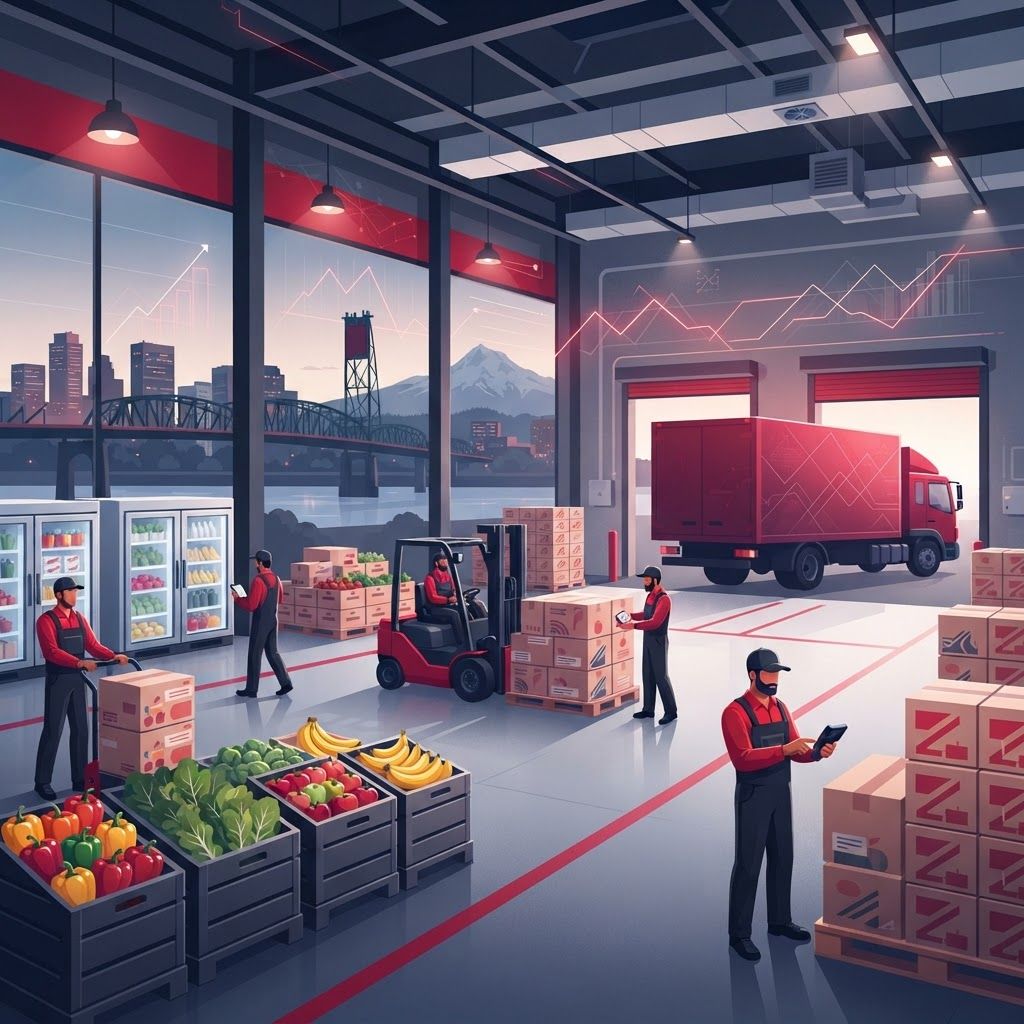
Why Portland Punches Above Its Weight in Food Distribution
Portland's national reputation for food is not an accident of talent alone. The city sits at the northern end of the Willamette Valley, one of the most agriculturally diverse regions in North America, and within a few hours of the Columbia River, the Oregon coast and Pacific fishing grounds. Berries, hazelnuts, wine grapes, brassicas, stone fruit, mushrooms, dairy, salmon, groundfish and shellfish all arrive from within a short radius, which compresses the distance between farm and plate to a degree that most metropolitan areas cannot replicate.
That proximity has shaped the wholesale sector. Rather than being dominated exclusively by national broadline distributors, Portland supports an unusual number of mid sized and specialty houses that can move small volumes of highly perishable, seasonal product quickly. A chef can build a menu around an ingredient that will only exist for three weeks because there is a distributor structurally capable of handling that reality. This is the quiet infrastructure behind the city's culinary identity.
What Food Operators Should Evaluate in a Wholesale Partner
Cold chain integrity should be the first question. Ask how temperature is monitored in transit, how quickly product moves from dock to truck and what the process is when a delivery arrives out of spec. A distributor that can answer precisely is one that has invested in the systems that protect food safety and product quality.
Delivery scheduling matters nearly as much. Restaurants operate on narrow prep windows, and a supplier who cannot commit to a consistent arrival time forces kitchens to build wasteful buffers. Clarify cutoff times for next day ordering, weekend coverage and how the company handles holiday weeks when volume spikes. Understand the pricing model too, since some distributors work on cost plus arrangements with transparent markups while others quote fixed prices that fluctuate with market conditions in ways that are harder to audit.
Finally, assess the relationship depth. The best wholesalers behave like advisors, flagging when a crop is peaking, warning about looming shortages and suggesting substitutions that protect a dish rather than simply canceling a line item. That kind of communication is worth more than a marginal discount.
The Top 10 Food Wholesalers in Portland
1. Pacific Coast Fruit Company
Pacific Coast Fruit Company is the reference point for produce distribution in the region. Its scale allows it to serve large institutional accounts while its buying team maintains genuine relationships with Willamette Valley growers, so seasonal specialty items appear alongside year round staples. Chefs cite the consistency of quality and the accuracy of the company's availability reporting as its defining strengths.
2. Rose City Food Distributors
Operating as a broadline supplier, Rose City Food Distributors covers dry goods, frozen product, dairy, proteins and disposables in a single ordering relationship. For independent operators, that consolidation reduces administrative overhead considerably. The company has also built a reputation for supporting smaller accounts with realistic minimums rather than pushing them toward volume commitments they cannot sustain.
3. Bridgetown Provisions
Bridgetown Provisions specializes in charcuterie, cheese, oils, vinegars and imported pantry items, serving restaurants, wine bars and specialty grocers. Its buyers travel to source directly, and the sales team is genuinely knowledgeable about production methods and aging profiles. Operators building cheese and salumi programs often rely on the company for staff education as much as for product.
4. Cascade Cold Chain Foods
This distributor focuses on frozen and refrigerated logistics, including proteins, prepared components and ice cream. Its investment in temperature controlled fleet and warehouse monitoring makes it a preferred partner for accounts where cold chain documentation is a compliance requirement. Grocery and institutional buyers particularly value the auditability of its records.
5. Willamette Valley Organics Supply
Willamette Valley Organics Supply aggregates output from certified organic farms across the valley and delivers it into Portland kitchens and co ops. Its model gives small growers access to urban demand while giving buyers a single point of contact for a rotating seasonal assortment. Weekly availability lists are detailed enough that chefs can plan specials several days in advance.
6. Stumptown Specialty Foods
Stumptown Specialty Foods curates hard to find ingredients, from regional hot sauces and fermented products to specialty flours and heirloom grains. Its assortment leans toward small producers, and it functions as a discovery channel for retailers looking to differentiate their shelves. The company is also known for helping local makers navigate their first wholesale accounts.
7. Columbia Seafood Wholesale
With direct relationships along the Oregon and Washington coast, Columbia Seafood Wholesale supplies salmon, halibut, rockfish, Dungeness crab and shellfish with strong traceability back to the vessel or farm. Its handling standards are rigorous, and it communicates openly about seasonality and closures rather than substituting inferior product to fill an order.
8. Northwest Bakery Supply Co.
Bakeries, cafes and pastry programs depend on this supplier for flour, butter, chocolate, yeast, sugars and specialized equipment consumables. It stocks multiple protein levels of flour and a range of chocolate percentages, which matters enormously for consistency in professional baking. Technical support on formulation issues is a differentiator that customers mention frequently.
9. Portland Restaurant Depot Partners
This operation blends cash and carry convenience with wholesale pricing, allowing operators to pick up product immediately when a delivery falls short or a weekend rush depletes inventory. Food carts and small kitchens without storage capacity rely on it as a flexible safety valve. Extended hours and straightforward pricing are the main draws.
10. Evergreen Beverage Distributors
Evergreen Beverage Distributors covers non alcoholic beverages, coffee, tea, syrups and increasingly the fast growing zero proof cocktail category. Its portfolio mixes national brands with Oregon producers, and it supports accounts with menu development guidance. As beverage margins become more central to restaurant profitability, that consulting element has become a meaningful advantage.
Trends Shaping Food Wholesale in Portland
Labor costs and menu price sensitivity are pushing operators toward more prepared and semi prepared components, and distributors are responding with expanded value added lines. At the same time, hyperlocal sourcing continues to matter for brand positioning, creating demand for suppliers who can bridge both worlds within one relationship.
Technology adoption is accelerating as well. Online ordering portals, real time availability data and automated invoice reconciliation are becoming baseline expectations rather than premium features. Waste reduction has also moved from a sustainability talking point to a financial imperative, and wholesalers offering smaller pack sizes and more frequent deliveries help kitchens hold less inventory and throw away less product.
Getting the Most From Your Distributor Relationships
Most successful Portland kitchens run two or three primary suppliers plus several specialists. That structure preserves negotiating leverage and provides redundancy when a shortage hits. Share your forecast honestly, place orders before cutoff rather than calling in emergencies, and give feedback promptly when quality slips. Distributors allocate their best product and their best service to accounts that make their operations easier.
Final Thoughts
Portland's food wholesale sector is a genuine competitive advantage for anyone operating a kitchen, cart, cafe or grocery in the region. The combination of agricultural proximity, specialty expertise and distributors willing to handle small seasonal volumes creates possibilities that simply do not exist in many markets. Choosing partners deliberately from the companies above is one of the highest leverage decisions a food business can make.
