
An Agricultural Powerhouse
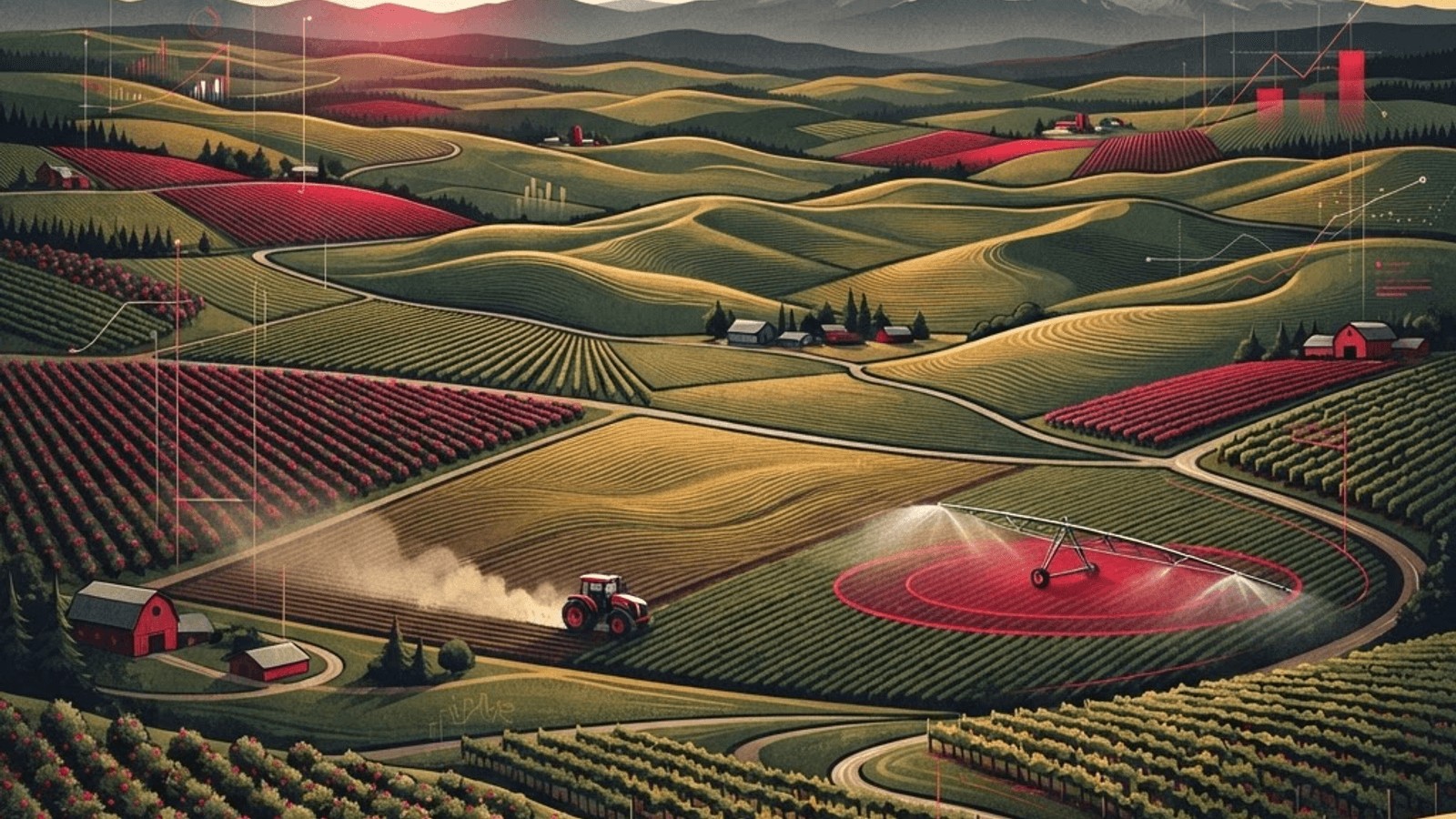
Washington produces well over three hundred commodities, a range few states can match. The Wenatchee and Yakima valleys anchor the nation's apple, cherry and pear production. The Yakima Valley grows the overwhelming majority of American hops, supplying breweries worldwide. The Columbia Basin, irrigated by one of the largest water projects in the country, yields potatoes, onions, sweet corn and processing vegetables at industrial scale. The Palouse hills in the southeast produce soft white wheat prized by Asian noodle and pastry markets. Skagit Valley grows berries, tulip bulbs, seed crops and vegetables in maritime conditions. Walla Walla and the Columbia Valley support a wine industry now recognized internationally, while western Washington sustains dairy, floriculture and diversified small farms.
The reason for this diversity is geography. The Cascade Range divides the state into a wet, temperate west and an arid, sun-drenched east with hot days, cool nights and long growing seasons. Combined with volcanic and loess soils and extensive irrigation infrastructure, that split creates microclimates suited to remarkably different crops within a few hours' drive.
What Defines a Leading Farming Company
Scale alone is not the measure. The strongest operations demonstrate agronomic discipline, including soil health programs, integrated pest management and precise irrigation scheduling. They invest in post-harvest infrastructure such as controlled atmosphere storage, packing lines and cold chain, because in tree fruit and vegetables the ability to store and ship quality product months after harvest determines profitability. They manage labor responsibly, with housing, training and safety programs that support workforce retention in a tight labor market. They hold relevant certifications, from GlobalG.A.P. and food safety audits to organic and salmon-safe designations. And they build market access, whether through cooperative marketing, direct export relationships or value-added processing.
Ten Notable Farming Companies and Cooperatives in Washington
1. Cascade Orchards Company
A tree fruit grower and packer in the Wenatchee region managing apple, pear and cherry acreage with modern high-density plantings. Investment in controlled atmosphere storage and optical sorting allows it to deliver consistent fruit quality to domestic and export buyers well beyond the harvest window.
2. Yakima Valley Hop Growers Cooperative
A grower cooperative producing aroma and alpha hop varieties for craft and global brewing customers, with on-site kilning, pelletizing and cold storage. Variety development partnerships and rigorous lot analysis make it a trusted source for brewers who need repeatable flavor profiles.
3. Columbia Basin Potato Farms
Large-scale irrigated potato production supplying processing and fresh markets, supported by precision irrigation, variety trials and integrated storage facilities. Efficiency in water and energy use is central to its operating model given the arid environment.
4. Palouse Grain Partners
A dryland wheat and pulse operation across the rolling southeastern hills, employing direct-seed and conservation tillage practices that reduce erosion on steep terrain. Its soft white wheat is oriented toward export markets that value low protein and consistent milling quality.
5. Skagit Valley Berry Growers
Producing raspberries, blueberries and strawberries in the maritime northwest, with both fresh-market and individually quick frozen processing outlets. Mechanical harvest capability and tight cold-chain management preserve fruit quality across a compressed picking season.
6. Walla Walla Vineyard Estates
A viticulture operation farming premium wine grape blocks with site-specific canopy management, deficit irrigation and sustainability certification. Long-term grower relationships with regional wineries and careful terroir-driven block selection define its reputation.
7. Whatcom Dairy Collective
A dairy group in the northwest corner of the state managing herd health, nutrient management plans and anaerobic digestion for manure-derived energy. Water quality stewardship and animal welfare protocols are central given the sensitivity of nearby watersheds.
8. Puget Sound Organic Produce Growers
Certified organic vegetable and salad crop production serving regional grocery, restaurant and community supported agriculture channels. Crop rotation, cover cropping and beneficial insect habitat underpin its pest and fertility strategy without synthetic inputs.
9. Olympic Peninsula Livestock Ranch
A grass-based cattle and sheep operation using rotational grazing to build pasture resilience and soil carbon. Direct-to-consumer and regional butcher relationships allow it to capture value that commodity marketing would not deliver.
10. Evergreen Nursery and Floriculture Farms
Producing ornamental nursery stock, bulbs and cut flowers for garden centers and landscape contractors regionally and nationally. Greenhouse climate control, tissue culture propagation and disciplined phytosanitary compliance support consistent plant quality.
Forces Shaping Washington Agriculture
Water is the defining issue. Snowpack variability, senior water rights, instream flow requirements for salmon recovery and drought years force growers toward drip conversion, soil moisture monitoring and deficit irrigation strategies. Labor is the second pressure point, with high demand for skilled seasonal workers driving both guest worker program participation and investment in mechanization. Automation is advancing quickly in tree fruit, from platform-assisted harvest to robotic thinning and vision-based sorting. Export exposure is significant, particularly for apples, cherries, hops and wheat, making trade policy and shipping capacity material business risks. Climate adaptation is prompting new variety selection, frost and heat protection systems, and wildfire smoke management in vineyards. Finally, sustainability verification is increasingly required by retail buyers, pushing documentation of water use, carbon practices and pollinator protection.
Practical Insight for Buyers and Partners
Those sourcing Washington produce should evaluate storage and cold-chain capability as carefully as growing practices, because post-harvest handling determines delivered quality. Confirm food safety audit status and traceability systems. Understand harvest calendars so contracts align with realistic availability. For long-term supply, favor growers with diversified water access and demonstrated agronomic investment, since these operations weather drought and market volatility more successfully.
Final Thoughts
Washington agriculture combines exceptional natural advantages with sophisticated operational management, and the companies profiled here reflect that blend across tree fruit, hops, potatoes, grain, berries, wine grapes, dairy, organics, livestock and horticulture. As water constraints tighten and automation matures, the operations that continue to lead will be those pairing agronomic precision with infrastructure investment and credible sustainability practices.
