
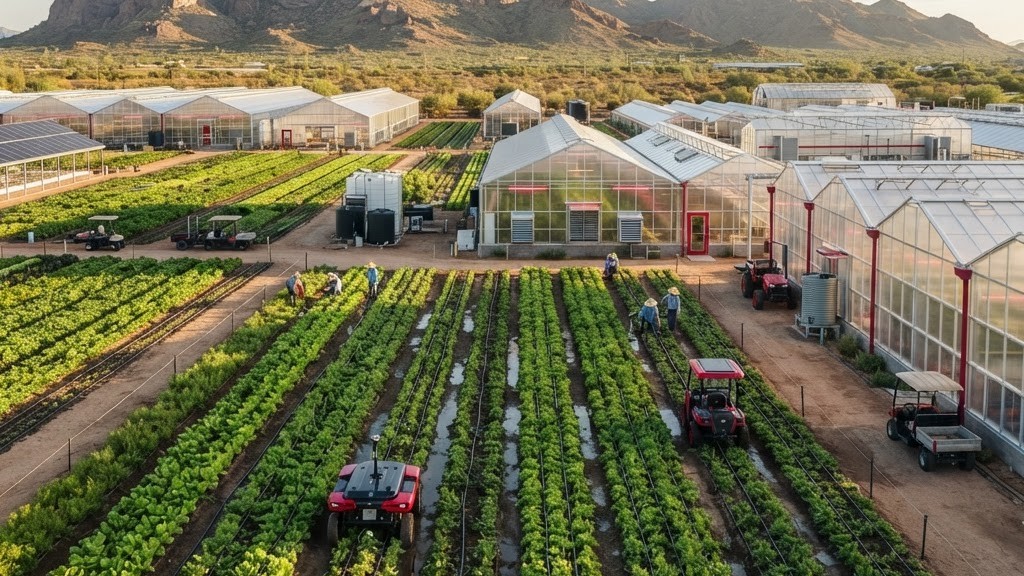
Agriculture in the Valley of the Sun
Farming has deep roots in the Salt River Valley, where canals, fertile soils, and year-round sunshine helped create one of Arizona's major agricultural regions. Today, Phoenix-area producers operate within a complex environment of extreme heat, limited water, urban expansion, labor pressures, and fast-changing consumer demand. The strongest operations combine practical desert knowledge with efficient irrigation, protected cultivation, direct sales, education, or value-added experiences. This list includes farms and agricultural enterprises across greater Phoenix rather than only businesses inside city limits.
1. Duncan Family Farms
Duncan Family Farms, based in the West Valley, is known for organic leafy greens and sustainable production practices. Its scale and focus on soil stewardship make it an important Arizona agricultural name. The operation demonstrates how crop planning, food safety, water management, and supply-chain discipline must work together when serving large retail and food-service markets.
2. Rousseau Farming Company
Rousseau Farming Company has longstanding ties to Arizona vegetable production. The business reflects the expertise required to grow, harvest, cool, and distribute fresh produce in a demanding climate. For buyers, experienced commercial farms can offer dependable specifications and volume, although seasonal availability and weather remain important planning factors.
3. Blue Sky Organic Farms
Blue Sky Organic Farms in Litchfield Park is a respected source of certified organic produce. Its assortment and local presence appeal to restaurants, markets, and consumers seeking regional food. The farm highlights the value of crop diversity, careful organic management, and direct relationships between growers and the communities they feed.
4. Crooked Sky Farms
Crooked Sky Farms is associated with organic and naturally grown produce for farmers markets, community programs, and local buyers. Its urban-facing model helps shorten the distance between field and table. Such operations strengthen regional food resilience while giving customers a clearer understanding of seasonality and realistic desert-grown availability.
5. Arizona Microgreens
Arizona Microgreens specializes in compact, nutrient-dense crops produced close to the metropolitan customer base. Microgreens suit controlled growing environments and short harvest cycles, making them attractive to chefs and specialty retailers. Consistency, sanitation, variety selection, and rapid delivery are key differentiators in this delicate, premium category.
6. True Garden
True Garden in the East Valley uses controlled-environment and vertical growing methods to produce crops in a water-conscious way. Its technology-forward approach is relevant in Phoenix, where protected agriculture can reduce exposure to heat and improve production consistency. Hydroponic systems still require disciplined nutrient, energy, sanitation, and equipment management.
7. Agritopia Farm
Agritopia Farm in Gilbert is integrated into a well-known agricultural community. It connects working farmland, local food, education, and neighborhood life. This model shows how agriculture can retain cultural and economic value as metropolitan development advances, while farm-based retail and events create additional ways to support ongoing production.
8. Steadfast Farm
Steadfast Farm is a small-scale East Valley operation known for intensive growing and community-oriented food production. Its approach emphasizes thoughtful crop selection and efficient use of limited land. Small farms can compete through freshness, specialty varieties, direct relationships, and adaptability rather than attempting to match commodity producers on volume.
9. Singh Meadows
Singh Meadows in Tempe combines agricultural land, community gathering, food, and ecological restoration. The property offers a distinctive example of how a farm can contribute to local quality of life beyond crop output. Healthy soils, shaded public space, and direct customer engagement make agriculture visible within the urban landscape.
10. Tolmachoff Farms
Tolmachoff Farms is a multigenerational Glendale operation known for produce and seasonal agritourism. Its festivals and family activities broaden the farm's revenue base and keep local agricultural traditions accessible. Agritourism requires careful coordination of crop production, guest safety, staffing, parking, and the highly seasonal expectations of Phoenix families.
What Sets Strong Phoenix Farms Apart
Water strategy is central. Efficient drip systems, irrigation scheduling, soil organic matter, crop selection, shade, and protected cultivation all influence long-term viability. Buyers should ask how a farm manages food safety, cooling, traceability, packaging, and delivery during extreme temperatures. Restaurants and retailers also benefit from flexible menus and merchandising that reflect local harvest windows rather than demanding identical products throughout the year.
Phoenix agriculture is not one uniform sector. It includes large commercial growers, organic farms, hydroponic facilities, microgreen specialists, neighborhood farms, and agritourism destinations. Together, these businesses preserve knowledge, support jobs, and bring fresher food closer to residents. Choosing among them depends on whether the priority is wholesale volume, specialty quality, educational value, local purchasing, or a memorable farm experience.
