
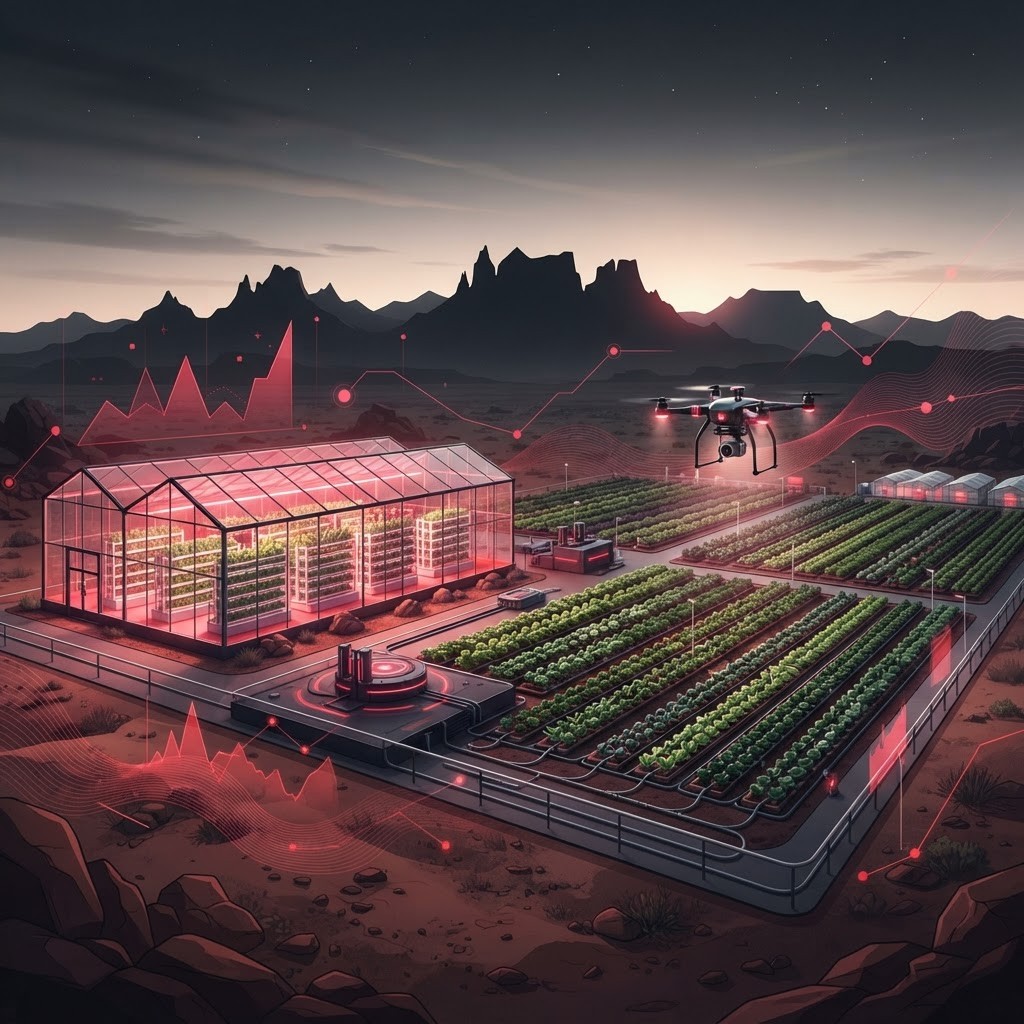
Agriculture in One of America's Driest Regions
Growing food near Las Vegas sounds improbable. Annual rainfall is measured in a handful of inches, summer temperatures routinely exceed one hundred degrees, and soils are often alkaline and low in organic matter. Yet agriculture persists and, in some segments, thrives. The reason is technology combined with market opportunity: an enormous local restaurant and resort economy willing to pay for freshness, situated hundreds of miles from traditional growing regions.
Controlled environment agriculture has been the breakthrough. Greenhouses and vertical farms use a fraction of the water required by field production, operate year-round regardless of outside temperature, and can be located minutes from the customers they serve. Meanwhile, traditional operations in the surrounding valleys continue producing alfalfa, livestock, dairy and seasonal produce using increasingly efficient irrigation methods.
Water: The Defining Constraint
Every agricultural decision in this region begins with water. Colorado River allocations, groundwater rights and conservation mandates shape what can be grown and how. Operations have responded by adopting drip and subsurface irrigation, soil moisture sensing, deficit irrigation scheduling, recirculating hydroponic systems and, in some cases, shifting away from water-intensive crops entirely. Producers that measure water use per unit of food produced, rather than per acre, tend to be the most resilient as policy tightens.
1. Desert Bloom Hydroponic Farms
Desert Bloom Hydroponic Farms grows leafy greens, lettuces and microgreens in climate-controlled greenhouses, delivering to restaurants within hours of harvest. Recirculating systems reuse water continuously, achieving dramatically lower consumption than field farming. Chefs value the consistency: because growing conditions are controlled, product quality does not swing with the weather, and supply remains stable through summer when field greens elsewhere struggle.
2. Silver State Vertical Farming
Silver State Vertical Farming stacks growing systems under precision lighting inside insulated facilities, producing high yields from a small footprint. This model allows production close to distribution points, cutting transportation entirely out of the freshness equation. The company focuses on herbs and specialty greens where flavor deteriorates quickly after harvest, which makes local production genuinely superior rather than merely convenient.
3. Mojave Valley Produce Growers
Mojave Valley Produce Growers operates traditional field production in the surrounding valleys, growing melons, squash, onions, root vegetables and other heat-tolerant crops. Its expertise lies in matching varieties to intense sun and alkaline soils, and in irrigation scheduling that maximizes yield per acre-foot of water. Seasonal harvests supply farmers markets, restaurants and regional distributors.
4. High Desert Dairy Company
Dairy has a long history in Southern Nevada, and High Desert Dairy Company supplies fresh milk, cream and cultured products to local processors and retailers. Heat abatement is central to herd management here, involving shade structures, cooling systems and adjusted feeding schedules. The company has invested in manure management and water recycling, reducing environmental impact while improving efficiency.
5. Canyon Gate Livestock and Ranching
Canyon Gate Livestock and Ranching manages cattle across rangeland in the broader region, practicing rotational grazing to protect fragile desert vegetation. Sustainable stocking rates are essential where forage recovery is slow. The operation supplies regional processors and increasingly sells directly to restaurants seeking locally raised beef with traceable origins.
6. Paradise Herb and Specialty Growers
Paradise Herb and Specialty Growers cultivates culinary herbs, edible flowers and specialty greens for high-end kitchens. These crops are ideal for local production because they are delicate, expensive to ship and highly valued when perfectly fresh. The company works directly with chefs, sometimes growing specific varieties to order, which is only feasible with a nearby grower.
7. Great Basin Greenhouse Growers
Great Basin Greenhouse Growers produces tomatoes, peppers, cucumbers and other vine crops in high-technology greenhouses using integrated pest management rather than heavy chemical intervention. Beneficial insects, sticky monitoring and biological controls maintain crop health while meeting demand for reduced-pesticide produce. Year-round production means restaurants can source vine-ripened product in winter without long-distance freight.
8. Fremont Urban Agriculture Collective
Fremont Urban Agriculture Collective converts underused urban space into productive growing area, combining raised beds, container growing and small greenhouse structures. Beyond production, the collective runs education programs and supplies neighborhood markets, addressing food access in areas with limited fresh options. Its model demonstrates that meaningful food production can happen within city limits.
9. Summerlin Date and Orchard Farms
Dates and certain tree crops are genuinely well suited to desert conditions, and Summerlin Date and Orchard Farms cultivates them along with pomegranates, figs and citrus in favorable microclimates. These crops tolerate heat and, once established, use water efficiently relative to their yield. Value-added processing into dried and packaged products extends the selling season well beyond harvest.
10. Neon Sprouts Microgreen Farms
Neon Sprouts Microgreen Farms produces microgreens, sprouts and living herbs on short cycles measured in days rather than months. Rapid turnover suits restaurant demand precisely, and the tiny footprint means production can be scaled inside modest indoor facilities. Because microgreens are extremely perishable, local production is effectively the only way to serve this category well.
Technology Driving the Next Decade
Several technologies are reshaping desert agriculture. Sensor networks monitor soil moisture, nutrient levels and microclimate conditions continuously, enabling irrigation decisions based on plant need rather than calendar schedules. Automated climate control in greenhouses balances temperature, humidity and light with minimal energy waste. Solar generation pairs naturally with agriculture in a region with abundant sunshine, offsetting the energy cost of indoor growing. Data-driven variety selection helps growers identify cultivars that perform under heat stress.
The Local Food Movement and Market Opportunity
Consumer and chef interest in local sourcing has created real economic opportunity for regional growers. Farmers markets across the valley have expanded, community supported agriculture subscriptions have gained subscribers, and resort culinary teams increasingly feature local producers on menus for both quality and storytelling reasons. For growers, direct relationships mean better margins and clearer feedback than commodity channels provide. For buyers, they mean shorter supply chains and produce harvested at peak rather than for transport durability.
Final Thoughts
Farming near Las Vegas is a genuine achievement of engineering and persistence. The companies above show what is possible when technology, water discipline and market proximity align: fresh food produced in one of the harshest agricultural environments in the country. As water constraints tighten and controlled environment methods improve, the region's agriculture is likely to become more productive, not less.
