
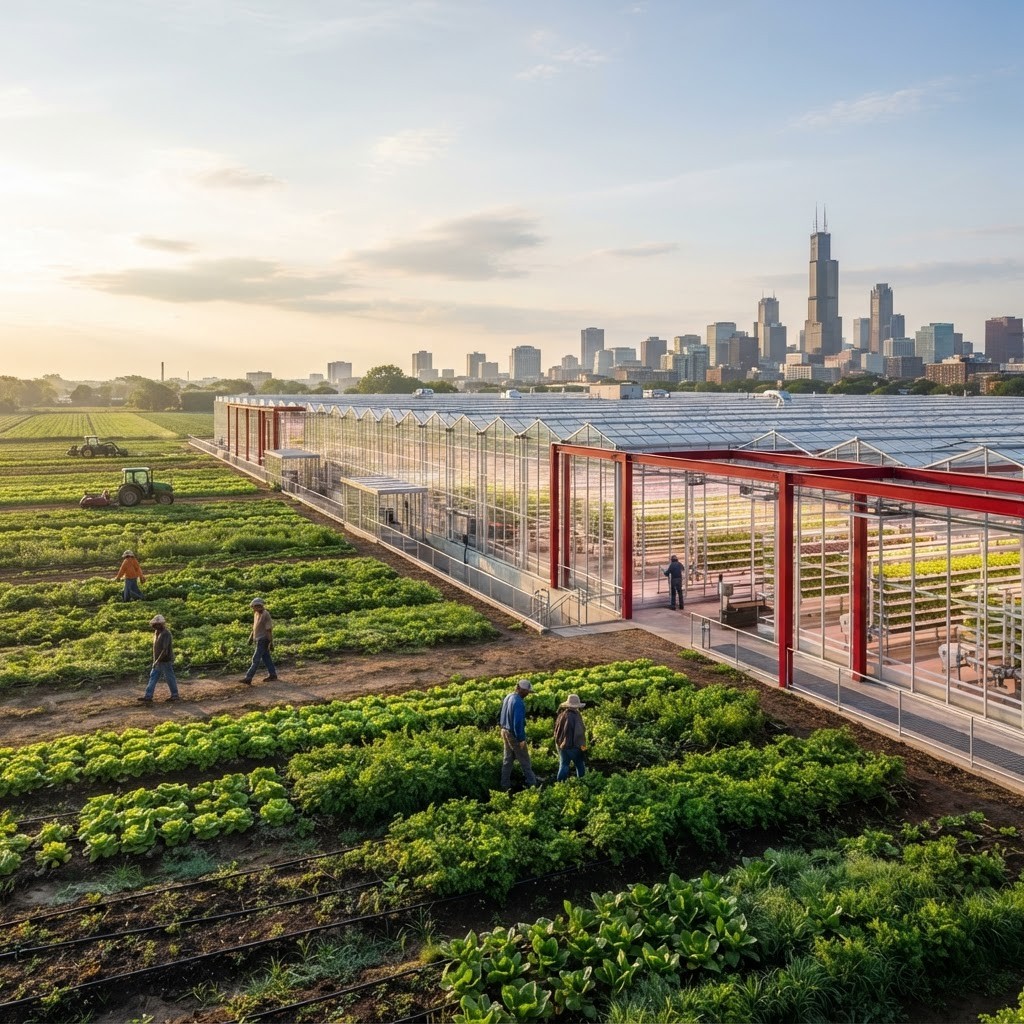
Understanding Farming in Chicago
Chicago is not a conventional farm town, yet it is one of North America’s most important agricultural business centers. The city connects Illinois farms with processors, commodity markets, railroads, restaurants, grocers, and international buyers. Within city limits, urban farms and controlled-environment growers use vacant land, rooftops, greenhouses, and indoor systems to produce food close to consumers.
This list includes operating farms, agriculture-focused companies, and enterprises that materially shape Chicago’s food-production ecosystem. Their models differ, so readers should evaluate them by mission, production method, market reach, community contribution, and environmental performance rather than using one definition of size.
1. Gotham Greens
Gotham Greens operates a major greenhouse in Chicago’s Pullman neighborhood. Its controlled-environment model produces leafy greens and herbs close to urban customers while using recirculating irrigation and protected growing conditions. Local production can shorten transit and provide consistent quality throughout much of the year.
2. The Urban Canopy
The Urban Canopy is a Chicago social enterprise engaged in urban farming, composting, and local food distribution. Its integrated approach demonstrates how food scraps can return to productive soil while neighborhood-scale agriculture improves access and community engagement.
3. Growing Home
Growing Home operates an urban farm and employment-training programs in Englewood. Beyond growing certified organic produce, it uses agriculture to develop workplace skills and create pathways to employment. The organization shows how farming can produce social as well as nutritional value.
4. Windy City Harvest
Windy City Harvest, an urban agriculture initiative of the Chicago Botanic Garden, combines production, education, apprenticeships, and community programming. Its farms and training programs help develop growers who understand sustainable practices and the realities of urban food businesses.
5. Farm on Ogden
Farm on Ogden brings together indoor and outdoor growing, training, aggregation, and community food resources on Chicago’s West Side. The facility supports year-round learning and illustrates how agriculture, health, and workforce development can share infrastructure.
6. Metropolitan Farms
Metropolitan Farms has developed aquaponic and urban growing operations in Chicago. Aquaponics combines fish culture and plant production in recirculating systems, potentially conserving water while producing fresh food near demand. Effective management requires careful control of water quality, energy, and biological balance.
7. Archer Daniels Midland
ADM maintains a major corporate presence in Chicago and operates across agricultural origination, processing, nutrition, and global supply chains. Although its farms are not urban plots, its decisions connect Midwestern crops with food, feed, fuel, and industrial markets worldwide.
8. Cargill
Cargill has extensive operations and commercial relationships throughout Illinois and the Chicago region. Its agricultural activities span grain, ingredients, animal nutrition, protein, and risk management. The company’s scale highlights Chicago’s role as a coordination center for global food systems.
9. John B. Sanfilippo & Son
Chicago-area John B. Sanfilippo & Son processes and markets nuts and related snack products. It connects agricultural crops with consumer packaging and retail channels, illustrating the importance of value-added processing to the regional farm economy.
10. Local Foods
Local Foods works with regional farmers and producers to bring Midwestern products into Chicago’s wholesale and retail market. Aggregation is critical for smaller farms because it helps them reach restaurants, institutions, and consumers without independently building complex city distribution.
Trends Shaping the Sector
Controlled-environment agriculture continues to attract interest, but success depends on energy efficiency, crop selection, labor, and reliable sales—not technology alone. Urban farms increasingly combine production with education, composting, workforce development, and health initiatives. Meanwhile, large agribusinesses are investing in traceability, lower-carbon practices, alternative proteins, and more efficient processing.
Buyers can support a resilient Chicago food system by asking where products were grown, how workers are supported, what growing practices are documented, and how waste is managed. No single model can feed the region. The strongest future combines productive Illinois farmland, responsible global supply chains, innovative city growing, efficient processors, and distribution systems that make fresh food accessible across Chicago neighborhoods.
