
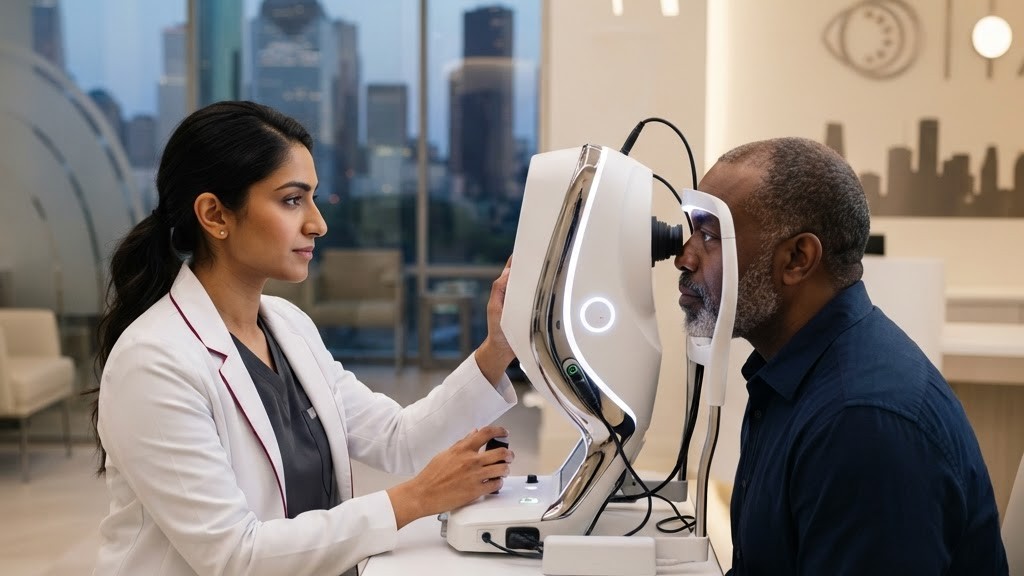
Matching Eye Care to Your Needs
Eye care ranges from routine vision correction to urgent treatment that protects sight. Optometrists commonly provide examinations, glasses and contact-lens prescriptions, and management of many eye conditions. Ophthalmologists are physicians who diagnose disease, prescribe treatment, and perform surgery. Houston's large medical community also includes subspecialists in retina, cornea, glaucoma, neuro-ophthalmology, pediatric ophthalmology, and ocular oncology.
The centers below stand out for specialty depth, geographic reach, or community service. Specific physicians, insurance participation, and appointment access change. Sudden vision loss, a curtain-like shadow, severe eye pain, chemical exposure, or new flashes and floaters may require urgent evaluation.
1. Baylor College of Medicine Alkek Eye Center
Alkek Eye Center offers comprehensive and subspecialty ophthalmology supported by Baylor College of Medicine. Programs address cataracts, corneal disease, glaucoma, retinal disorders, pediatric conditions, and other complex problems. Academic expertise and access to multiple subspecialists make it a strong option when a diagnosis crosses traditional boundaries.
2. Houston Methodist Eye Associates
Houston Methodist Eye Associates provides medical and surgical eye care within a major health system. Specialists manage cataracts, corneal disorders, glaucoma, retinal disease, and neuro-ophthalmic concerns. Coordination with neurologists, rheumatologists, diabetes teams, and other physicians can benefit patients whose eye findings relate to broader health conditions.
3. UTHealth Houston Ruiz Department of Ophthalmology and Visual Science
UTHealth Houston's ophthalmology program combines academic care, teaching, and research. It serves patients with routine and advanced conditions and benefits from links to the Texas Medical Center. Subspecialty evaluation and hospital relationships are valuable for trauma, complex surgery, and medically complicated patients.
4. University Eye Institute at the University of Houston
The University Eye Institute provides optometric care through faculty, residents, and supervised trainees. Services include comprehensive exams, contact lenses, low-vision rehabilitation, pediatrics, binocular vision, and management of ocular disease. The educational environment can offer thorough evaluation and access to specialized optometric services.
5. Mann Eye Institute
Mann Eye Institute is known for refractive and cataract surgery while also offering broader ophthalmic services. Houston-area patients may consider it for laser vision correction, lens-based procedures, dry-eye evaluation, and routine eye health. Surgical candidates should ask about expected outcomes, alternatives, enhancement policies, and the effect of age-related vision changes.
6. Berkeley Eye Center
Berkeley Eye Center has a substantial regional presence and provides routine vision care, cataract surgery, refractive procedures, glaucoma management, retinal services, and optical products at selected locations. Its network can make follow-up more convenient across greater Houston. Confirm which subspecialists and diagnostic equipment are available at each office.
7. Houston Eye Associates
Houston Eye Associates is a large ophthalmology group with comprehensive and specialty services. Its physicians cover cataracts, retina, glaucoma, cornea, oculoplastics, pediatrics, and other areas. Multiple locations can reduce travel for routine follow-up, while some procedures or subspecialists may be concentrated at particular sites.
8. Texas Children's Ophthalmology
Texas Children's provides pediatric ophthalmology for conditions such as strabismus, amblyopia, congenital disease, eye trauma, and vision problems related to complex childhood illness. Child-focused testing and coordination with pediatric neurology, genetics, and surgery are important strengths. Early evaluation is especially important because visual development occurs during childhood.
9. Kelsey-Seybold Eye Care
Kelsey-Seybold integrates optometry and ophthalmology with primary and specialty medicine. Shared records can help clinicians monitor diabetes, medication effects, and systemic diseases that influence eye health. Neighborhood clinics make routine examinations accessible, with referral pathways for surgery or advanced treatment.
10. San José Clinic Vision Services
San José Clinic helps eligible uninsured or underserved patients access vision evaluation and related care. Mission-driven services address an important gap because uncorrected vision and untreated disease affect work, education, driving, and independence. Eligibility and scheduling requirements apply, and community partnerships may support additional treatment.
How to Evaluate an Eye Center
For a routine exam, ask whether dilation, retinal imaging, contact-lens fitting, and optical services are included or separately billed. For disease or surgery, choose a clinician with relevant subspecialty training and ask how outcomes are monitored. Bring current glasses, contact-lens information, medication lists, and a family history of glaucoma, retinal disease, or early vision loss.
Houston's intense sun and high allergy burden can influence comfort, but redness or blurred vision should not automatically be dismissed as allergies. Protective eyewear is also important in industrial, construction, and yard settings. The best eye care center is the one equipped for the patient's actual condition, willing to explain findings clearly, and able to provide timely follow-up that protects vision over the long term.
