
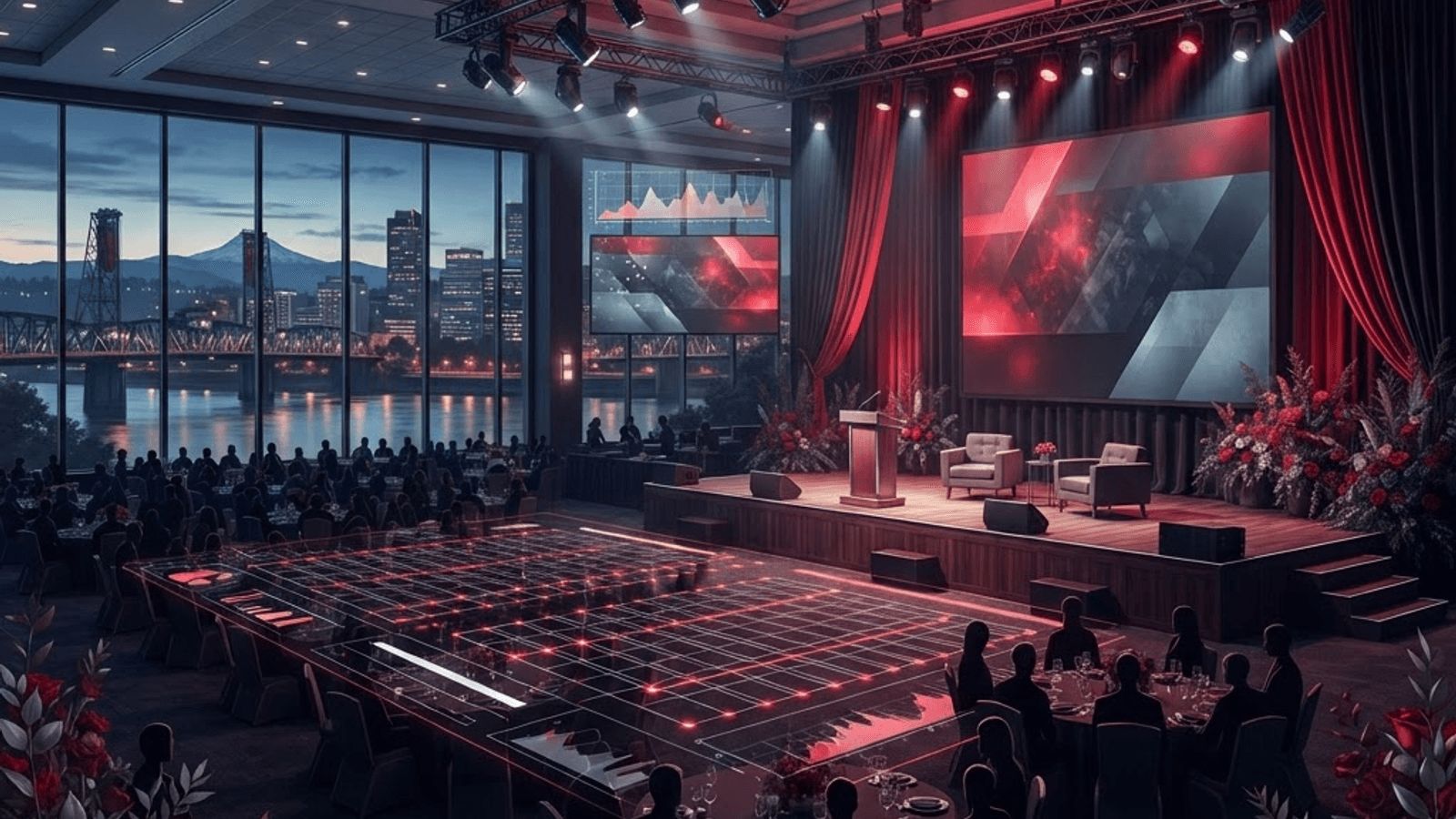
Portland as an Events Destination
Portland has quietly become one of the most desirable event cities on the West Coast. It offers a walkable downtown core, a large convention center, an internationally regarded food and beverage scene, striking natural backdrops within an hour's drive, and hotel rates well below those of larger coastal metros. Add wine country to the southwest, the Columbia River Gorge to the east, and the coast to the west, and planners gain remarkable venue variety inside a compact geography.
That appeal has produced a deep bench of professional event management firms serving corporate meetings, nonprofit galas, product launches, trade shows, conferences, festivals, and weddings. The market is competitive, which generally benefits clients, but it also means capability varies widely between firms.
What Event Management Companies Actually Do
Clients often underestimate the scope. Full-service event management typically includes concept development, budget construction and control, venue sourcing and contract negotiation, vendor selection and management, production design covering staging, lighting, audio and video, registration and attendee communications, permitting and insurance compliance, staffing, run-of-show documentation, day-of coordination, and post-event reporting.
The value of a strong firm shows up in the parts clients never see: a contract clause that protects against weather cancellation, a load-in schedule that prevents union overtime, a redundant power plan, or a vendor relationship that produces availability during peak season.
1. Full-Service Corporate Event Agencies
Portland's leading corporate event agencies handle multi-day conferences, sales kickoffs, and executive summits for regional technology, athletic apparel, and manufacturing companies. Their differentiators are project management rigor, budget transparency, and production capability that can scale from a fifty-person board retreat to a two-thousand-person general session with broadcast-quality video.
2. Conference and Association Meeting Planners
Association and conference specialists focus on registration systems, abstract and speaker management, exhibitor sales, continuing education compliance, and attendee housing blocks. These operational disciplines are very different from experiential design, and firms that excel here are usually chosen for their systems and reliability rather than their creative flourish.
3. Experiential and Brand Activation Studios
Brand activation studios build immersive environments for product launches, pop-up retail, sponsorship footprints, and street-level marketing moments. Their strength is fabrication and design, translating a brand concept into a physical space that photographs well and generates social sharing. Portland's design and apparel industries have made this a particularly strong local category.
4. Nonprofit Gala and Fundraising Producers
Fundraising events demand a specialized skill set: auction strategy, donor journey design, paddle raise choreography, sponsorship fulfillment, and tightly controlled cost ratios so that net proceeds justify the production. Firms in this niche measure success by dollars raised per guest, not simply by guest satisfaction.
5. Wedding Planning and Design Firms
Portland and the surrounding wine country support a mature wedding industry. Top planners bring vendor relationships built over years, realistic budget frameworks, design direction, and calm logistical control on the day itself. Their local knowledge of vineyard, farm, forest, and urban loft venues, including noise limits, access constraints, and weather contingencies, is difficult to replicate.
6. Festival and Large Public Event Operators
Public festivals introduce complexity that private events do not: street closures, city permitting, crowd management planning, accessibility compliance, sanitation, security coordination, and vendor licensing. Operators experienced in this space are valued primarily for their regulatory fluency and safety planning discipline.
7. Audiovisual and Technical Production Companies
Technical production partners supply staging, rigging, lighting design, LED walls, audio systems, and increasingly hybrid streaming infrastructure. Since content delivery quality determines whether an audience stays engaged, many planners consider the AV partner the single most consequential vendor decision after venue.
8. Catering and Food Experience Partners
In a city defined by its food culture, catering is rarely an afterthought. Portland's event caterers work with regional produce, seafood, and wine, and they increasingly design interactive food stations rather than static buffets. Strong partners handle dietary accommodation gracefully and coordinate service timing precisely with program flow.
9. Destination Management Companies
Destination management companies serve out-of-town organizers who need local expertise: transportation logistics, off-site venue curation, team activities in the Gorge or wine country, and guest experience programming. They effectively act as a client's local operations department, which reduces risk substantially for first-time visitors to the region.
10. Independent Certified Event Planners
Independent planners and small studios serve clients whose events do not require agency infrastructure. Their advantages are direct senior-level attention, flexible pricing structures, and lower overhead. For events under roughly two hundred guests, an experienced independent planner frequently delivers better value than a large firm.
Trends Shaping Portland Events
Hybrid and streamed components are now standard rather than optional, and audiences expect production quality comparable to broadcast media. Sustainability has moved from marketing language to procurement requirement, with clients asking about waste diversion, local sourcing, reusable signage, and travel emissions. Personalization is rising too, with registration data driving tailored agendas and networking recommendations. Meanwhile, cost pressure from labor and equipment has pushed planners toward tighter scoping and earlier vendor commitments.
How to Choose and Budget
Define your objective before your aesthetic. A pipeline-generation event, a culture-building retreat, and a fundraising gala require fundamentally different designs. Set a realistic total budget and expect venue, food and beverage, and technical production to consume the majority of it. Ask candidate firms for references from events of similar size and type, request a sample run-of-show, and clarify exactly how they are compensated, whether by flat fee, percentage, or commission from vendors, since incentives shape recommendations.
Final Thoughts
Portland's event management industry combines national-caliber production capability with genuine regional character. The right partner depends less on prestige than on fit: match your event type to a firm's demonstrated specialty, agree on measurable objectives, and involve the planner early enough to influence venue and date decisions. Do that, and the city's venues, vendors, and talent will do the rest.
