
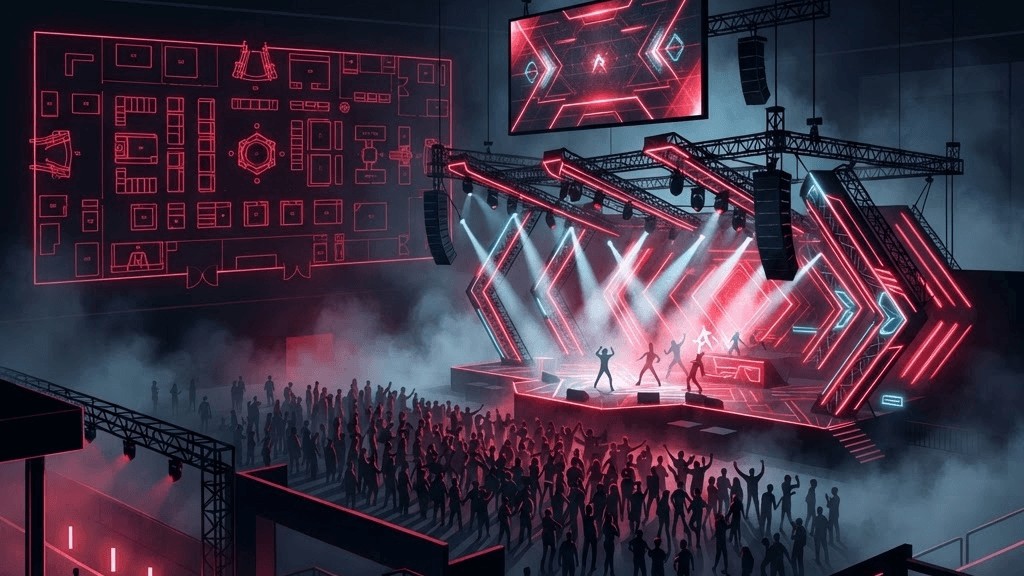
The Event Capital of the World
Las Vegas is built for gathering people. The city offers millions of square feet of exhibition space, tens of thousands of hotel rooms within walking distance of major venues, an airport minutes from the Strip, and a hospitality workforce that operates around the clock. Those advantages attract enormous trade shows, corporate meetings, product launches, concerts, sporting events, and a wedding industry that ranks among the busiest anywhere.
That density has produced an event management industry of unusual sophistication. Producers here routinely handle move in schedules measured in hours, union labor coordination, complex venue regulations, and audiences that expect spectacle. A planner who can execute reliably in Las Vegas can generally execute anywhere, which is why many national and international brands hire local production partners even when their headquarters are elsewhere.
What Distinguishes an Excellent Event Company
Clients evaluate event companies on more than creativity. Venue and vendor relationships come first, because access to preferred rates, priority scheduling, and trusted subcontractors determines both cost and reliability. Technical production capability is second, covering audio, lighting, video, staging, rigging, and increasingly hybrid streaming. Third is logistical discipline, including permitting, licensing, insurance, security planning, and labor coordination. Fourth is financial transparency, since opaque markups are the most common source of client dissatisfaction in this industry.
The Leading Event Management Companies in Las Vegas
1. Neon Summit Event Group is best known for large scale corporate general sessions and trade show presence, combining strategic program design with in house technical production. Clients cite meticulous run of show documentation and calm execution under compressed timelines.
2. Desert Stage Productions focuses on technical production, providing staging, rigging, lighting design, and large format video for concerts, awards shows, and brand activations. Its equipment inventory and engineering depth make it a frequent partner to other planning firms.
3. Silver State Convention Services specializes in exhibition management, handling booth logistics, exhibitor services, floor planning, registration, and drayage coordination. Its expertise in the operational machinery of trade shows is highly specialized and difficult to replicate.
4. Red Rock Weddings and Celebrations serves the social market with full service wedding planning, from intimate desert ceremonies to large destination programs. Vendor curation, guest travel coordination, and detailed contingency planning define its reputation.
5. Mojave Brand Experience Agency concentrates on experiential marketing, designing immersive activations, pop ups, and sponsorship environments. It bridges marketing strategy and physical build, which appeals to brands seeking measurable engagement rather than decoration.
6. Canyon Corporate Meetings Collective handles incentive travel, executive retreats, board meetings, and multi day conferences with an emphasis on attendee experience and clear budget control. Its strength lies in program management rather than spectacle.
7. Frontier Sports and Entertainment Events manages tournaments, race weekends, fan festivals, and stadium adjacent programming. Crowd flow planning, credentialing, and coordination with public agencies are core competencies.
8. Sunbelt Hybrid Event Studios focuses on broadcast quality virtual and hybrid production, including multi camera streaming, remote presenter integration, and interactive digital audience tools. Demand for this capability has remained strong well beyond its original catalyst.
9. Vegas Valley Catering and Event Design pairs culinary programming with décor, floral, and environment design, offering a unified aesthetic and menu approach for galas, fundraisers, and premium hospitality suites.
10. Basin Logistics and Event Operations rounds out the list with behind the scenes strength in freight, warehousing, labor scheduling, permitting, and site operations. Producers rely on it for the unglamorous work that determines whether an event opens on time.
Industry Trends Shaping Events
Hybrid and digital extension is now permanent. Even events with strong in person attendance stream keynotes, publish on demand content, and use apps for networking and analytics. The best producers design for both audiences simultaneously rather than treating the stream as an afterthought.
Data and measurement have become central. Clients expect attendance analytics, engagement metrics, lead quality reporting, and post event attribution. Registration platforms, badge scanning, and session tracking give planners evidence to justify budgets, which has raised expectations across the market.
Sustainability is a growing requirement, particularly for corporate clients with public environmental commitments. Reusable structures, reduced single use materials, local sourcing, food donation programs, and carbon reporting are increasingly written into contracts. In a desert city, water conscious design and energy efficient production are also practical concerns rather than symbolic ones.
Finally, safety and risk planning have matured. Comprehensive security assessments, medical staffing, emergency communication protocols, and flexible cancellation terms are standard elements of professional proposals.
How to Choose the Right Partner
Begin by defining objectives and budget honestly, because a company optimized for a 12,000 person general session is rarely the right fit for a 60 person executive retreat. Request case studies from comparable events, then ask to speak with those clients about problem handling rather than highlights. Review the proposed team, since the people assigned to your program matter more than the firm's overall portfolio.
Insist on line item budgeting that distinguishes pass through costs from management fees, and clarify how change orders are priced. Verify insurance coverage, licensing, and vendor contracts. Walk the venue with the producer if possible, and discuss contingency scenarios for weather, technical failure, speaker cancellation, and attendance shortfall. A partner who plans for problems openly is far more valuable than one who promises perfection.
Final Thoughts
Las Vegas event management is a high pressure discipline where creativity means little without operational precision. The companies listed above have earned their reputations by mastering venue relationships, technical production, logistics, and increasingly the data and sustainability expectations of modern clients. For any organization planning a program in the valley, matching a partner's genuine strengths to your event type is the decision that most determines success.
